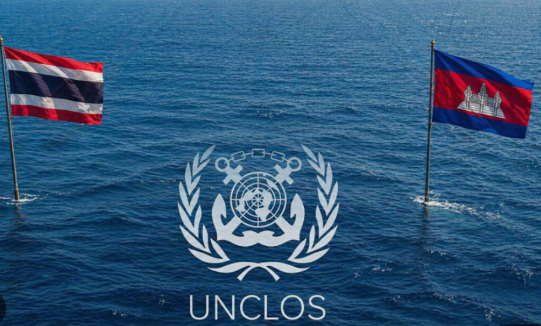
Thailand has formally accepted Cambodia's request to pursue compulsory conciliation under the 1982 United Nations Convention on the Law of the Sea, marking a significant step in resolving their long-standing maritime boundary dispute in the Gulf of Thailand. However, Bangkok has carefully framed its participation by emphasising that the process will not constitute litigation and that any recommendations emerging from the conciliation will carry no legal weight, underscoring the kingdom's preference for bilateral negotiations to reach a final settlement.
The Thai Ministry of Foreign Affairs submitted its formal response to Cambodia on June 19, approximately three weeks after Cambodia transmitted its conciliation notification on June 2. In its submission, Thailand has sought to narrow the scope of the proceedings, insisting that the conciliation should be confined exclusively to maritime delimitation issues under Unclos, rather than extending to broader matters such as provisional joint development arrangements or resource-sharing frameworks that Cambodia may wish to include.
Deputy Prime Minister and Foreign Minister Sihasak Phuangketkeow has been designated as Thailand's principal Agent in the conciliation proceedings, while Songchai Chaipatiyut, currently serving as Thailand's ambassador to Kuwait and formerly a senior official with the Department of Treaties and Legal Affairs, takes the role of Deputy Agent. These appointments signal Thailand's commitment to the process while placing authority in experienced hands well versed in maritime law and diplomatic negotiations.
The Thai government has identified two internationally recognised conciliators to represent its interests: Judge Albert J Hoffmann of South Africa and Judge Rudiger Wolfrum of Germany, both acknowledged specialists in maritime and international law. These selections reflect Bangkok's intention to secure representation from respected jurists capable of engaging meaningfully with complex questions of ocean boundary delimitation and the application of Unclos principles.
Under the conciliation framework, the four conciliators appointed by both Thailand and Cambodia will jointly select a fifth neutral chairman within 30 days of Thailand's formal response, establishing a five-member conciliation commission tasked with mediating between the parties. The commission is anticipated to complete its deliberations and prepare a final report containing recommendations within approximately 12 months, though either side may request extension if more time proves necessary to address the technical and political complexities involved.
Bangkok's diplomatic framing emphasises a crucial distinction: conciliation differs fundamentally from judicial proceedings in that the selected experts function as neutral facilitators rather than adjudicators. Their role encompasses listening to arguments presented by both nations, comprehending the historical and geographical context of the disagreement, and endeavouring to identify a pathway toward settlement that both parties might accept. This presentation appears designed to manage domestic and regional expectations about what the conciliation might achieve.
The Foreign Ministry has made explicit that the conciliation process will produce a non-binding report containing recommendations rather than enforceable judgments. This outcome may subsequently serve as a foundation for resumed bilateral negotiations, but it imposes no legal obligation on either Thailand or Cambodia to accept the conciliators' views. Thailand continues to maintain that outstanding disagreements must ultimately be resolved through direct government-to-government dialogue, with any final agreement requiring formal approval through both nations' respective governance structures.
This Thai position aligns precisely with Article 6 of Unclos Annex V, which explicitly stipulates that a conciliation commission's report and recommendations do not bind the parties to the dispute. By repeatedly invoking this provision, Thailand is signalling to Cambodia, domestic constituencies, and the broader international community that accepting conciliation does not represent capitulation to external authority, but rather an engagement with a structured dialogue mechanism that preserves national sovereignty.
The underlying dispute concerns overlapping maritime claims in the Gulf of Thailand, a strategically important zone encompassing economically significant deposits of natural gas and other hydrocarbon resources. For decades, the boundary question has been intertwined with questions of how to jointly develop and equitably share the benefits from these offshore energy reserves, complicating what might otherwise be a purely technical delimitation exercise. Thailand's insistence on limiting conciliation to boundary definition alone reflects its desire to separate these issues and prevent resource-sharing questions from constraining the conciliation process.
A crucial precursor to the conciliation acceptance was Thailand's Cabinet decision in May to terminate the 2001 memorandum of understanding with Cambodia, colloquially known as MoU 44 within Thai policy circles. That agreement had provided the operational framework for managing overlapping continental shelf claims for more than two decades, yet Prime Minister Anutin Charnvirakul indicated the termination stemmed not from antagonism toward Cambodia but from the accord's demonstrable failure to generate substantive progress over 25 years of operation. Thai officials framed the MoU's cancellation as a strategic recalibration rather than a hostile act, intended to reset the cooperation framework on more effective foundations.
Thailand's strategy involves using Unclos itself as the common reference point for future maritime discussions, since both countries are now convention parties. By terminating the bilateral MoU while simultaneously accepting the conciliation process, Thailand has positioned itself as simultaneously modernising the diplomatic apparatus governing the relationship and demonstrating commitment to international legal mechanisms. This dual approach allows Bangkok to maintain rhetorical commitment to resolution while preserving maximum flexibility in bilateral negotiations.
Cambodia, by initiating compulsory conciliation, has sought to move the dispute into a more formalised international framework, characterising this step as advancing peaceful resolution through established international law rather than perpetuating bilateral deadlock. The conciliation mechanism thus represents a tactical divergence between the two countries' preferred approaches: Cambodia appears to favour external structure and expert guidance, while Thailand emphasises that any resolution must ultimately flow from bilateral agreement rather than external recommendation.
For Southeast Asian observers and the broader Indo-Pacific region, this maritime dispute exemplifies the persistent challenges facing countries sharing overlapping maritime claims yet lacking clear mechanisms to resolve them. The Thai-Cambodian conciliation process may establish precedents, both positive and cautionary, for how other regional maritime disputes might be managed under international legal frameworks. The next 12 months will reveal whether structured conciliation can genuinely facilitate movement toward settlement or merely formalise a continuation of disagreement in a different diplomatic venue.