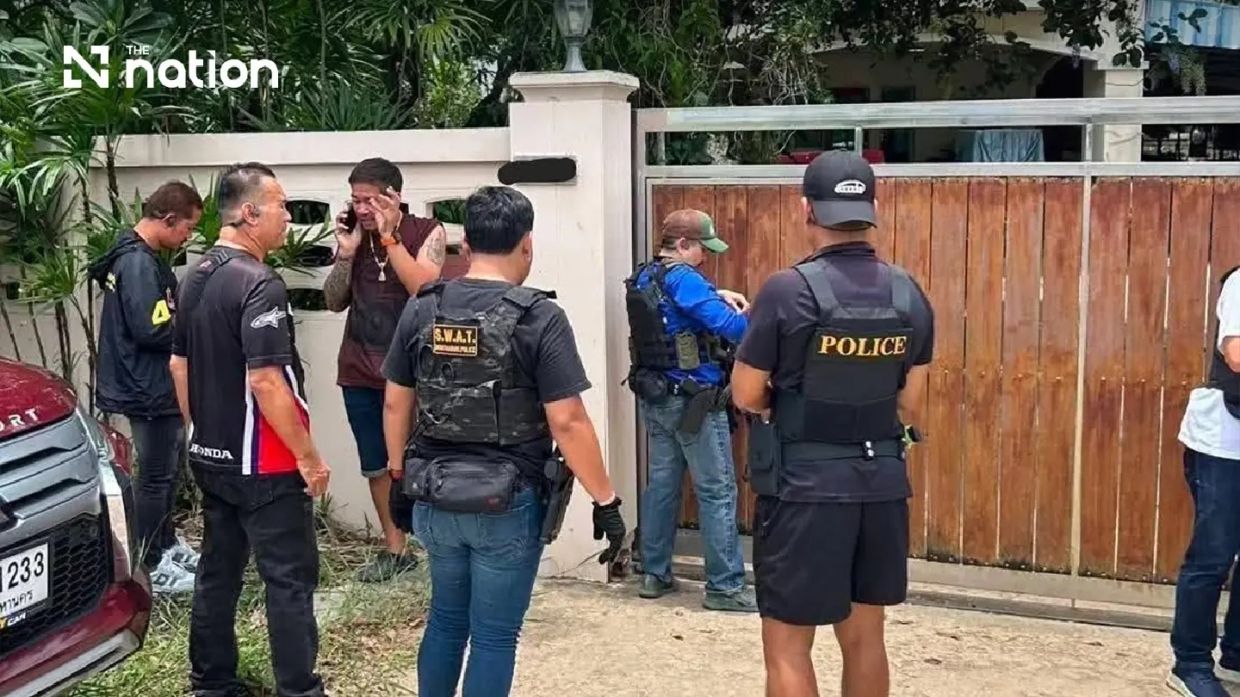
A secondary school student in Thailand's Nonthaburi province killed his paternal grandparents at their home before proceeding to carry out a shooting attack at Debsirin Nonthaburi School that resulted in seven deaths and fifteen injuries, according to police investigations. The incident unfolded on Friday morning, August 7, when the Mathayom 2 pupil, whose identity remains undisclosed due to his age, first committed the homicide at a residential property in Soi Wat Lat Pla Duk, Bang Khu Rat subdistrict, Bang Bua Thong district, before taking the same weapon to the school.
When officers inspected the family residence following the school shooting, they discovered that both elderly relatives had died earlier that same morning, with evidence suggesting they were killed using the identical firearm that was subsequently employed in the school attack. The weapon in question has been identified as a CZ 9mm handgun that had been formally registered under the grandfather's name, raising critical questions about firearm safety protocols and storage within the household.
Royal Thai Police spokesman Pol Lt Gen Trairong Phiwphan confirmed that authorities had successfully contained the violence at the school and neutralised the immediate threat. The scale of the tragedy proved significant, with seven fatalities overall—including the suspected attacker himself—and fifteen wounded individuals receiving medical attention. Emergency responders worked to evacuate all casualties from the school premises, whilst senior police leadership moved swiftly to coordinate a comprehensive response.
National police chief Pol Gen Kitrat Phanphet issued direct orders for the site to be thoroughly cleared, examined for evidence, and meticulously documented through detailed scene planning. Beyond the investigative focus, Phanphet recognised the psychological toll such traumatic events inflict on survivors and the broader school community. He instructed the chief medical officer of Police General Hospital to dispatch mental health professionals and psychologists to the affected area to provide immediate and ongoing support to teachers, students, and other traumatised individuals.
At the core of the police inquiry lies a troubling investigative gap: how the young suspect obtained unauthorised access to his grandfather's firearm and ammunition. Although authorities have confirmed the weapon's legal registration to a family member, establishing the precise sequence of events through which the student removed the gun from secure storage, if it was stored securely at all, remains a critical investigative priority. Police have not yet disclosed whether the handgun was kept locked or whether ammunition was stored separately as a basic safety precaution.
The investigation into motive has proven complex and preliminary at this stage. Pol Lt Gen Trairong acknowledged that determining why the student committed such violent acts requires deeper examination of his behavioural patterns, his social environment, his family circumstances, and any prior warning signs that may have been overlooked. Officers have established that the suspect had been residing with his elderly relatives, but the factors that prompted such extreme violence remain under scrutiny.
For Southeast Asian observers, this incident highlights recurring vulnerabilities in how households in the region manage licensed firearms. Thailand permits civilian gun ownership under regulated conditions, yet the case raises uncomfortable questions about whether existing protocols ensure weapons remain inaccessible to unauthorised, particularly vulnerable individuals. The registration system may track ownership legally, but enforcement of secure storage standards appears inconsistent.
The psychological intervention ordered by national police leadership signals recognition that mass shooting incidents create cascading trauma extending far beyond victims and fatalities. Students who witnessed violence on school grounds, teachers who attempted to protect pupils, and families who lost loved ones all require structured mental health support to process the tragedy and prevent long-term psychological deterioration. This represents an important shift in how Thai authorities respond to such crises, moving beyond mere law enforcement to encompass holistic community care.
The incident also underscores broader questions about adolescent mental health, early warning systems for at-risk youth, and family dynamics in households where firearms are present. The suspect's decision to first harm his grandparents, with whom he lived, before transitioning to the school suggests deeply fractured family relationships, though specific grievances remain undisclosed pending investigation.
As the police investigation progresses, attention will likely focus on whether the school, family, or community had documented concerns about the student's mental state, behavioural problems, or expressions of violent ideation prior to the attack. The sequence of events—killing his immediate caregivers first, then striking at the school community—suggests this was not a random act but rather deliberate violence rooted in specific grievances that authorities must now piece together from evidence, witness accounts, and the student's limited prior records.
Thailand has experienced multiple mass shooting incidents over recent decades, creating a troubling precedent that complicates public safety discussions. Each incident prompts calls for stricter firearm regulations, yet reform remains incremental. This case may catalyse renewed debate about mandatory gun safety training, secure storage requirements, and psychological screening for both initial firearm licensing and ongoing renewal cycles. For Malaysian readers, the parallel concerns about gun ownership in neighbouring jurisdictions warrant attention, particularly as cross-border security considerations depend on understanding regional trends in firearm-related violence.
The immediate crisis response demonstrated coordinated police work, with scenes secured and evidence preserved for forensic analysis. However, the longer-term challenge involves understanding how a young person reached such a state of desperation or rage that homicide and mass violence appeared to be a rational course of action, and whether earlier intervention at home, at school, or within the broader community might have prevented this tragedy.

