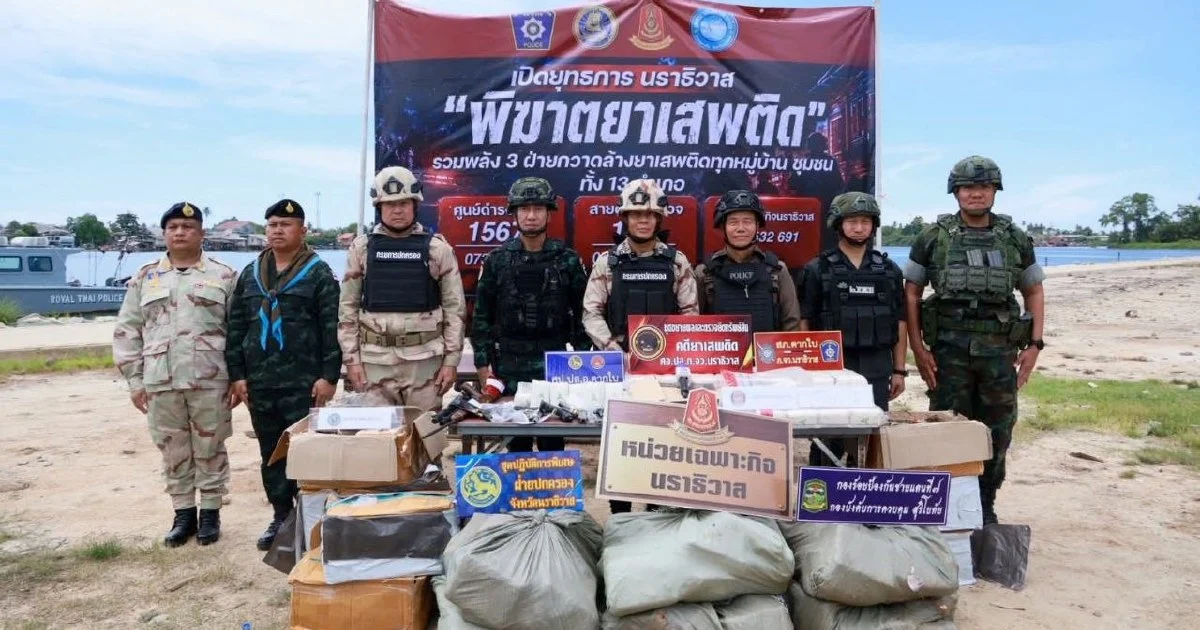
Law enforcement agencies in Thailand have made significant strides in combating transnational drug trafficking following a coordinated crackdown that resulted in the arrest of 233 suspected drug syndicate members across Narathiwat province. The operation, which spanned a full month, yielded what authorities describe as a meaningful blow against organised criminal networks that operate across the porous southern Thailand-Malaysia border region. Among those detained, investigators identified individuals with suspected ties to Malaysian trafficking organisations, underscoring the deeply interconnected nature of narcotics smuggling throughout Southeast Asia.
The operation in Narathiwat, which borders Malaysia's Kelantan state, revealed a sophisticated cross-border drug movement apparatus. Authorities disrupted an attempted smuggling operation that would have transported narcotics valued at RM1.2 million through Malaysian territory, suggesting that traffickers were using the country as a transit hub for distributing drugs throughout the region. This discovery highlights how Malaysia's geographic position and established transport networks make it an attractive route for criminal organisations seeking to move contraband between production centres and end markets.
The arrest of suspects with Malaysian connections illustrates the reality facing law enforcement agencies across the region: drug trafficking syndicates operate without regard for national boundaries. They typically exploit weaknesses in border security, corrupt officials, and existing smuggling corridors to move merchandise. The cooperation between Thai and Malaysian authorities, though not explicitly detailed in this operation, represents an increasingly necessary approach to combating transnational organised crime that respects no territorial limits.
Narathiwat province has long been recognised as a critical flashpoint in Thailand's drug war. Its position at the junction of major trafficking routes makes it both a source and thoroughfare for narcotics destined for regional markets. The province's remote terrain, mixed governance challenges, and established informal trading relationships with Malaysia have traditionally made enforcement particularly challenging. The scale of this month-long operation demonstrates Thailand's commitment to intensifying pressure on these networks despite the operational difficulties.
The involvement of Malaysian-linked suspects suggests that traffickers have established distribution networks extending into Peninsular Malaysia. Organised syndicates typically maintain compartmentalised operations across multiple jurisdictions, allowing them to disperse risk and maximise profits. By identifying these cross-border connections, Thai authorities have provided Malaysian law enforcement with valuable intelligence that could facilitate parallel investigations and disruption operations on the Malaysian side of the frontier.
The RM1.2 million drug cache represents only a fragment of the broader smuggling economy operating in this region. Authorities estimate that substantially larger quantities of contraband transit across Thai-Malaysian borders annually, much of it reaching end-users in Malaysia, Singapore, and beyond. This particular interception demonstrates that enforcement agencies can identify and intercept significant shipments, though the overall volume suggests that such successes represent only a portion of actual traffic.
Malaysian readers should note the implications of these operations for domestic drug control efforts. The identification of Malaysian involvement in Thai-based trafficking networks indicates that criminal syndicates operating locally maintain direct connections to international supply chains. This means that Malaysian drug abuse problems are intrinsically linked to broader regional production and trafficking dynamics. Disrupting these cross-border networks requires sustained intelligence sharing and coordinated enforcement between Thailand, Malaysia, and other affected nations.
The arrest figures—233 suspects in a single month—suggest either an exceptionally productive enforcement period or a sign of the scale at which trafficking organisations operate in this region. Either interpretation underscores the resource and logistical challenge facing police forces attempting to combat drug crimes. The sustainability of such intensive operations remains questionable without accompanying improvements in border security technology, inter-agency coordination, and intelligence gathering capabilities.
These developments occur within Thailand's broader struggle against methamphetamine and other synthetic drug production and distribution. The country remains simultaneously a significant production location and a transit point for narcotics sourced from neighbouring production zones. Malaysian authorities have similarly identified synthetic drugs—particularly methamphetamine tablets and crystal methamphetamine—as the primary challenge facing domestic law enforcement, with much of the supply originating from or transiting through Thailand.
For Malaysian policy makers, the operation underscores the necessity of enhanced border management and intelligence cooperation with neighbouring countries. The identification of Malaysian-linked suspects in Thai operations suggests that information gaps remain in monitoring cross-border criminal movement. Investment in surveillance capabilities, controlled inter-agency databases, and real-time intelligence sharing platforms could enhance Malaysian authorities' ability to intercept traffickers before drugs reach domestic distribution networks.
The broader context reveals that despite ongoing enforcement efforts, drug trafficking remains highly profitable and resistant to suppression through arrests alone. Criminal organisations continue recruiting replacements for arrested members, adapting routes when corridors are interdicted, and leveraging corruption to maintain operations. This reality suggests that law enforcement successes, while valuable, must be complemented by demand reduction strategies, treatment services, and economic development in border regions to address root factors driving participation in drug trafficking.
Looking forward, the Thai operation highlights both the possibilities and limitations of intensive enforcement campaigns. The identification of 233 suspects demonstrates police capacity for identifying and apprehending traffickers. Yet without corresponding action against higher-level organisers, major financiers, and corrupt officials protecting these networks, individual arrests achieve limited impact on overall trafficking volumes. Sustainable progress requires sustained bilateral cooperation between Malaysian and Thai authorities, supported by intelligence agencies and judicial systems working in concert to prosecute major traffickers and dismantle the criminal enterprises they control.

