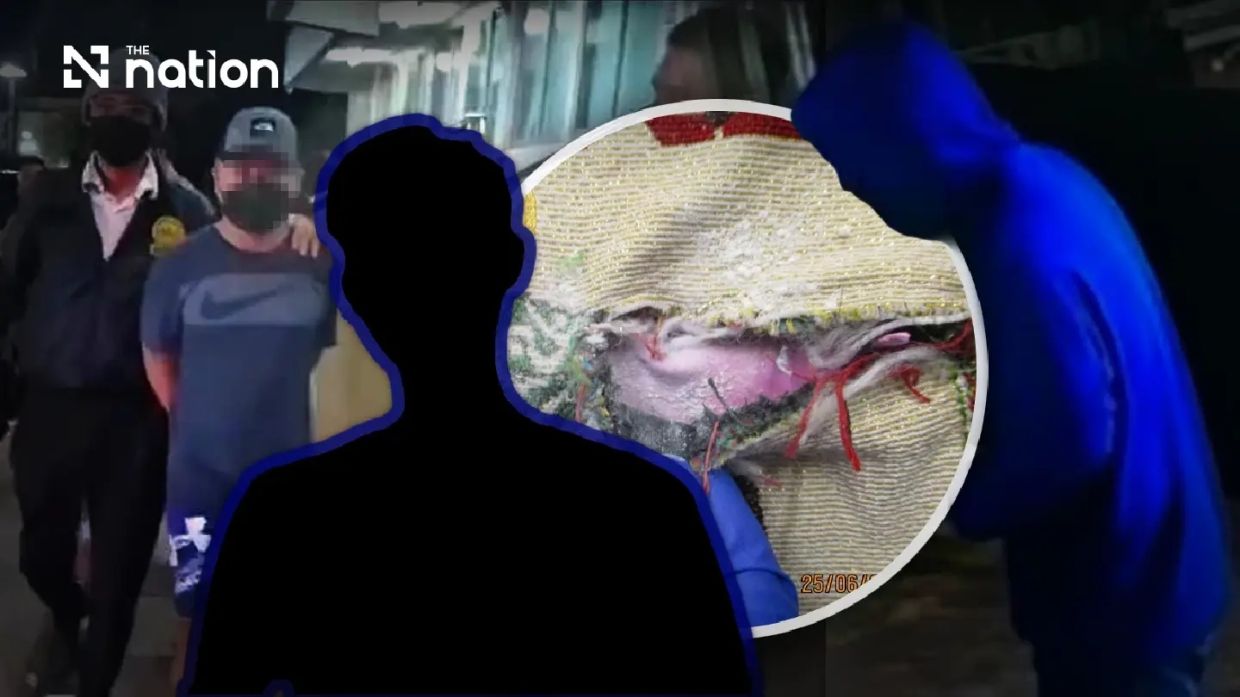
Thai police have widened their inquiry into a narcotics trafficking operation centred on heroin hidden inside an elephant-print fabric bag destined for Australia, with the arrest of a key suspect operating as a middleman in the supply chain. Pol Maj Gen Theeradej Thamsuthee, deputy commissioner of the Metropolitan Police Bureau, disclosed that officers detained Ekkawit in Phayao province overnight as part of the expanding investigation into the international drug smuggling scheme.
According to police allegations, Ekkawit occupied a crucial position within the criminal network, acquiring the fabric bag in Chiang Mai before collecting narcotics concealed within it and transferring the package to Uthai, a man previously apprehended while wearing a blue hood. Uthai subsequently handed the contraband to a Thai flight attendant identified as Mina, whom authorities say was recruited to transport the illegal cargo to Australia. The sequence of handovers reveals a deliberately compartmentalised operation designed to insulate major organisers from direct contact with couriers or contraband.
Investigators established that Ekkawit communicated with Uthai using the online handle "Rin Rin," arranging collection of the elephant-print bag from Chiang Kham district in Phayao province. Police believe Ekkawit personally delivered the package himself rather than relying on intermediaries, suggesting his deep involvement in operational logistics. During preliminary interrogation, the suspect confessed to executing the task in exchange for THB100,000, acknowledging that he had purchased the bag and admitting to conducting similar assignments on approximately two or three previous occasions. The relatively modest compensation relative to the drug quantities involved suggests Ekkawit held a subordinate rather than leadership position within the hierarchy.
The investigation has unveiled a sophisticated communication structure utilising pseudonymous chat accounts to coordinate activities across provincial boundaries. Police determined that Ekkawit maintained contact with another operative using the alias "Rose Rose," a person who allegedly directed the initial instruction to purchase the elephant-print bag. The chat-based coordination system enabled handlers to maintain operational distance from street-level participants while maintaining command-and-control authority. Ekkawit revealed that Rose Rose would instruct him to leave the purchased bag at specified kilometre markers along Thai highways, where associates would collect it and introduce the heroin before returning it to a drop point.
The operational methodology unveiled by investigators demonstrates calculated compartmentalisation intended to frustrate law enforcement detection. Once the narcotics were concealed within the bag—which Ekkawit claimed occurred in Laos, though police expressed scepticism regarding this claim—Rose Rose would arrange for the package to be recovered by Ekkawit at another pre-arranged location. At the collection point, cash payment of THB100,000 would be left alongside the bag, subsequently supplemented by Ekkawit transferring THB60,000 to Uthai through an automated bank deposit machine. This combination of physical and digital financial transfers reduces the frequency of face-to-face meetings and creates documentary trails difficult to trace in real time.
Detectives have assembled substantial biographical evidence linking Ekkawit directly to the Rose Rose operative, despite the latter's use of anonymous online accounts. Both individuals originate from Phayao province, and photographic evidence retrieved during the investigation shows them travelling together, suggesting a personal relationship predating their criminal collaboration. Such family or intimate connections frequently characterise smuggling networks in Southeast Asia, where trust among participants represents a critical vulnerability that law enforcement agencies have learned to exploit through patient relationship mapping and witness examination.
Police brought Ekkawit to Phayao to identify locations relevant to the investigation before transferring him to the Narcotics Suppression Bureau for formal custody procedures. His arrival at NSB facilities was anticipated for the evening of Friday, July 10, 2026, when Pol Gen Samran Nuanma, deputy national police chief, intended to conduct personal interrogation. The involvement of senior national command personnel in questioning a mid-level operative suggests authorities view this case as indicative of broader trafficking infrastructure rather than an isolated smuggling attempt.
Criminal analysts note that Rose Rose, while occupying a coordinator position, may not represent the apex of the trafficking hierarchy. Police intelligence suggests an undisclosed senior organiser maintains command over Rose Rose and other operatives, orchestrating supply acquisition, package preparation, courier recruitment, and destination coordination from a position insulated from direct law enforcement vulnerability. This tiered structure—common among sophisticated trafficking networks serving Australia's lucrative illicit drug market—compartmentalises risk and complicates prosecution of principal architects.
Uthai, the flight attendant handler arrested earlier in the investigation, claimed during questioning that he had executed similar courier assignments between five and six times. Investigators remained unconvinced by his account, suspecting he had rehearsed explanations before arrest and possessed substantially more involvement than his initial disclosures indicated. Police discovered that Uthai had maintained a rented room in Phra Nakhon Si Ayutthaya province for at least five or six months, suggesting sustained involvement in trafficking operations and implying substantially higher activity frequency than his admitted participation level.
The investigation's expansion reflects Thai authorities' determination to dismantle the entire operational network rather than prosecute isolated participants. Law enforcement agencies throughout Southeast Asia have increasingly recognised that arresting individual couriers or low-level intermediaries proves insufficient without simultaneously pursuing supply chain managers and financial handlers responsible for recruitment, logistics, and resource deployment. The forthcoming interrogation by senior police leadership suggests this case may expose connections between multiple provincial smuggling cells and illuminate the recruitment and compensation mechanisms utilising by trafficking organisations targeting Australian markets.

