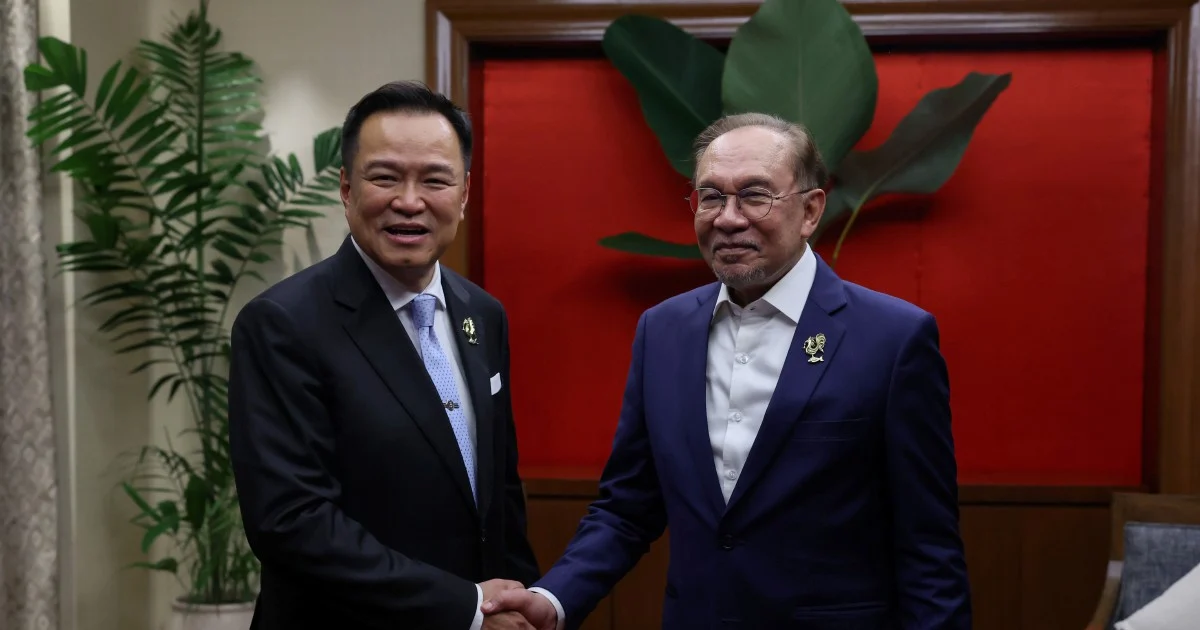
Thai Prime Minister Anutin Charnvirakul is preparing to travel to Malaysia on July 9 and 10 for high-level talks with Prime Minister Datuk Seri Anwar Ibrahim, signalling renewed diplomatic engagement between Bangkok and Kuala Lumpur at a time when both countries face overlapping regional security and economic pressures.
The visit arrives amid heightened attention to transnational crime and security vulnerabilities along the Malaysia-Thailand border, a 644-kilometre frontier that has long served as a transit route for smuggling operations. The shared boundary has become increasingly significant as both countries grapple with the movement of contraband goods, including drugs and illicit wildlife trade, which destabilises communities on both sides. Malaysian authorities have consistently raised concerns about criminal networks exploiting porous border areas, while Thailand has similarly struggled to contain these flows through its southern provinces.
Beyond security imperatives, the bilateral agenda reflects the two nations' mutual interest in deepening trade relationships. Malaysia and Thailand rank among Southeast Asia's largest economies, and closer commercial ties could unlock opportunities in manufacturing, agriculture, and digital services. Both countries are positioned to benefit from supply chain diversification initiatives that reduce dependence on distant markets, making intra-ASEAN economic cooperation increasingly attractive to policymakers in both capitals.
Anwar Ibrahim's administration has prioritised strengthening Malaysia's regional partnerships as part of a broader strategy to position the country as a central player in Southeast Asian affairs. A substantive engagement with Thailand's government reflects this diplomatic orientation, particularly given Thailand's historical influence in shaping regional security architectures. The visit also comes at a moment when Malaysia seeks to consolidate relationships across ASEAN ahead of anticipated shifts in regional geopolitics.
The choice of July for this bilateral meeting carries significance. This period falls outside the peak tourism season and suggests the governments intend to focus substantively on policy matters rather than ceremonial elements. Both leaders will likely review existing bilateral agreements and identify areas where cooperation can be accelerated, whether through enhanced intelligence-sharing on transnational criminal activity or coordinated trade negotiations within the ASEAN Economic Community framework.
Border security discussions will probably concentrate on practical mechanisms for information exchange and joint patrols in sensitive areas. Thailand's southern region has historically experienced violence related to separatist movements and criminal enterprises, challenges that occasionally spill across into northern Malaysia. Coordinated responses by security agencies in both countries have proven effective in previous operations, and the visit may establish protocols for deepened collaboration.
Economic cooperation between the nations extends across multiple sectors. Thai investors maintain substantial interests in Malaysian manufacturing and real estate, while Malaysian companies operate throughout Thailand's industrial zones. Bilateral trade volumes have fluctuated in recent years, reflecting global economic cycles, but both governments see potential for expansion through targeted sectoral initiatives. Agricultural trade, particularly in rubber and palm products, remains significant for both economies.
From Malaysia's perspective, strengthening ties with Thailand supports the nation's strategy of maintaining balanced regional relationships. Thailand's geopolitical importance cannot be overstated—as a major non-Communist ally for several decades and a longstanding player in regional institutions—making the relationship strategically valuable beyond immediate trade considerations. The visit demonstrates Malaysia's commitment to bilateral relationships with key neighbours, complementing its broader ASEAN engagement strategy.
The timing also reflects ongoing efforts by both countries to address post-pandemic economic recovery. Tourism, a critical revenue source for Thailand and significant for Malaysia's economy, has rebounded substantially, but both nations recognise that sustainable growth requires diversification and infrastructure investment. Discussions may touch upon joint development projects, particularly in border regions where coordinated investment could generate employment and reduce cross-border tensions.
Thailand's government, under Anutin's current leadership, has emphasised pragmatic engagement with all regional partners regardless of political orientation. This approach aligns with Malaysia's own diplomatic philosophy under Anwar Ibrahim's administration, creating favourable conditions for productive dialogue. Both governments have expressed commitment to resolving differences through dialogue rather than confrontation, a principle that underpins healthy bilateral relations.
The visit carries implications for broader Southeast Asian stability. As the region navigates complex challenges ranging from competing claims in maritime areas to managing great power influence, strong bilateral relationships among ASEAN nations provide a foundation for coordinated responses. Malaysia and Thailand, as neighbours and established ASEAN members, have particular responsibility for maintaining regional equilibrium and setting examples of constructive engagement.
Observers will be watching for any formal agreements or statements emerging from the bilateral meetings, particularly regarding security cooperation frameworks or trade facilitation measures. Such outcomes would signal the depth of commitment both governments are prepared to make toward deepening relations and addressing shared challenges.

