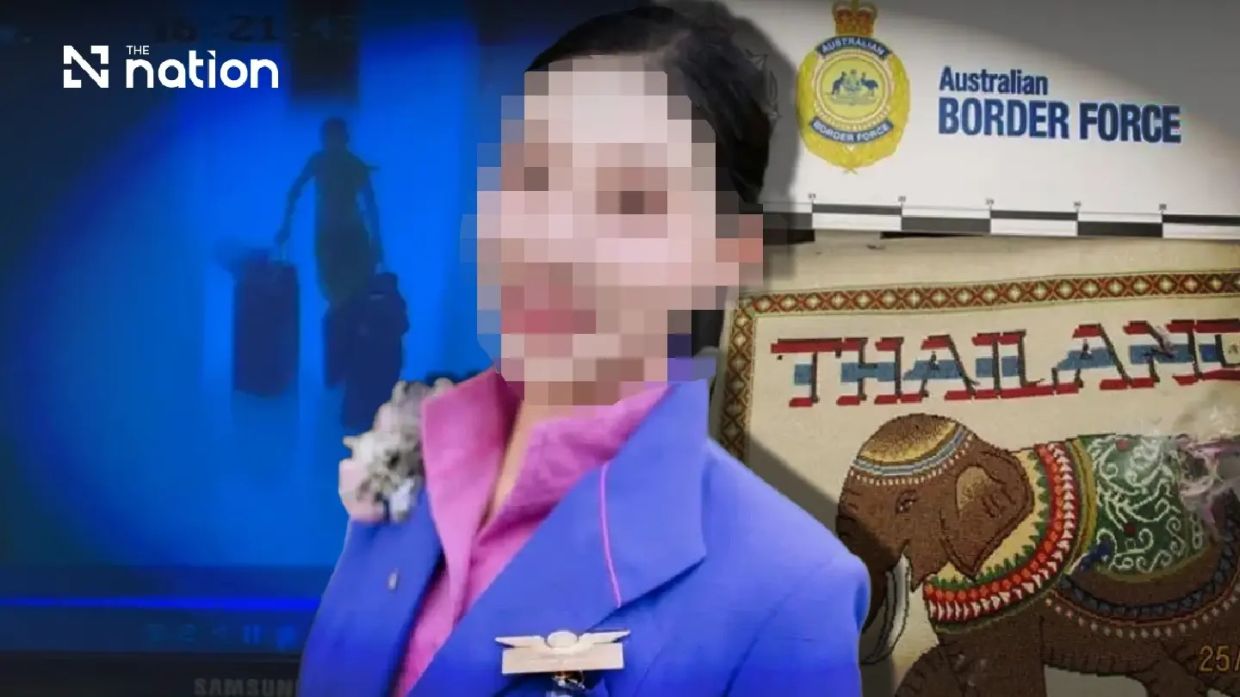
Thai narcotics authorities are expanding a major investigation into the case of a flight attendant detained in Australia with 900 grammes of heroin, revealing what investigators believe is a sprawling international smuggling operation rooted in the lawless Golden Triangle border region. The woman, arrested at Melbourne Airport, has not yet been formally charged and remains classified as a detainee while Thai and Australian authorities coordinate their efforts to uncover the full extent of the smuggling network and determine her precise role in the operation.
The Office of the Narcotics Control Board has partnered with Thai security agencies to dissect the mechanics of an elaborate scheme that authorities suspect may have exploited the flight attendant through social engineering rather than genuine criminal complicity. According to investigators, the network appears to operate on multiple continents, using fake online profiles to target airline workers and frequent international travellers with lucrative offers to transport parcels across borders—a method that has proven disturbingly effective in recruiting unsuspecting couriers. The involvement of postal delivery channels alongside direct hand-to-hand transfers suggests a sophisticated logistics operation designed to minimise detection while maximising distribution reach.
Arrepeak Ngernbamroong, deputy secretary-general of the ONCB, disclosed that Thai authorities had orchestrated three to four arrests in Bangkok connected to the case, resulting in the seizure of more than 26 kilogrammes of heroin. The discovery of a delivery rider receiving narcotics from foreign nationals, combined with evidence implicating a Lao couple, has prompted the Department of Special Investigation to assume primary responsibility for pursuing what officials now characterise as a large-scale transnational criminal enterprise rather than an isolated trafficking incident. This elevation in investigative priority underscores Bangkok's assessment that the network operates across multiple countries and involves coordination between disparate criminal cells.
Metropolitan Police officials have established that the network leverages a calculated recruitment strategy centred on deception. Scammers allegedly create fictitious social media profiles and send mass messaging campaigns to airline staff and regular international commuters, proposing substantial payments for smuggling goods—a tactic that preys on financial vulnerability and the perceived legitimacy of courier work. The flight attendant appears to have been contacted through such channels and subsequently directed to receive a parcel containing elephant-patterned bags from a delivery rider in Bangkok. According to her boyfriend's account, she inspected the bags upon receipt, found nothing suspicious, and packed them into her suitcase before departure—actions that could suggest genuine ignorance rather than deliberate participation in drug trafficking.
A crucial figure in the Australian end of the operation is a Thai national known as Dear, who has resided in Australia for approximately a decade under circumstances still being clarified by authorities. Thai investigators have established that Dear was the intended recipient of the heroin shipment and believe this individual has participated in multiple previous smuggling operations in the same capacity. The Australian Federal Police have taken charge of investigating Dear's background, residency status, and network connections, with particular focus on identifying the ultimate recipients of the narcotics and mapping the full distribution chain within Australia. The fact that the same person has repeatedly acted as receiver in prior incidents suggests a deliberate operational role within a larger organisational hierarchy rather than random participation.
The financial dimension of the case remains opaque, creating evidentiary complications for prosecutors. Australian police extracted a figure of 8,800 baht (approximately US$264) from mobile phone data, yet Thai investigators have uncovered conflicting information suggesting two separate transfers of 1,700 baht each—purportedly triggered when goods were received and again when flight tickets became available. Critically, when authorities examined the flight attendant's bank records, they found no trace of these transactions and noted the account balance was modest, raising questions about whether the payment data is accurate or whether compensation was delivered through alternative channels. This ambiguity cuts both directions: it could indicate she was genuinely unaware of the operation's true nature, or alternatively suggest sophisticated criminal tradecraft designed to obscure financial trails.
The delivery rider who transported the parcels has provided testimony that functionally contradicts any suggestion of systematic conspiracy. He claims to have executed similar deliveries three or four times previously but stated this was his initial transaction involving the female flight attendant—an assertion that, if accurate, undermines prosecution arguments that she was an established member of a criminal conspiracy. Thai investigators cannot yet determine whether the flight attendant possessed genuine knowledge of the heroin's presence, making the distinction between unwitting dupe and knowing accomplice legally and morally significant. X-ray screening at Bangkok's airport detected no irregularities, suggesting that either the inspection procedures were ineffective or the drug concealment was extraordinarily sophisticated.
The geographical dynamics of the drug trade reveal why Malaysia and other Southeast Asian nations should regard this case with urgent concern. The Golden Triangle—where Thailand, Laos, and Myanmar converge—has historically served as the epicentre of regional opium production and heroin manufacturing, with traditional northern Thailand smuggling routes now compromised by intensive Thai enforcement efforts. Traffickers have systematically shifted their operations toward north-eastern Thailand, exploiting the lengthy, sparsely monitored Mekong River frontier through provinces including Nakhon Phanom, Bueng Kan, Loei, and Nong Khai. The relative narrowness of the waterway in these locations contrasts sharply with the vast territory requiring surveillance, creating enforcement gaps that networks have exploited to move product from the production zones into Thai territory and onward to international markets.
The shift in trafficking patterns carries direct implications for Malaysia's border security and drug interdiction operations. As Thai authorities intensify pressure on traditional corridors, smuggling networks adapt by diversifying routes and methodologies, often extending operations into neighbouring countries' spheres of influence. The recruitment of airline personnel as couriers represents a particularly vexing challenge because it integrates the transportation infrastructure that connects Southeast Asia to Australia and beyond, essentially weaponising legitimate commercial aviation for illicit purposes. Intelligence sharing among regional law enforcement agencies becomes critical when syndicates operate across multiple jurisdictions, yet bureaucratic compartmentalisation and limited resources often prevent effective coordination.
Thailand and Laos maintain ongoing coordination mechanisms for narcotics interdiction, though the deputy ONCB secretary-general's insistence that Laos has not neglected enforcement efforts suggests some sensitivity around the issue. Regardless of Laotian commitment levels, the harsh geography and demographic realities of the border region mean that complete interdiction remains impossible—syndicates need only succeed occasionally to maintain profitable operations. The heroin seized in Bangkok and destined for Melbourne likely represents merely one operational line within a considerably larger distribution apparatus, with similar consignments moving through alternative channels on different timelines. The Golden Triangle's persistent production capacity and the financial incentives driving transnational trafficking ensure that cases like this flight attendant's will recur with depressing regularity unless source-country production can be fundamentally disrupted.
The classification of the flight attendant as a detainee rather than an accused person reflects Thai authorities' genuine uncertainty about her culpability while simultaneously indicating their commitment to supporting her legal defence through evidence sharing with Australian counterparts. Thai consular officials have been enlisted to assist, and evidence packets have been forwarded to the Australian Federal Police to illuminate mitigating circumstances. Whether this prosecutorial restraint translates into meaningful protection for someone who may have been manipulated by sophisticated international criminals remains uncertain, as Australian courts will ultimately determine her fate based on evidence presented. The case exemplifies the vulnerability of ordinary workers caught in criminal networks' sophisticated recruitment machinery and underscores why preventing supply-chain infiltration requires not merely law enforcement responses but also public awareness campaigns targeting the deceptive recruitment tactics increasingly deployed across Southeast Asia.

