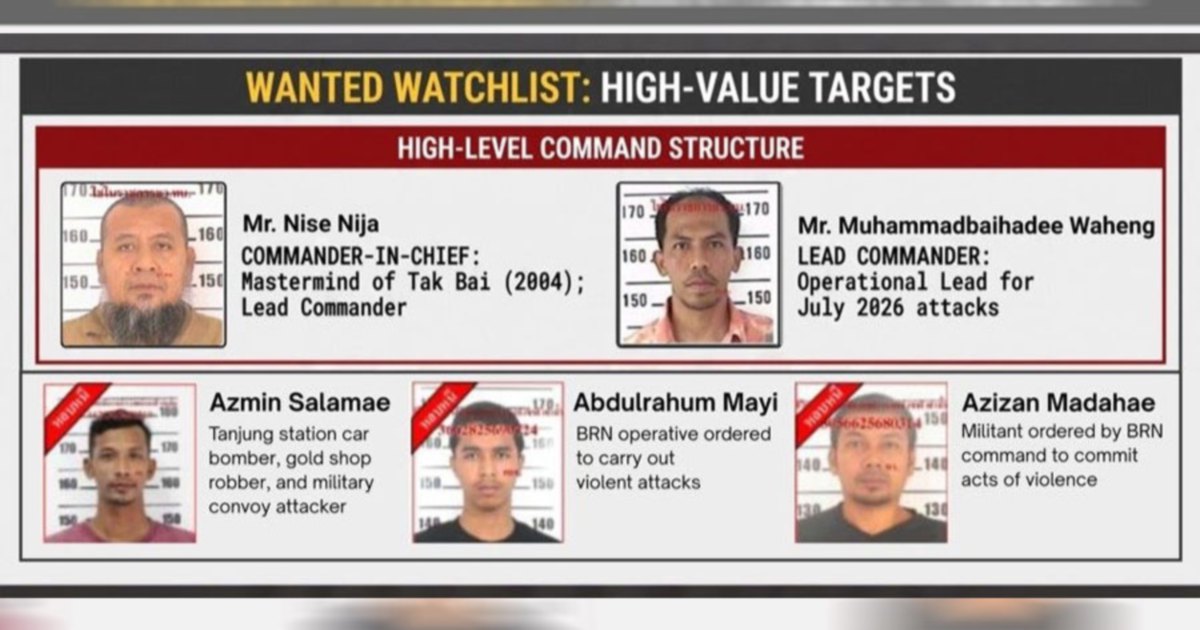
Thai authorities have intensified their security response following a coordinated attack on a checkpoint in the southern province of Narathiwat, issuing arrest warrants for five individuals suspected of orchestrating the deadly ambush. The incident unfolded on July 22 along Bukit Sami Municipal Road in the Tanjong Mas subdistrict of Ra-ngae district, marking another violent episode in Thailand's persistently troubled deep south.
The timing and location of the assault underscore the ongoing challenges facing Thai security forces in managing militant activity across the Narathiwat-Yala-Pattani border corridor. Ra-ngae district, situated in the northernmost section of Narathiwat province, has historically served as a transitional zone where insurgent groups operate with varying degrees of freedom, making it a strategic flashpoint for regional security concerns. The checkpoint targeted was a standard defensive position, suggesting attackers possessed operational intelligence regarding Thai security deployments.
The decision to issue arrest warrants represents a formal escalation in the investigation, moving beyond initial intelligence gathering into active prosecution. Thai authorities typically pursue this course when they have accumulated sufficient evidence linking specific individuals to attack planning or execution. For Malaysian readers, the development carries particular significance given Kelantan's geographical proximity to Narathiwat and the historical pattern of cross-border security incidents affecting both nations.
Insurgent operations in Thailand's southern provinces have evolved substantially over the past two decades, shifting from high-profile bombings in tourist areas toward targeted strikes against state security personnel and infrastructure. This tactical adjustment reflects both the maturation of militant operational planning and the Thai military's success in hardening civilian targets. Checkpoint ambushes represent a preferred tactic precisely because they concentrate security assets in predictable locations, offering attackers window opportunities for maximum impact.
The broader context of Thai-Malaysian border dynamics cannot be overlooked. While the checkpoint lies entirely within Thai territory, the regional insurgency maintaining significant sanctuaries and supply networks across the Malaysian border in Kelantan and Perak creates a complex security environment. Malaysian authorities have implemented extensive counter-insurgency measures, though the porous nature of the frontier continues to pose challenges for bilateral cooperation and threat containment.
The five suspects now subject to arrest warrants represent only the immediate operational tier of what intelligence analysts assess as a larger organisational structure. Thai security agencies are likely pursuing leads that extend beyond these individuals toward coordinators, planners, and material suppliers. Such compartmentalised networks have proven resilient precisely because eliminating frontline operatives does not necessarily disrupt command structures or eliminate capability for subsequent attacks.
For regional maritime commerce and civilian travel, incidents in Narathiwat carry implications for movement security throughout the northern peninsula. Although international headlines rarely reflect daily violence in this region, the accumulation of such incidents shapes threat assessments for transportation operators, commercial entities, and international organisations maintaining presence across southern Thailand and northern Malaysia. Insurance calculations, security escorts, and route planning all factor in the frequency and severity of ambush incidents.
Thailand's security response has historically emphasised military-led operations combined with targeted law enforcement actions. The arrest warrant strategy aligns with conventional counter-insurgency doctrine that prioritises identifying and neutralising operational leaders. However, successful resolution of the July 22 ambush faces considerable obstacles, including witness cooperation challenges, terrain advantages favouring suspects, and the sophisticated counter-surveillance practices employed by organised militant groups.
The investigation's progress will substantially depend upon intelligence cooperation between Thai and Malaysian authorities. Cross-border pursuit protocols, extradition arrangements, and real-time intelligence sharing through established bilateral channels become critical when suspects potentially flee toward Malaysian territory. Kelantan's border towns have historically offered refuge to individuals wanted in Thailand, though Malaysian security operations have gradually restricted such sanctuary.
Regional security analysts will closely monitor whether Thai authorities apprehend the five suspects and whether successful prosecutions follow. Conviction rates in southern Thailand insurgency cases have been uneven, with trials sometimes extending across years and requiring extensive security measures. The outcome will signal whether Thai authorities possess sufficient operational capability to pursue suspects in the challenging Narathiwat environment, or whether the five individuals ultimately evade capture and continue operational activities.
For Malaysian government agencies and border communities, the ongoing Narathiwat security situation necessitates maintained vigilance regarding cross-border ramifications. While Thai authorities bear primary responsibility for addressing insurgent activity within their borders, spillover effects—including potential refugee flows, weapons trafficking, and operational planning within Malaysian territory—remain legitimate Malaysian security concerns. The arrest warrant issuance represents standard Thai procedure, but translating warrants into actual apprehensions requires sustained operational effort that will ultimately determine whether this particular attack receives institutional justice or contributes to the region's mounting catalogue of unresolved violence.

