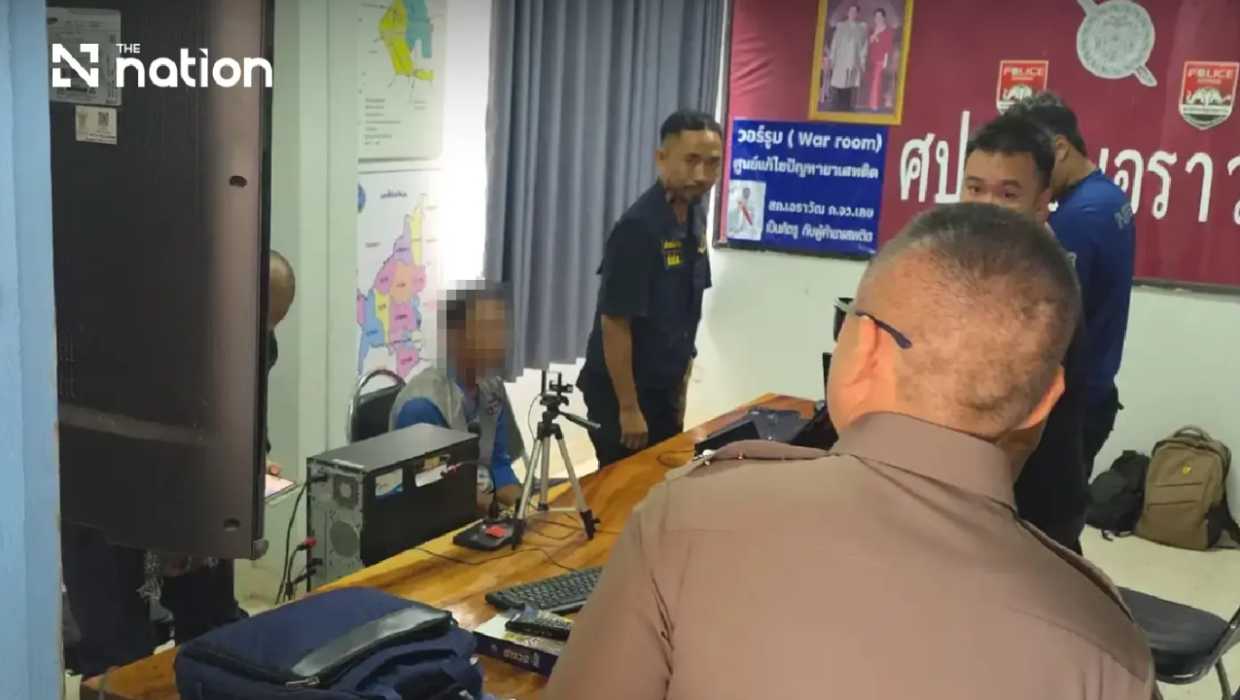
Thai authorities have broadened their investigation into a suspected international drug trafficking operation by detaining a married couple in the northeastern province of Loei. The arrests represent a significant escalation in law enforcement efforts following the detention of a Thai Airways flight attendant in Melbourne, Australia, who was found with what police believe to be heroin concealed in her luggage.
The suspect identified in Thai media reports as Mina was apprehended by Australian police at Melbourne Airport after officers discovered approximately one kilogramme of heroin allegedly hidden within her baggage. The discovery triggered Thai police to initiate a comprehensive investigation aimed at identifying the individuals responsible for organising and dispatching the contraband. Authorities recognised that a single flight attendant would be unlikely to operate independently, leading investigators to focus on identifying the network of facilitators and organisers behind the smuggling attempt.
On Thursday, 2 July, officers from Chiang Khan Police Station, working alongside personnel from the Office of the Narcotics Control Board (ONCB) and other relevant police divisions, conducted a raid on a property in That subdistrict, Chiang Khan district, after receiving intelligence suggesting connections to the suspects. The initial target address yielded no results, prompting investigators to pursue alternative leads. Through further inquiries, authorities learned that two individuals—Athit, 43, and Thatsaphon, 42—had been employed in the rubber tapping industry in Erawan district, forcing police to adjust their search strategy.
Investigators successfully located Athit at Wat Tham Pha Mak Ho temple in Sri Songkhram subdistrict, Wang Saphung district, where he was working on roof repairs. Police brought him to Erawan Police Station for formal questioning. During preliminary interrogation, Athit acknowledged his involvement in a parcel delivery scheme, confessing to transporting packages to Bangkok on six separate occasions. According to police records, three parcels had been dispatched through a parcel service outlet in Chiang Khan, with two originating from Ban That in That subdistrict and one from Erawan district. He stated that he received 8,000 baht (approximately US$240) per delivery from what he identified as a Lao national, with the most recent shipment sent on 28 June 2026.
Thatsaphon was apprehended shortly after authorities discovered a black Mitsubishi Triton pickup truck bearing Loei registration plates in a rubber plantation within the Pha Nang-Pha Koeng area of Pha In Plaeng subdistrict, Erawan district. The vehicle's location and connection to the suspects proved instrumental in leading police to her whereabouts. Upon detention and subsequent questioning at Erawan Police Station, Thatsaphon, a Lao national and Athit's wife, denied any knowledge of or participation in the alleged operation. The contrasting statements from the two suspects suggest they may attempt to shift responsibility or claim coercion, a common defence strategy in transnational drug cases.
Both individuals will be transferred into the formal custody and interrogation process managed by the ONCB, which will assume principal investigative authority. The agency's involvement signals the significance authorities attach to the case and indicates that investigators will pursue more ambitious lines of inquiry designed to establish the full scope of the operation. Police are particularly interested in identifying those who orchestrated the smuggling scheme, provided financial support, or assisted in any capacity at various stages of the operation. The multi-layered structure of the suspected network—spanning Thailand, Laos, and Australia—suggests that additional arrests may follow as investigators work through the supply chain.
According to the ONCB secretary-general, the case exemplifies how contemporary transnational drug syndicates exploit geographical boundaries and compartmentalised operations to evade law enforcement detection. By employing individuals at different operational levels and leveraging cross-border movement, trafficking organisations create structural insulation that complicates investigations. The secretary-general acknowledged that collaborative efforts between Thai and international law enforcement agencies had proven essential in identifying potential connections and reconstructing the network's framework within Thailand. This recognition underscores the increasing necessity for regional cooperation in combating sophisticated drug trafficking operations that transcend national boundaries.
The ONCB has committed to intensifying investigative efforts and pursuing formal legal proceedings against every individual identified as having participated in the operation at any level, from street-level couriers to organisers and financiers. The agency intends to strengthen bilateral and multilateral cooperation with foreign law enforcement counterparts to intercept drug shipments, dismantle trafficking routes, and sever the financial mechanisms that sustain these networks. These measures align with the Thai government's broader drug-suppression agenda, which prioritises the dismantling of international syndicates rather than merely addressing local consumption.
For Malaysian authorities and regional observers, the case illustrates vulnerabilities in cross-border security and the sophistication of networks exploiting legitimate transportation channels. Thai Airways employees, like workers in any major carrier, represent potential recruitment targets for smugglers seeking to circumvent customs scrutiny. The involvement of Lao nationals in coordination and financing roles reflects established trafficking patterns in Southeast Asia, where the porous borders and limited resources of smaller nations sometimes facilitate transnational criminal activity. Malaysian law enforcement should recognise that similar networks may operate within or transit through Malaysian territory, necessitating heightened vigilance at airports and enhanced intelligence-sharing protocols with regional partners.
The case also demonstrates how initial law enforcement success—the arrest at Melbourne Airport—can generate critical intelligence that ripples backward through supply chains, potentially unravelling entire operations. Australian police cooperation in providing details about the arrested flight attendant enabled Thai authorities to identify the sending point and subsequently trace the logistics network. This retroactive tracing capability underscores the value of seamless international information-sharing among law enforcement agencies. For Malaysia, which sits at a critical geographical nexus for both legitimate commerce and illicit trade, cultivating intelligence partnerships and maintaining real-time communication with international counterparts remains strategically essential.
The financial dimensions of the operation—8,000 baht per delivery—reveal the economic incentive structures that make small-scale couriers vulnerable to recruitment. Many individuals in rural areas of Thailand, Laos, and potentially other Southeast Asian nations face limited employment prospects, making payments of several hundred dollars per transaction extremely attractive despite the associated criminal risk. Organised traffickers exploit this economic disparity systematically, identifying individuals in disadvantaged communities and leveraging their financial desperation. Understanding these socioeconomic drivers is crucial for developing comprehensive counter-narcotics strategies that address not only enforcement but also alternative livelihood programmes in vulnerable regions.

