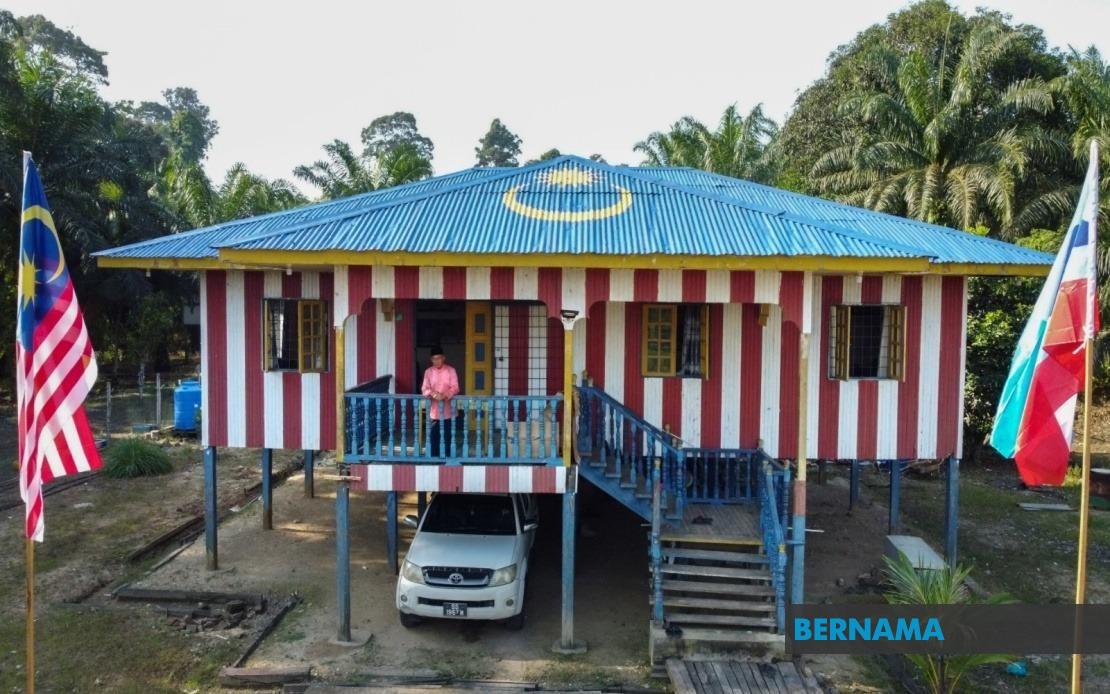
In the Batu 15 area of Sandakan, a house has become impossible to ignore. Painted in bold red, white, blue and yellow, with a deep-blue roof crowned by a golden-yellow crescent moon and 14-pointed star, Teratak Gemilang stands as one man's colourful declaration of devotion to Malaysia. The home belongs to Mohd Halikin Angga, a 68-year-old entrepreneur whose vision transformed an ordinary wooden structure into a striking patriotic landmark that draws visitors throughout the year, particularly during National Month celebrations.
Mohd Halikin's journey toward creating this symbol began two decades ago in 2004, rooted in a personal sentiment born from witnessing the temporary nature of national pride. Each year, he observed the ritual of raising and lowering flags during Independence Day festivities, only to see them removed when celebrations ended. What truly troubled him, however, was the sight of flags discarded carelessly—blown away by wind, falling from vehicles, landing on roads and pavements. This disconnect between the formal displays of patriotism and their casual disposal sparked something deeper within him. He conceived an ambitious plan: why not create a permanent physical manifestation of national pride, one that would stand year-round as a constant reminder of Malaysia's independence and identity?
The decision to paint his home was equally rooted in filial devotion. Mohd Halikin harboured profound respect for his parents, who had lived through the colonial era and witnessed Malaysia's struggle for independence first-hand. Their generation understood the sacrifice and hardship that preceded nationhood in a way younger Malaysians could only learn through history. By immortalizing the Jalur Gemilang on his home's walls, Mohd Halikin sought to honour their generation's legacy and their lived experience of a nation being born. This dual motivation—personal pride in Malaysia's independence combined with reverence for those who fought for it—gave Teratak Gemilang its emotional foundation.
The transformation of the house extended beyond mere paint. Stepping into Teratak Gemilang reveals a thoughtfully curated mini-gallery that serves as an informal museum of Malaysian leadership. The living room displays formal portraits of the Yang di-Pertuan Agong, the Yang di-Pertua Negeri Sabah, and every Prime Minister from Tunku Abdul Rahman Putra Al-Haj to the incumbent office holder. These images function as more than decoration; they represent a visual chronicle of Malaysia's political evolution and the individuals who have guided the nation through distinct historical periods. Each portrait carries weight, marking leadership transitions and the passage of decades.
Among Mohd Halikin's most cherished possessions is a historic black-and-white photograph from 1961 documenting Tunku Abdul Rahman meeting with 20 North Borneo leaders to discuss Malaysia's formation. The image's acquisition itself reflects his dedication. During an Umrah flight in 2005, he encountered the photograph in a newspaper, immediately recognizing its historical significance. He requested permission from cabin crew to preserve and frame it—a request that speaks volumes about his commitment to documenting Malaysia's foundational moments. This single photograph encapsulates the pivotal conversation that ultimately led to Malaysian federation, making it a tangible link to the nation's creation narrative.
Mohd Halikin's patriotism extends into the intimate sphere of family naming conventions, revealing how deeply national identity permeates his personal life. Among his seven children, three bear names honouring prominent Malaysian figures and statesmen. His eldest child carries the name of Tun Dr Mahathir Mohamad, the second is named after Tun Abdullah Ahmad Badawi, and his sixth child, Nur Zahirah, was named in honour of the 13th Raja Permaisuri Agong. These choices represent far more than fashionable naming; they constitute an intentional strategy to embed national leadership into familial identity. Mohd Halikin articulates his philosophy with clarity: a name transcends mere labels and becomes a vessel of hope, a silent reminder to each generation that they should remember and appreciate the contributions of those who came before and shaped the nation's trajectory.
The house has become an unexpected tourist attraction, particularly during sensitive periods on Malaysia's national calendar. Visitors, especially during the August-September national celebration period and September 16's Malaysia Day, frequently halt at Teratak Gemilang to photograph the striking structure. What began as a personal project has organically transformed into a public monument, drawing attention and triggering conversations about patriotism among both locals and tourists passing through Sandakan. The residence demonstrates how individual acts of civic pride, when executed with genuine passion and visibility, can influence communal sentiment and inspire reflection on national identity.
For Sabah specifically, Teratak Gemilang holds particular significance within the context of strengthening multiracial unity. Sabah's population comprises diverse ethnic communities with distinct histories and traditions. The house, with its unambiguous Malaysian iconography and patriotic message, serves as a unifying symbol that transcends ethnic boundaries. Mohd Halikin consciously positions his creation as a platform for fostering cohesion among Sabah's varied communities, especially during moments when national consciousness is heightened. The structure implicitly argues that Malaysian identity, rooted in shared constitutional values and national symbols like the Jalur Gemilang, provides common ground upon which diverse populations can build collective pride.
Looking ahead, Mohd Halikin has articulated his commitment to maintaining Teratak Gemilang in perpetuity, ensuring the house remains painted in Jalur Gemilang colours for decades to come. This decision carries implications beyond mere aesthetics. It represents a conscious rejection of the temporary and disposable nature of patriotic expression that originally troubled him. By committing to permanent maintenance, he transforms individual patriotism into a sustained cultural artifact. The forthcoming Malaysia Day 2026 celebrations (HKHM), which will mark six decades since Sabah's entry into the federation, will provide an important moment for Teratak Gemilang's symbolic resonance to amplify.
Mohd Halikin's endeavour raises broader questions about how communities express national identity in the contemporary era. While government institutions manage formal patriotic observances through flags, anthems, and official ceremonies, individual citizens like Mohd Halikin demonstrate that grassroots expressions of nationality can be equally powerful. Teratak Gemilang proves that patriotism need not be performance-based or temporally constrained; it can be woven into the physical environment, becoming a permanent part of the urban or suburban landscape. As Malaysia navigates questions of social cohesion, generational transmission of national values, and the markers of collective identity, Teratak Gemilang exemplifies one individual's answer: through persistent, visible, and heartfelt dedication to national symbols and historical memory.

