The funeral rites for Tengku Puteri Seri Kemala Tengku Datuk Seri Aishah, elder sister of the Sultan of Pahang Al-Sultan Abdullah Ri'ayatuddin Al-Mustafa Billah Shah, culminated in her burial at the Royal Mausoleum in Pekan on Wednesday. The 69-year-old passed away at 9.25 pm on Tuesday at a private hospital in Kuala Lumpur, concluding a significant chapter in Pahang's royal household as the extended family mourned the loss of a senior member of the state's reigning dynasty.
The funeral proceedings reflected the solemn dignity befitting a member of Malaysia's royal circles, beginning with congregational prayers held at the Khalid bin Al-Walid Mosque located along Jalan Padang Tembak in Kuala Lumpur. From there, the deceased's remains were transported via military aircraft from Subang Air Base to Pahang, underscoring the formal protocols observed for senior royalty. The journey back to the state represented a final homecoming to the ancestral domain, where further observances awaited at the Sultan Ahmad 1 Mosque adjacent to the mausoleum complex.
The Sultan of Pahang, accompanied by Tengku Ampuan Tunku Azizah Aminah Maimunah Iskandariah and their son Tengku Mahkota Tengku Hassanal Ibrahim Alam Shah, maintained a visible presence throughout the proceedings, demonstrating the family's commitment to honouring her memory. The gathering at Pekan also drew other prominent state and national figures, including Melaka's Yang Dipertua Negeri Tun Mohd Ali Rustam and Pahang's Menteri Besar Datuk Seri Wan Rosdy Wan Ismail, whose attendance reflected both personal condolences and official recognition of her standing within the federation's royal circles.
The remains arrived at the Sultan Ahmad 1 Mosque at 1.25 pm on Wednesday, permitting the performance of additional congregational prayers following the zuhur prayer time. This sequencing allowed the community and dignitaries to participate in Islamic funeral rites traditionally observed in Malaysian royal circles, where both immediate family and state officials customarily attend such observances. The mosque, as one of Pekan's principal religious institutions, provided an appropriate setting for these final prayers.
Following the afternoon prayers, the cortege proceeded to the Royal Mausoleum situated beside the mosque, where the interment ceremony proceeded under full ceremonial protocol. Pahang's Mufti Datuk Dr Asmadi Mohamed Naim oversaw the spiritual dimensions of the burial ritual, leading the recitation of Yasin and conducting the traditional tahlil and concluding prayers. These elements constitute fundamental components of Islamic funeral rites, performed to seek divine mercy for the departed and to affirm the family's faith during their period of loss.
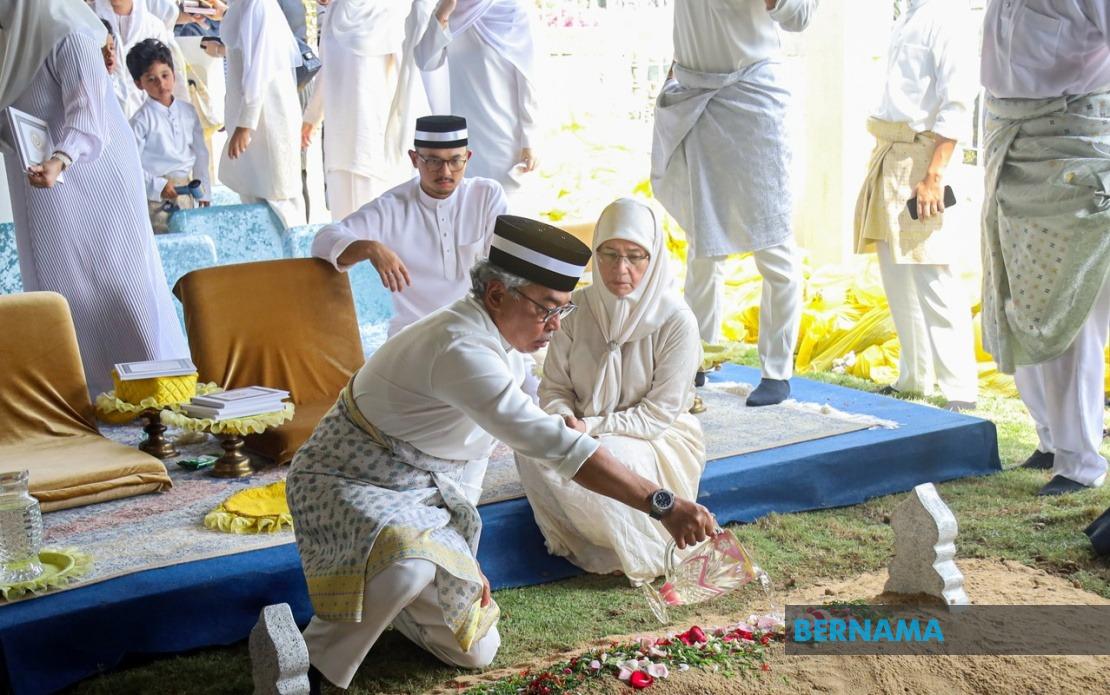
The Sultan and Tengku Ampuan participated directly in the final rites, sprinkling rose water and scattering flowers across the gravesite—a gesture carrying both religious significance and personal affection. Such acts, while grounded in Islamic tradition, also represent contemporary Malaysian royal practice, where members of the reigning family take active roles in honouring deceased relatives rather than remaining distant observers. The image of the state's monarch and consort performing these personal acts conveyed the depth of familial bonds transcending protocol and formality.
Tengku Puteri Seri Kemala's passing marks a transition within Pahang's ruling house at a time when the state navigates ongoing political and administrative challenges. As the Sultan's elder sister, she occupied a position of seniority within the royal hierarchy, and her death removes a link to the previous generation of Pahang's reigning family, including the late Sultan Ahmad Shah, whose name graces the principal mosque at Pekan. The loss underscores the passage of time within institutional structures where continuity and succession remain perpetually relevant concerns for Malaysia's hereditary monarchy system.
The Royal Mausoleum itself functions as a custodian of Pahang's dynastic memory, housing the remains of previous sultans and senior members of the royal household across generations. The burial of Tengku Puteri Seri Kemala alongside these predecessors situates her within the physical geography of the state's historical narrative, where successive reigns and their principal figures occupy designated places. This geographical permanence at Pekan reinforces the symbolic connection between the ruling family and the state's identity, a relationship central to Malaysia's constitutional monarchy framework.
For Southeast Asian monarchies more broadly, the observance surrounding Tengku Puteri Seri Kemala's funeral illustrates how contemporary Asian kingdoms balance Islamic religious observance with hereditary royal custom. The coordination between religious authorities, state officials, and family members reflects sophisticated protocols evolved over decades to address the ceremonial requirements of plural societies where religious and constitutional monarchical elements intersect. Malaysia's approach, visible in such proceedings, demonstrates how traditional practices adapt to modern institutional contexts while maintaining spiritual authenticity.

