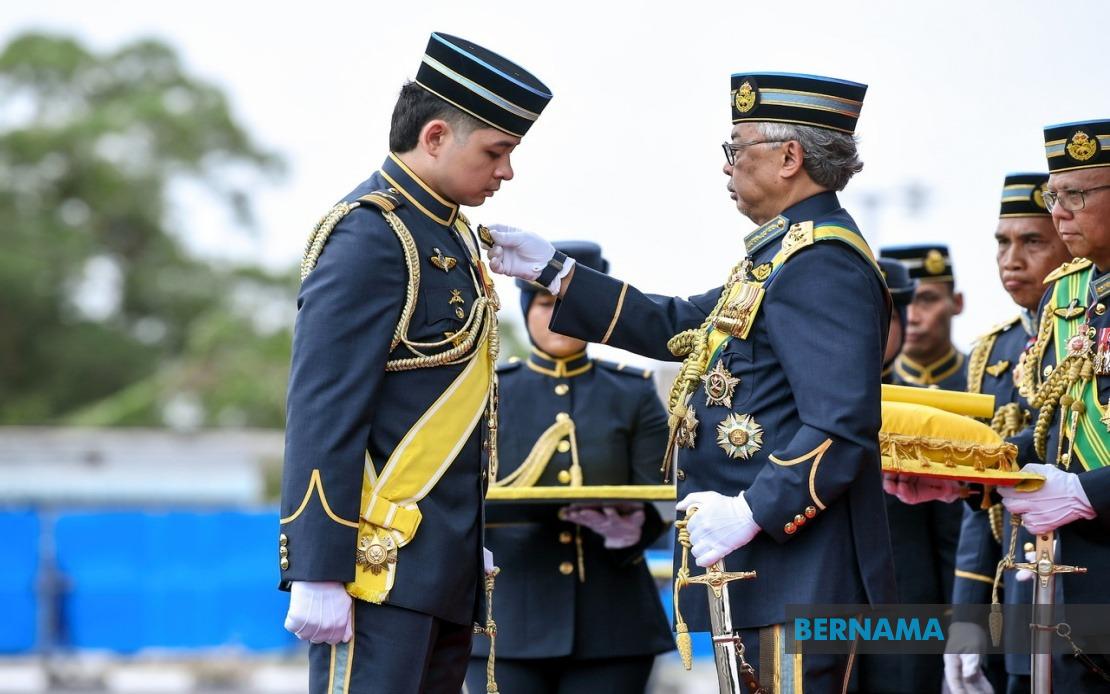
The Tengku Mahkota of Pahang, Tengku Hassanal Ibrahim Alam Shah Ibni Al-Sultan Abdullah Ri'ayatuddin Al-Mustafa Billah Shah, has achieved a significant milestone by completing the Royal Malaysian Air Force's Basic Helicopter Flying Course at Air College in Alor Setar, becoming the first member of the royal family to undertake and successfully finish such rigorous military aviation training. His accomplishment was formally recognised on August 15 when he received his RMAF Flying Wings at a ceremony presided over by the Sultan of Pahang, Al-Sultan Abdullah Ri'ayatuddin Al-Mustafa Billah Shah, who serves as Colonel-in-Chief of the air force.
The Flying Wings Presentation Parade marked a significant occasion for Malaysia's military aviation establishment, with 40 personnel in total receiving their wings following successful completion of their respective courses. Beyond the Tengku Mahkota, the recipients included 39 graduates from the Malaysian Armed Forces, composed of 37 newly qualified pilots and two weapons systems officers representing personnel from all three military services. The diversity of the graduating cohort underscored the breadth of the RMAF's training pipeline and its ongoing commitment to developing skilled aviators across different specialisations and service branches.
The Tengku Mahkota participated in the 67(A)/26 Basic Helicopter Flying Course, which ran intensively from early June through the end of July and utilised the EC120B Colibri helicopter as the primary training platform. During this concentrated two-month period, he successfully navigated multiple high-stakes evaluations that progressively tested his capabilities as a developing aviator. His assessments included the Basic Handling Test, designed to evaluate fundamental flight control and aircraft management skills; the Instrument Flying Test, assessing his ability to operate safely using cockpit instruments during low-visibility conditions; the Final Navigation Test, measuring his capacity to execute precise route planning and directional flying; and the Final Handling Test, confirming his overall operational readiness. Excellence across all these evaluation components demonstrated not only technical proficiency but also the mental acuity and decision-making capacity demanded of military pilots.
The broader ceremonial event recognised four separate flying courses whose graduates received their wings on the same occasion. In addition to the Tengku Mahkota's helicopter course, personnel from the 67/25 Basic Helicopter Flying Course and the 87/25 Basic Flying Course also graduated, along with officers completing the 01/25 Basic Weapon Systems Officer Course. This multifaceted approach to aviation training reflects the RMAF's need to develop personnel across diverse roles, from fixed-wing pilots to helicopter operators to sophisticated weapons system specialists who operate modern avionics and targeting systems.
Beyond the presentation of wings to all qualified graduates, the ceremony distinguished six individuals who demonstrated exceptional performance across multiple dimensions of military life. These recipients received special recognition awards reflecting their achievements in flying proficiency, academic performance, discipline and military bearing, and leadership qualities. Such honours serve both to celebrate individual excellence and to establish benchmarks of aspiration for future cohorts of trainee pilots and air force personnel.
General Tan Sri Muhamad Norazlan Aris, the Royal Malaysian Air Force's Chief, delivered remarks that contextualised the significance of the day's achievements within the broader framework of military professional development and national service. He attributed the success of the Tengku Mahkota and his fellow graduates to qualities cultivated deliberately throughout their training: perseverance in the face of demanding schedules and challenging technical content, fighting spirit that drove them to overcome obstacles, mental resilience when confronted with stress and complexity, and rigorous discipline that transformed individuals into professional military aviators.
The Air Force Chief explicitly acknowledged the invisible but crucial support systems that enabled these accomplishments. He recognised that behind every graduate stood family members—parents, spouses, children and extended relatives—whose prayers, encouragement and moral support provided essential psychological reinforcement during months of intensive preparation. This acknowledgment reflects a sophisticated understanding within Malaysia's military leadership that personal achievement remains rooted in family commitment and emotional sustenance, a perspective particularly resonant within Malaysian cultural values that emphasise kinship bonds and collective family honour.
General Muhamad Norazlan's keynote address also conveyed a deeper philosophical message about the meaning of the RMAF Flying Wings themselves. He characterised the presentation ceremony not as a conclusion to a training journey but rather as a commencement—the point at which newly qualified aviators assume genuine operational responsibilities within the air force structure. This reframing proves psychologically important, signalling to the graduates that earning wings represents not the achievement of a credential but acceptance into a professional community bound by shared standards and mutual accountability.
The General further articulated the symbolic weight carried by the physical wings worn on an aviator's chest. These insignia, he explained, embody not merely individual accomplishment but rather the honour, aspirations and trust invested by the institution and the nation itself. For Malaysian aviators, particularly those operating in an increasingly complex regional security environment where aerial capabilities carry strategic implications, this understanding of wings as representing national interests and collective security responsibilities underscores the seriousness with which the RMAF regards its personnel.
The achievement of the Tengku Mahkota holds particular significance within Malaysian institutional and symbolic contexts. The participation of senior royal family members in military training, particularly in demanding technical fields such as aviation, reinforces the constitutional role of the Malaysian monarchy as custodian and symbol of national unity and defence. His successful completion of a rigorous course alongside non-royal military personnel also demonstrates commitment to standards of merit-based excellence and the principle that military qualifications reflect demonstrated capability rather than status alone.
From a broader Southeast Asian perspective, Malaysia's investment in developing advanced aviation capabilities through structured pilot training programmes positions the nation alongside regional air forces in maintaining relevant and sophisticated aerial defence capacities. The RMAF's demonstrated ability to graduate multiple cohorts of qualified aviators annually, including specialists in helicopter operations and weapons systems, contributes to Malaysia's credible military deterrence and capacity to protect national airspace and maritime interests.
The ceremony in Alor Setar thus represents more than a routine military graduation event. It encapsulates Malaysia's institutional commitment to rigorous professional military development, the royal family's participation in national defence frameworks, and the integration of individual aspiration with collective security responsibilities. As the newly qualified aviators assume operational roles, they carry forward the standards, discipline and excellence standards embodied in their training and symbolised by the wings they have earned.

