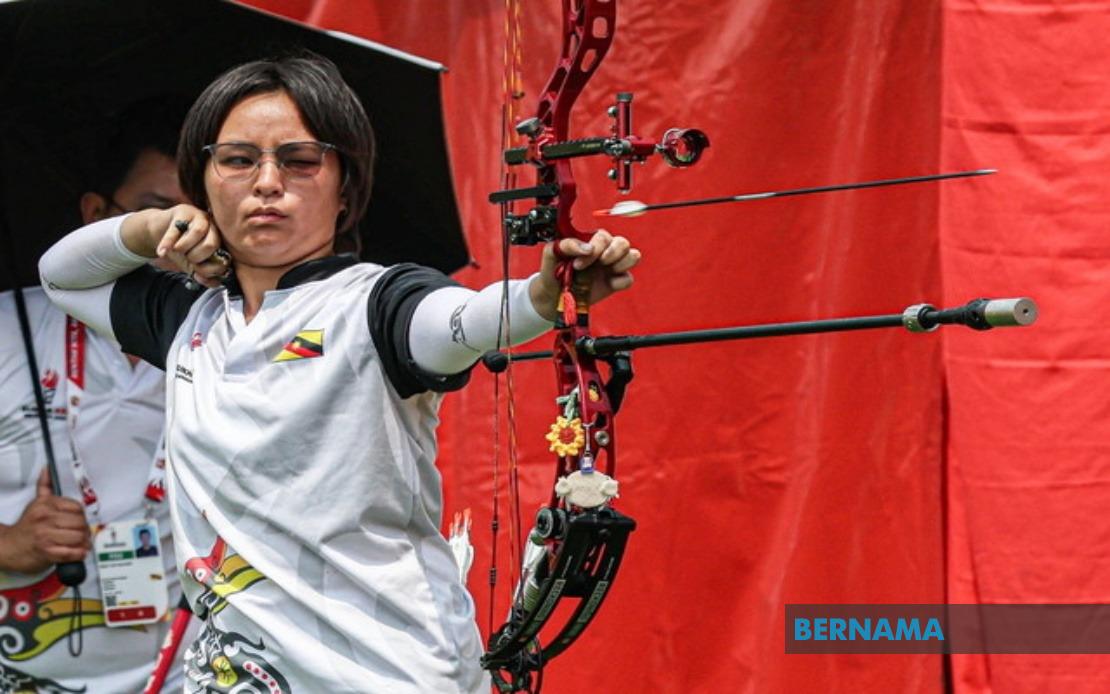
Wee Yee Qi's strategic shift to compound archery has already delivered remarkable results for Sarawak at the 2026 SUKMA Games. The 17-year-old archer, competing in her first SUKMA tournament, captured two gold medals on her opening day at the National Institute of Valuation Stadium in Bangi, cementing what appears to be a shrewd career move that may reshape her trajectory in Malaysian sport.
In the mixed team competition, Yee Qi partnered with Eason Lau Hui Wan to narrowly edge out Kedah's pairing of Muhammad Zaim Ahmad and Ili Nabihan Shafizan in a tense final that went down to the wire with a score of 151–150. The narrow margin underscores both the growing competitiveness of Malaysian archery and the precision required at the highest levels of regional competition. Later the same day, the Miri-born athlete joined forces with Aira Nadirah Aizuddin and Nur Zara Aisyah Khairul Fadly to claim the women's team title, defeating Terengganu 217–213 in a contest that saw Sarawak mount a dramatic turnaround during the final round after trailing throughout the opening three phases.
The Terengganu trio of Airazalia Azrai, Nur Shafiena Mohd Shuhamri and Putri Aqiera Issandra Ismayuddin had largely controlled the match's momentum until the closing stages, when Sarawak's coordinated assault proved decisive. The ability to recover from trailing positions in high-pressure team formats demonstrates mental fortitude and technical consistency that bodes well for Yee Qi's development as a competitive archer. Her coaches have clearly invested significantly in developing not only her individual skill set but also her capacity to perform under tournament stress.
Yee Qi's journey to this breakthrough reflects the value of adaptive decision-making in elite sport. She had spent six years in archery, initially progressing through the recurve discipline after her aptitude was identified during secondary schooling. However, recognising that recurve was not yielding the competitive returns she sought, she made the pivotal choice late last year to transition to compound, a variant that emphasises different biomechanical principles and technical approaches. This willingness to reinvent herself within her chosen sport rather than abandon it entirely speaks to both personal resilience and access to quality coaching that could identify and facilitate the necessary adjustments.
In remarks following her victories, Yee Qi emphasised her gratitude to her coaching team, acknowledging their instrumental role in her development and their commitment to exposing her to competitive environments across multiple tournaments. This investment in broad competition experience has clearly paid dividends, providing her with the tactical awareness and composure needed to excel at the regional level. Her family's unwavering support has also been foundational, a factor that proves crucial for young athletes navigating the demanding pathway toward elite performance.
Yet Yee Qi faces a significant interruption to her sporting momentum. With the Sijil Pelajaran Malaysia examination scheduled for November, she must temporarily redirect her concentration toward academic commitments. The timing presents a common dilemma for talented young Malaysian athletes: balancing the critical final year of secondary education with the intensive training required to maintain and build upon recent success. How effectively she manages this dual demand over the coming months could substantially influence her longer-term trajectory.
Looking beyond the immediate season, Yee Qi has articulated a clear long-term objective: representing Malaysia at the national level and potentially on the international stage. This ambition, while appropriately aspirational for a teenager who has just claimed two gold medals, underscores the serious intent embedded in her career planning. Sarawak's strength in archery at SUKMA 2026 suggests that regional competition serves as a meaningful pathway for identifying and developing talent with genuine national potential.
The broader context of these results reflects Sarawak's emerging prominence in Malaysian archery. The state's success in securing two gold medals across mixed and women's team formats indicates systematic investment in the sport and access to technical expertise. For a state often perceived as peripheral in certain sporting disciplines, SUKMA 2026 has provided a platform to demonstrate depth and quality in archery.
Meanwhile, Selangor claimed the bronze medal in the mixed team event through the partnership of Muhammad A'rif A'fiq Suhaimi and Nur Alyaa Nazurah Fadzil Fairuz, who defeated Sabah's Hiew Ichin and Catherine Looi Mei Qi Abdullah 154–152. The Selangor women's team of Amira Batrisyia Mohamad Azizul Rahman, Nur Alya Sofrina Mohd Sarif and Nur Alyaa Nazurah Fadzil Fairuz also captured bronze after a 219–212 victory in their contest. These results reflect the competitive distribution of archery talent across Malaysia's states, with multiple regions capable of producing medal-winning performances at SUKMA.
Yee Qi's emergence as a double gold medalist at SUKMA 2026 carries implications beyond her individual achievement. Her success illustrates how technical flexibility and willingness to adapt one's approach within a sport can unlock dormant potential. For younger Malaysian archers contemplating their specialisation choices, her example demonstrates that switching disciplines, when executed with proper coaching support and deliberate practice, need not represent failure but rather strategic repositioning. As she temporarily shifts focus to her SPM examination, the archery community will be monitoring her return to full-time competition, expecting that she will build substantially on the foundations laid at these Games.

