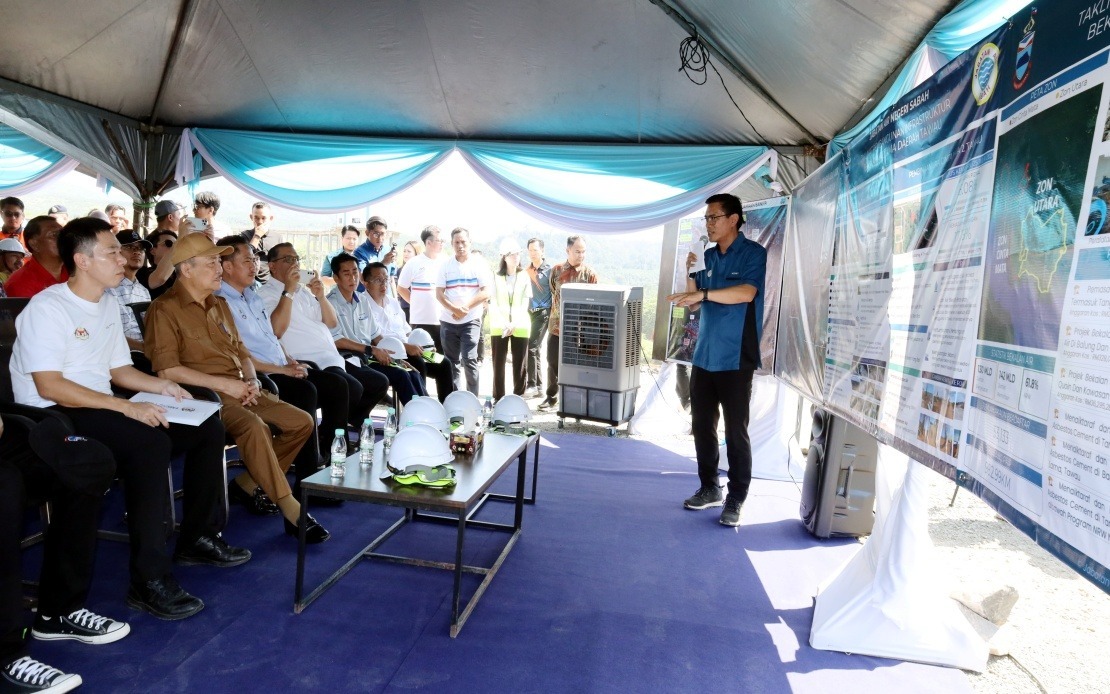
Tawau residents facing chronic water scarcity for decades can expect relief before the end of 2027, when the ambitious RM450.5 million Tawau Water Supply Scheme Phase III reaches completion. This major infrastructure undertaking represents one of Sabah's most significant water security investments and marks a decisive shift toward resolving a problem that has constrained the growth and quality of life in the district for years.
Sabah Chief Minister Datuk Seri Hajiji Noor confirmed the project's progress during a working visit to construction sites, emphasizing that despite the contractor's request for additional time, the overall timeline remains intact. The scheme encompasses multiple components designed to fundamentally transform water availability across Tawau and surrounding communities. At its core lies the construction of the Tawau Dam, engineered to capture and store 30 million cubic metres of raw water—a capacity that will simultaneously address flood vulnerability in downstream areas.
As of late July, the dam construction had achieved 74.04 percent completion, with project managers tracking progress against original schedules. The dam serves as the backbone of a comprehensive system designed to feed treated water to three distribution plants: the existing Cinta Mata 1 and Cinta Mata 2 facilities, as well as the Utara Water Treatment Plant. Once fully operational, these three plants will collectively produce 161 million litres of treated water daily—a dramatic increase from current output and a response to the widening gap between supply and demand.
The current situation in Tawau exemplifies the infrastructure challenges facing many Malaysian districts struggling with rapid urbanization. Existing water production stands at only 130 million litres per day, while actual demand has climbed to 142 million litres daily. This 12-million-litre shortfall has necessitated rationing, planned interruptions to supply, and logistical complications for residents and businesses alike. With 53,133 registered water accounts in the district, the inadequacy of current supply affects a substantial portion of the local population, from domestic users to commercial establishments dependent on reliable water access.
Chief Minister Hajiji acknowledged that this inherited challenge did not originate under the current state administration but made clear that the government accepts responsibility for delivering solutions. His remarks signal a pragmatic approach to managing legacy infrastructure problems—a stance increasingly important for political credibility in Malaysian states where water security remains a defining governance issue. The government has signalled willingness to allocate additional funding should project requirements demand it, pending detailed assessments from the Sabah State Water Department and the Department of Irrigation and Drainage.
The centrepiece Cinta Mata 2 Water Treatment Plant, budgeted at RM299.9 million with a capacity to process 30 million litres daily, represents the largest single component after the dam. As of late July, this facility had achieved only 16.08 percent physical progress, with completion targeted for July 2028. Once operational, the plant will directly benefit approximately 42,000 consumers in Tawau town and peripheral settlements, a population concentration that underscores the scheme's priority focus on the district's urban core.
The infrastructure will also incorporate 11.6 kilometres of 700-millimetre diameter pipelines to transport raw water from the dam to treatment plants. This engineering specification reflects contemporary best practice for minimizing transmission losses and ensuring water quality during transport from source to processing facility. The scale of piping infrastructure required highlights the complexity and cost associated with transforming raw water availability into treated household supply.
For Malaysian policymakers monitoring water security across the peninsula and Sabah, the Tawau project offers instructive lessons in managing infrastructure deficits accumulated over decades. Southeast Asian cities increasingly struggle with aging water systems built for populations smaller than present-day realities. Tawau's experience reflects broader regional challenges where demand growth outpaces infrastructure expansion, forcing governments to undertake expensive catch-up investments.
The additional benefit of flood risk reduction adds another dimension to the project's value proposition. By capturing significant water volumes in a controlled reservoir, the dam mitigates downstream flooding during monsoon periods—a compound benefit that justifies investment beyond purely supply considerations. This dual functionality reflects contemporary infrastructure thinking that seeks multiple outcomes from capital expenditure.
Successful completion by end-2027 would position Tawau among Sabah's better-serviced municipalities, fundamentally changing the calculation for residents and businesses considering relocation or expansion in the district. Reliable water supply remains among the most basic prerequisites for economic development and quality of life in any location. The project thus carries implications extending well beyond utility provision into regional economic competitiveness and demographic patterns.
The contractor's application for additional time, while acknowledged by state leadership, has not derailed the overall schedule—a reminder that project management involving complex infrastructure necessarily accommodates adjustments while maintaining ultimate delivery timelines. This balance between flexibility and accountability will likely determine whether Tawau achieves the late-2027 milestone that residents and administrators now anticipate.
For Tawau's 53,000-plus water account holders, the forthcoming transformation promises an end to the uncertainty and inconvenience that has characterized their relationship with municipal water services. The investment represents not merely additional litres of water but rather the restoration of a fundamental service reliability that communities expect from modern administrations.

