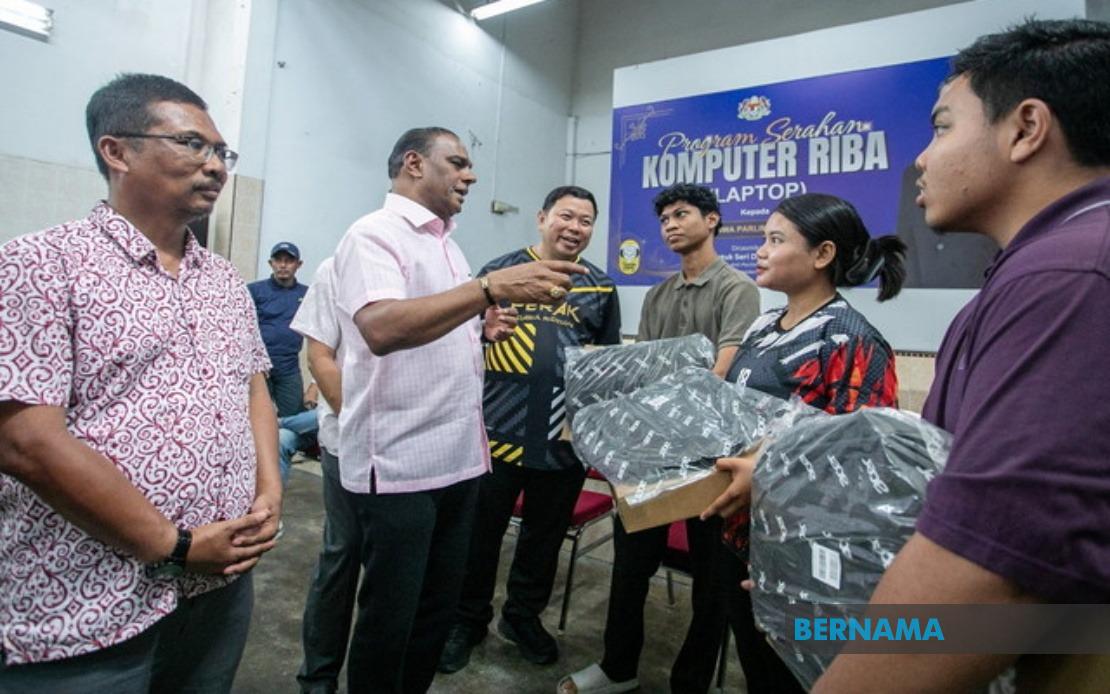
Tapah Member of Parliament Datuk Seri M. Saravanan has distributed laptops to 45 university students from low-income B40 families in the parliamentary constituency, marking another year of a programme that has reached more than 1,000 beneficiaries since beginning in 2008. The initiative, delivered at the Mahatma Gandhi Hall, addresses a fundamental shift in Malaysian higher education where digital tools have transitioned from luxury items to essential learning equipment.
The year's recipients represented a cross-section of different educational pathways and levels of study. Among the 45 students, 30 pursued diploma qualifications, five were enrolled in certificate programmes, four attended matriculation courses, and three pursued full degree qualifications. The remaining three recipients came from SPM, STPM and foundation programme backgrounds respectively, demonstrating the programme's breadth across Malaysia's varied post-secondary education landscape.
Saravanan emphasised that the provision of laptops has become critical for students from disadvantaged backgrounds as educational institutions increasingly embed digital technology into their teaching and assessment methods. Universities across Malaysia now depend heavily on online learning platforms, digital submissions, and virtual collaboration tools, particularly following the widespread adoption of hybrid learning models. For B40 families already stretching limited budgets across essential needs, acquiring computers remains a substantial financial burden that directly impedes academic participation and success.
The selection process for beneficiaries involved rigorous vetting conducted by a dedicated committee that examined each application thoroughly. Assessors consulted with the District Education Office (PPD) and engaged local community leaders to verify eligibility claims and ensure resources reached genuinely disadvantaged households. This structured approach guards against misallocation and maintains community confidence in the fairness of the distribution mechanism.
One notable outcome highlighted by Saravanan concerns the Orang Asli population in Tapah, where educational advancement has accelerated markedly over the past two decades. The constituency has witnessed a growing cohort of indigenous youth successfully completing higher education and establishing themselves in professional fields including medicine, law, and other skilled occupations. This progression represents a significant sociological shift for communities historically marginalised from tertiary education, with improved access to educational infrastructure playing a contributing role in these transformations.
Aidil Iskandar Ramlan, an 18-year-old recipient and former student of SMK Syeikh Abdul Ghani in Bidor, exemplifies the programme's intended beneficiaries. Preparing to commence a Diploma in Public Administration at Universiti Teknologi MARA (UiTM) Raub in Pahang the following month, Aidil recognised that the laptop would prove indispensable for completing coursework and engaging in study-related digital activities. His family context illustrates the economic pressures facing B40 households, with his father employed as a school security guard and his mother occupied as a homemaker, leaving limited disposable income for technology purchases.
For families at this income level, the financial relief provided by the laptop distribution proves transformative. Aidil articulated how the assistance eliminated the necessity for his parents to allocate large sums toward computer equipment, a purchase that would otherwise have diverted limited household resources away from other basic needs. The programme thereby functions not merely as an educational intervention but as a targeted poverty alleviation measure that addresses digital exclusion while simultaneously reducing economic strain on vulnerable households.
Another beneficiary, 19-year-old Ea Endry Iana Aslan, similarly recognised the programme's significance for her family's financial wellbeing. Enrolling in a Diploma in Early Childhood Education at FELCRA College, Ea expressed gratitude for assistance that would have otherwise remained financially inaccessible. For students from B40 backgrounds, the inability to acquire a laptop represents not merely inconvenience but a potential barrier to educational completion, as institutions increasingly assume digital device access when setting assignment submission procedures and course delivery methods.
The continuation of the Tapah Parliamentary Constituency Student Laptop Handover Programme since 2008 reflects a sustained political commitment to narrowing educational inequalities within the constituency. Over sixteen years, the initiative has supported more than 1,000 students, representing cumulative impact that extends beyond individual beneficiaries to create broader social mobility pathways. The programme's longevity demonstrates that addressing digital access requires consistent, long-term investment rather than sporadic interventions.
Malaysia's digital divide remains a persistent challenge, particularly in constituencies with significant lower-income populations and marginalised communities such as Orang Asli settlements. While national broadband expansion and digital literacy initiatives have progressed, hardware acquisition continues to constrain educational participation for B40 families. Parliamentary constituency-level programmes complement national efforts by providing targeted, locally-responsive support that accounts for specific community needs and demographic profiles.
The implications of this initiative extend beyond individual academic success to influence broader patterns of social and economic mobility. Students who complete higher education with necessary technological access translate into a more skilled workforce, increased earning potential, and reduced long-term dependency on social assistance. For Orang Asli communities specifically, improved educational outcomes generate role models and demonstrate viable career pathways to younger generations, challenging historical stereotypes and expanding community aspirations.
As Malaysian higher education institutions continue digitising curricula and assessment methods, ensuring equitable access to essential technology becomes increasingly intertwined with educational equity itself. Programmes targeting B40 students address not peripheral convenience but fundamental access to learning infrastructure. The Tapah initiative, by distributing laptops based on genuine financial need rather than academic merit alone, recognises that educational potential exists across all income levels and that removing technological barriers enables capable students from disadvantaged backgrounds to realise their academic and professional capabilities.

