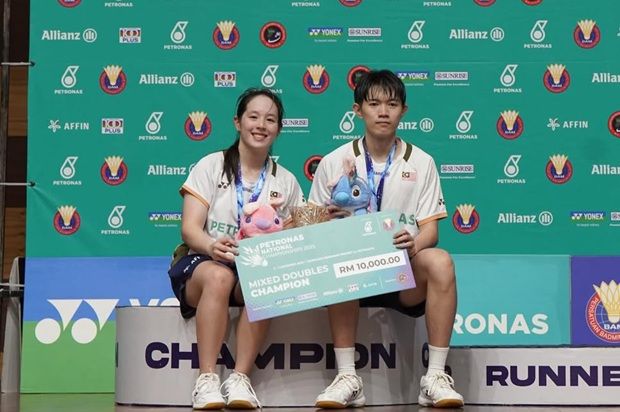
Badminton's Clarissa San faces one of the most significant milestones of her athletic career next week when she steps onto the courts of the Japan Open, one of the world's most prestigious tournaments on the BWF World Tour calendar. The 20-year-old mixed doubles player will make her debut at the event alongside her newly assigned partner, Chen Tang Jie, after the original pairing underwent unexpected restructuring. Her focus remains straightforward: to maintain composure and savour the experience of competing at an elite international stage.
Clarissa's path to the Japan Open took an unexpected turn when her previous partner, Toh Ee Wei, suffered an anterior cruciate ligament injury that has sidelined him from competition. Ee Wei is currently in Melbourne undertaking rehabilitation, leaving his position vacant. This turn of events created an opportunity for Clarissa to team up with Tang Jie, a development that the young shuttler views not as a setback but as a chance to prove herself on a larger platform. The transition from a familiar partnership to one she is still building demonstrates the fluid nature of elite badminton partnerships and the resilience required of players adapting to unexpected changes.
Tang Jie has assumed a dual role in Clarissa's preparation, functioning simultaneously as her on-court partner and a trusted advisor off the court. The 20-year-old has credited both Tang Jie and their mixed doubles head coach Nova Widianto with providing consistent emotional support throughout the lead-up to the tournament. The counsel they offer remains consistent: avoid allowing anxiety to dominate her mindset. Clarissa has reflected on their approach, noting that reminders to stay calm and embrace the competitive environment have become daily occurrences. This psychological scaffolding represents a crucial element of tournament preparation, particularly for players experiencing their first appearance at major international events.
Though naturally eager to perform well, Clarissa has maintained realistic expectations about outcomes. Rather than fixating on results, she has articulated a philosophy centred on translating her training work directly into match situations. She acknowledges substantial areas for improvement and views the Japan Open not merely as a single tournament but as the beginning of an extended period during which she and Tang Jie will develop their partnership chemistry. Their collaboration is expected to extend through three or four additional tournaments beyond Japan, offering multiple opportunities to refine their understanding and tactical approach together.
Clarissa's characterisation of Tang Jie as both mentor and elder brother speaks to the supportive dynamic that has been cultivated within their partnership. Whenever mistakes arise during matches or practice, Tang Jie provides constructive guidance rather than criticism. This approach has created an environment in which Clarissa can develop her capabilities without becoming overwhelmed by pressure. The informal nature of their mentoring relationship, where Tang Jie functions as a brother figure rather than merely a colleague, suggests a personal investment in her growth that extends beyond standard professional obligations.
For their opening contest at the Japan Open, Tang Jie and Clarissa will encounter Taiwan's Yang Po-hsuan and Hu Ling-fang. The matchup presents a significant test immediately, as opening-round opponents at premier tournaments are rarely lacking in quality or experience. Clarissa's strategy remains centred on executing the foundational elements she has refined during training rather than attempting something novel or overly ambitious in the pressure of a major competition. This conservative tactical approach, paired with her emphasis on enjoyment, suggests a healthy maturity in her approach to competitive badminton.
Other Malaysian badminton combinations will also represent the nation at the Japan Open. Jimmy Wong and Cheng Su Yin are scheduled to face Japanese opponents Yuichi Shimogami and Sayaka Hobara in their opening fixture. Independently ranked Goh Soon Huat and Shevon Lai Jemie will challenge American players Chen Zhi Yi and Francesca Corbett, while Wong Tien Ci and Lim Chiew Sien have drawn China's fifth-seeded pairing of Guo Xinwa and Chen Fanghui in what is shaping as their most difficult opening test. Malaysia's representation across multiple pairings underscores the nation's continued depth in mixed doubles competition, even as Clarissa takes her place among the established competitors.
The Japan Open represents a significant escalation in competitive standard compared to tournaments Clarissa may have previously encountered. The concentration of elite international talent at such premier BWF World Tour events creates an environment that tests technical proficiency, mental resilience, and tactical awareness simultaneously. Her entry into this sphere at a relatively young age, with only modest experience at this level, requires both determination and the stabilising influence of partners and coaches who believe in her potential. Tang Jie's investment in Clarissa's success may ultimately prove as valuable as any technical skill she brings to their partnership.
Looking forward, Clarissa's trajectory will depend significantly on how effectively she and Tang Jie can build their partnership across the multiple tournaments scheduled over the coming months. Each competition offers data and experience that refines their understanding of each other's strengths, positioning preferences, and decision-making under pressure. Rather than viewing the Japan Open as a singular test, Clarissa has chosen to frame it as the opening chapter in a developing story. This perspective, combined with her commitment to maintaining emotional equilibrium and her willingness to absorb guidance from both Tang Jie and coach Nova Widianto, positions her to extract maximum value from what promises to be a transformative period in her badminton career.

