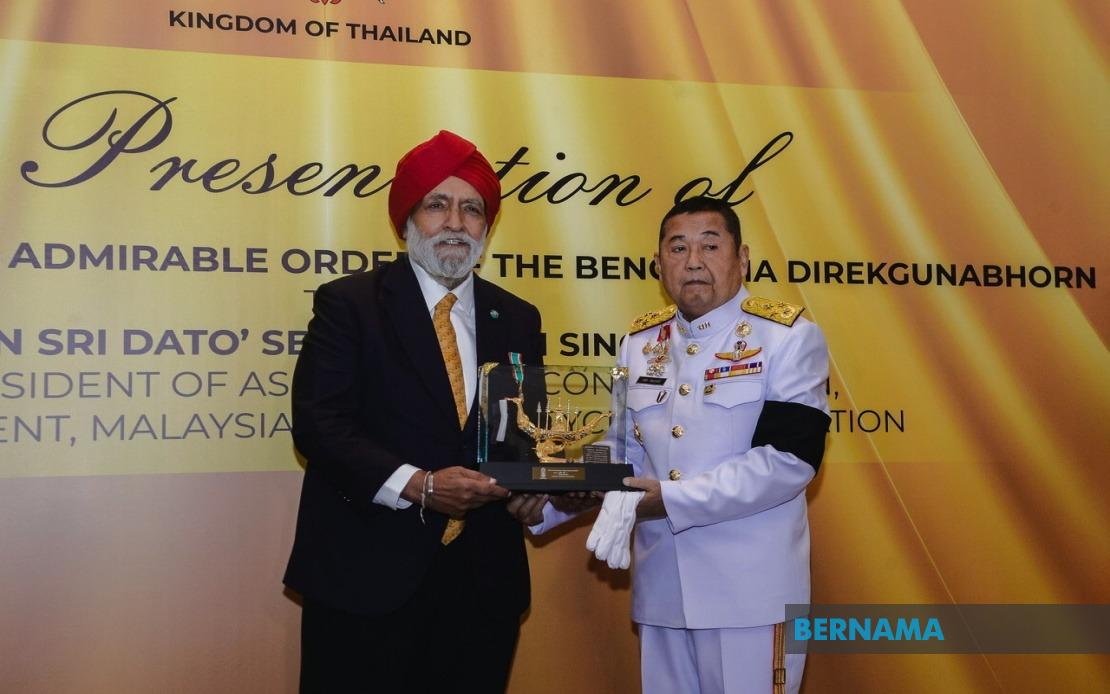
Tan Sri Darshan Singh Gill, a towering figure in Malaysian and Asian cycling administration, has been invested with Thailand's most prestigious honour, the Order of the Direkgunabhorn (Fifth Class - Benjama Direkgunabhorn), in a ceremony held in Kuala Lumpur. The decoration, originally bestowed by the late His Majesty King Bhumibol Adulyadej The Great of Thailand, was presented by General Decha Hemkasri, senior vice-president of the Asian Cycling Confederation, underscoring the deep respect that regional sports bodies hold for Darshan's lifelong contributions to the sport across multiple continents.
The recognition carries particular significance given Darshan's long stewardship of Malaysian cycling institutions. During his tenure as president of the Malaysian National Cycling Federation from 1988 to 1990, he laid groundwork that would eventually establish Malaysia as a competitive force in regional cycling. His subsequent leadership of the Asian Cycling Confederation, which he headed from 1996 to 2005, positioned him as a defining architect of the sport's development across the continent, navigating the complex dynamics of sports governance across diverse Asian nations with varying resources and infrastructure.
Darshan characterised the honour not merely as personal recognition but as validation of Malaysia's journey as a cycling nation. Speaking to reporters immediately after the ceremony, he contextualised the award within the broader trajectory of Malaysian cycling achievement, drawing connections between historical milestones and contemporary success. He referenced the pioneering work of earlier cyclists M. Kumaresan and Rosman Alwi, whose performances had first brought Malaysian cycling onto the international radar during formative decades of the sport's development in the country.
The award ceremony occurred at a moment when Malaysia's cycling renaissance appears particularly vibrant. Just days before the investiture, track cyclist Datuk Mohd Azizulhasni Awang claimed gold in the men's keirin event at the Commonwealth Games in Glasgow, ending a 16-year drought for Malaysian gold medals at the Games in cycling disciplines. Azizulhasni's achievement represents the culmination of years of dedication and investment in specialist track cycling programmes, placing Malaysia among the elite cycling nations capable of producing world-class track athletes who compete successfully against traditional powerhouses.
Darshan drew deliberate parallels between athletic accomplishment and administrative excellence, noting that Malaysia's progress extended beyond the velodrome and road courses. He highlighted the election of Datuk Amarjit Singh Gill, the incumbent Malaysian National Cycling Federation president, to the position of vice-president of the International Cycling Union following the 194th UCI Congress held in Kigali, Rwanda, last year. This development carries immense symbolic weight, as Amarjit became the first Malaysian ever to secure such a senior position within the world governing body of cycling, signifying Malaysia's elevation within global sports governance hierarchies.
The UCI vice-presidency that Amarjit will hold until 2029 represents recognition of Malaysian expertise in sports administration at the highest international level. The position places a Malaysian voice directly within the decision-making structures that shape the sport globally, from rule-making to competition formats and host nation selection. Such representation remains rare for Southeast Asian nations in international sports bodies, making Amarjit's achievement a watershed moment for Malaysian influence in global sporting affairs.
Darshan's perspective encapsulates a holistic understanding of national sporting progress that encompasses both the visible triumphs of medal-winning athletes and the less publicised but equally vital work of administrators who build systems, forge international relationships, and develop governance structures. His own career exemplified this dual contribution, having worked within the administrative infrastructure that enabled subsequent generations of Malaysian cyclists to flourish on international stages. The Thai honour thus recognises not just individual achievement but a philosophy of service to sport that prioritises institutional development and regional cooperation.
For Malaysian readers, Darshan's investiture carries implications extending beyond cycling circles. It demonstrates the international recognition that Malaysian sports leaders can command through sustained, principled service to their disciplines. In an era when Southeast Asian nations compete for influence and soft power through various channels, the successful elevation of Malaysian sports administrators to global positions of responsibility represents a tangible form of diplomatic and cultural influence that complements more traditional state-to-state relations.
The award also underscores Thailand's role as a mature partner in regional sports governance. That the Thai monarchy's honour should be conferred upon a Malaysian sports administrator reflects the cross-border networks of cooperation and mutual respect that bind Southeast Asian cycling communities. Such honours function as signals of esteem that strengthen institutional relationships and enhance the prestige of regional sports bodies, contributing to the broader infrastructure that enables athletes and administrators throughout the region to access international opportunities and recognition.
Looking forward, Darshan's investiture and the contemporaneous achievements of Malaysian cyclists and administrators suggest that the country's cycling sector has transitioned from developing status to established competitive standing. The combination of elite athletes like Azizulhasni winning Commonwealth gold, administrative leaders like Amarjit securing global governance positions, and elder statespersons like Darshan receiving international honours indicates a maturation of the Malaysian cycling ecosystem across multiple dimensions. This ecosystem, built incrementally through decades of institutional work by figures like Darshan, now produces consistent results that place Malaysia among cycling's relevant nations in Asia.

