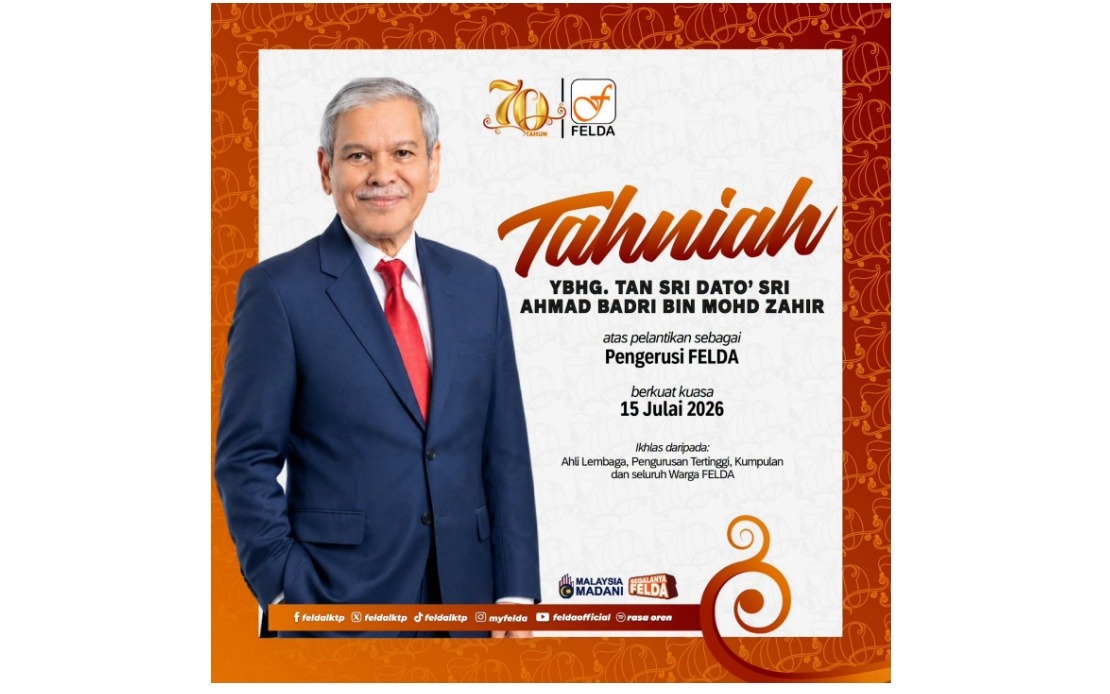
The Federal Land Development Authority (FELDA) has appointed Tan Sri Ahmad Badri Mohd Zahir as its new chairman, a move the government says reflects confidence in his proven ability to lead major strategic organisations. The appointment signals the government's commitment to strengthening governance at the agency while advancing its broader development agenda affecting millions of rural Malaysians.
The decision to elevate Ahmad Badri comes as FELDA faces the challenge of modernising its operations and ensuring sustainable returns for the settler community. With more than three million settlers depending on FELDA's economic performance, the choice of leadership carries significant implications for agricultural development and rural prosperity across the country. Ahmad Badri's appointment underscores the government's determination to inject fresh momentum into the organisation's transformation initiatives.
Ahmad Badri's career trajectory spans more than three decades working within Malaysia's financial establishment and corporate landscape. He joined the Ministry of Finance in 1989, marking the beginning of a steady rise through the public sector that would eventually position him as one of the country's most influential financial administrators. His experience navigating complex fiscal and administrative challenges has equipped him with insights into government operations and economic policymaking.
Perhaps his most high-profile role came when he served as Treasury Secretary-General from 2018 to 2020, a period during which Malaysia navigated significant macroeconomic adjustments and fiscal planning challenges. This position placed him at the centre of government budgeting and financial strategy, providing him direct exposure to the priorities and constraints that shape national economic policy. Such experience proves invaluable when leading an organisation with sprawling operations and settlement obligations.
Beyond his Treasury role, Ahmad Badri has accumulated extensive board experience across Malaysia's financial and strategic institutions. He previously chaired the Employees Provident Fund (EPF), the retirement savings institution that manages contributions for millions of Malaysian workers. His tenure there demonstrated his capacity to oversee vast pools of assets while maintaining institutional credibility and stakeholder confidence. He has also served on the boards of Bank Negara Malaysia (BNM), Permodalan Nasional Berhad (PNB), and Tenaga Nasional Berhad (TNB), positioning him within the highest echelons of Malaysia's institutional leadership.
Currently, Ahmad Badri holds the chairmanship of RHB Bank Bhd and the Malaysian Rubber Board (LGM), roles that keep him engaged with both financial services and agricultural commodity sectors. His presence on the board of Sime Darby Bhd, one of Malaysia's largest multinational corporations operating extensively in palm oil, rubber, and related industries, connects him directly to the commercial realities of plantation and agricultural enterprise. These contemporary responsibilities mean he brings current market knowledge to his new FELDA position.
Educationally, Ahmad Badri holds qualifications that span both technical and management domains. His undergraduate degree in Estate Management from Universiti Teknologi MARA (UiTM) provides grounding in land and property administration, disciplines directly relevant to FELDA's core functions. His Master of Business Administration from the University of Hull in the United Kingdom demonstrates commitment to advanced management education from an international institution, equipping him with contemporary business frameworks and global perspectives.
FELDA's transformation agenda represents one of the significant institutional modernisation projects underway in Malaysia's public sector. The organisation operates across diverse economic activities and must balance multiple competing objectives: delivering returns to settlers, maintaining operational efficiency, adapting to agricultural market changes, and contributing to national economic objectives. Ahmad Badri's mandate explicitly includes strengthening governance structures and enhancing management excellence, reflecting ongoing concerns about institutional effectiveness.
The appointment carries particular significance given FELDA's historical role in Malaysia's rural development strategy. For decades, FELDA schemes formed the backbone of agricultural settlement policy, offering landless rural Malaysians opportunities for economic participation. Today, with settler demographics shifting and agricultural markets evolving, the organisation must adapt while protecting the interests of its existing beneficiary population. Leadership committed to sustainability and inclusive growth becomes crucial in navigating these transitions.
Ahmad Badri's background suggests an institutional operator rather than a visionary disruptor. His career reflects incremental advancement through established channels, suggesting he understands bureaucratic processes and stakeholder management within Malaysia's institutional ecosystem. For FELDA, this may mean continuity in strategic direction combined with refined execution and governance improvements rather than radical operational restructuring. His track record indicates someone comfortable working within system constraints while pursuing efficiency gains.
The appointment also reflects broader patterns in Malaysian institutional leadership whereby individuals with finance ministry backgrounds move into stewardship roles across the government-linked companies and statutory authorities that constitute much of the nation's economic infrastructure. This pattern ensures consistency in government direction and facilitates coordination between public sector bodies. However, it also concentrates power among a relatively small cadre of established administrators, raising questions about institutional diversity and fresh perspectives.
For FELDA's three million settlers and their dependents, Ahmad Badri's appointment represents a significant leadership transition with implications for dividend distributions, service quality, and long-term sustainability of settler incomes. His background in financial management and governance suggests focus on operational efficiency and fiscal prudence. Whether such priorities align perfectly with settler welfare objectives will become apparent as his tenure develops. The coming years will test whether his extensive institutional experience translates effectively to managing FELDA's complex operational, social, and economic challenges.

