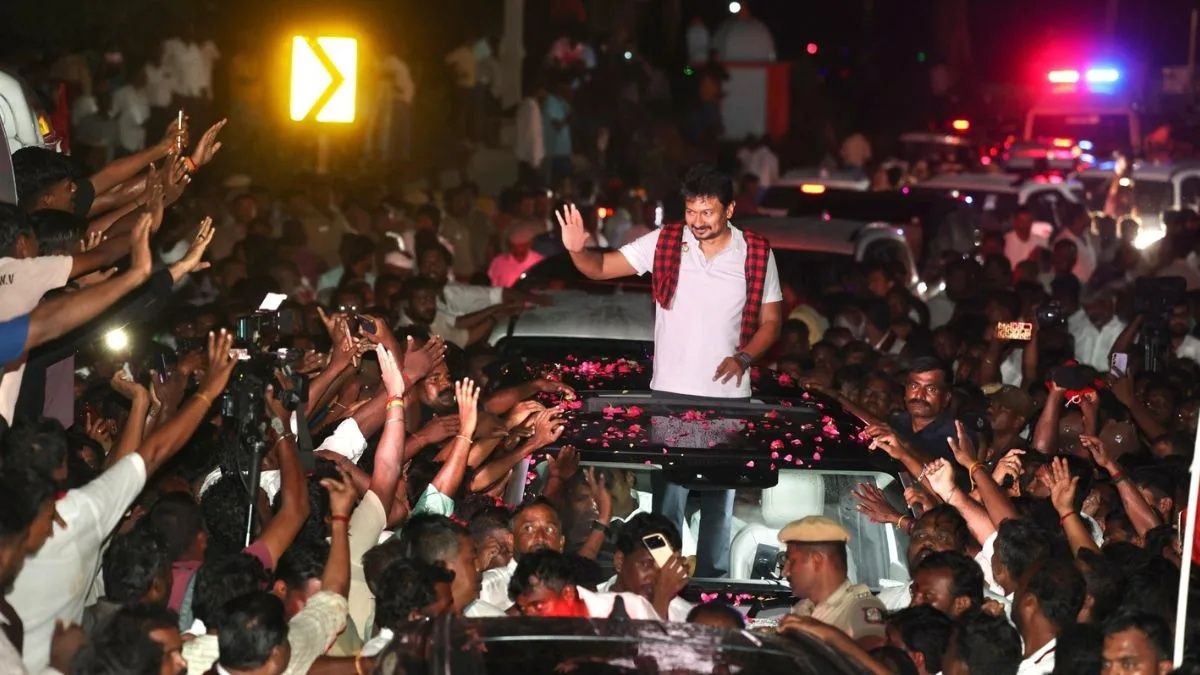
Udhayanidhi Stalin, the Leader of Opposition in Tamil Nadu, walked free on station bail late Tuesday evening following an extended interrogation by police, marking the latest flashpoint in the intensifying political conflict between the DMK and Chief Minister Vijay's TVK government. The former deputy chief minister had been arrested at his Chennai residence earlier in the day in connection with comments he made at a public rally that were alleged to contain sexual innuendo directed at actress Trisha Krishnan, a figure widely believed to maintain close associations with the ruling party leadership.
Thousands of DMK party workers and supporters descended on the Sengipatti police station where Stalin was being held, creating a charged atmosphere outside the facility as party members chanted anti-government slogans and orchestrated a spontaneous reception following his release. The show of party solidarity underscored the deepening political polarisation in the southern state, where tensions between the two competing political camps have escalated significantly since the TVK swept to power in the 2024 elections. The gathering reflected the DMK's determination to frame the arrest as an act of political persecution rather than legitimate law enforcement.
At a hastily organised press conference following his release, Stalin categorically denied any wrongful intent behind his statements, characterising his detention as a calculated diversion tactic by the incumbent administration. He vehemently rejected suggestions that his language carried double meanings, insisting that his words were innocent and solely directed at highlighting the region's water scarcity challenges and the threat posed by Karnataka's Mekedatu dam project. His measured but pointed responses suggested a careful strategy to position himself as a victim of governmental overreach while maintaining the high ground on substantive policy matters affecting rural constituencies.
The controversy originated during a DMK-organised protest gathering in Thanjavur district, where Stalin was delivering remarks critical of the state government's handling of the longstanding Cauvery water dispute with neighbouring Karnataka. While articulating concerns about the proposed Mekedatu hydroelectric project and its implications for Tamil Nadu's agricultural sector, supporters in the crowd began chanting the name of actress Trisha Krishnan, reportedly in reference to her known proximity to the ruling party's senior figures. In response to this interruption, Stalin paused momentarily, smiled, and delivered a statement that would subsequently trigger the political firestorm: "Wherever water comes, whether it comes or not, water should come there."
The statement's ambiguity created immediate space for competing interpretations that proved damaging to Stalin's political standing. While the DMK leader claimed the remark was entirely contextual, addressing the critical need for water distribution across agricultural regions, critics from the ruling TVK faction quickly characterised the comment as containing unmistakable sexual innuendo that amounted to objectification and harassment of a woman. The ruling party's swift and aggressive response reflected both the escalating political hostilities in Tamil Nadu and the sensitive nature of gender-based political discourse in the state.
The TVK government's response moved through multiple channels with striking coordination and speed. Party officials filed formal complaints with law enforcement agencies, simultaneously lodging grievances with the National Commission for Women to amplify the narrative of harassment and misconduct. This multi-pronged approach suggested a deliberate strategy to elevate the matter beyond routine police action into a broader public conversation about political decorum and respect for women in public life. The complaint mechanism itself became a political weapon, weaponising institutional frameworks that ostensibly exist to protect vulnerable citizens.
Stalin's arrest from his residence represented a significant escalation in the tit-for-tat confrontations characterising Tamil Nadu's current political environment. The development underscores how swiftly political disputes in the state can translate into law enforcement actions, raising broader questions about the independence of judicial and police institutions when functioning within contexts of intense partisan conflict. For regional observers monitoring Indian politics, the incident exemplifies the challenges facing democratic institutions when sharp ideological and personal rivalries between competing power centres threaten to instrumentalise law enforcement mechanisms.
The underlying Cauvery water dispute that prompted Stalin's original remarks remains one of South India's most intractable interstate disagreements, with enormous implications for Tamil Nadu's agricultural economy and food security. Karnataka's proposed Mekedatu project has emerged as a particularly contentious flashpoint because it threatens to reduce water flow to downstream Tamil Nadu during critical irrigation seasons. Stalin's criticism on this substantive issue commands genuine political resonance among farmer communities and rural constituencies throughout the state, suggesting that the controversy serves as much as a proxy conflict over serious resource allocation questions as it does a personal dispute involving the actress.
The political calculus surrounding this incident extends beyond immediate partisan advantage to reflect deeper questions about the nature of political competition in Tamil Nadu. The state has historically witnessed intense personal animosities between rival leaders, but the current dispensation appears characterised by unprecedented willingness to weaponise state institutions against political opponents. Stalin's release on station bail rather than continued detention suggests police or judicial recognition that the legal foundations for prolonged custody may be fragile, yet the mere act of arrest accomplishes significant political messaging regardless of ultimate legal outcomes.
For Malaysian observers and those tracking South Asian political developments, the Tamil Nadu situation illustrates how electoral competition at the regional level can rapidly spiral into institutional confrontations with implications for democratic norms. The incident also reflects the particular vulnerabilities of women in political discourse when they become symbols or proxies in masculine political disputes, even when nominally defending their interests. As Tamil Nadu navigates the early years of this new political configuration, the trajectory established through incidents like this one will significantly shape whether institutional independence can be preserved or whether the state's democratic institutions become permanently subordinated to partisan objectives.

