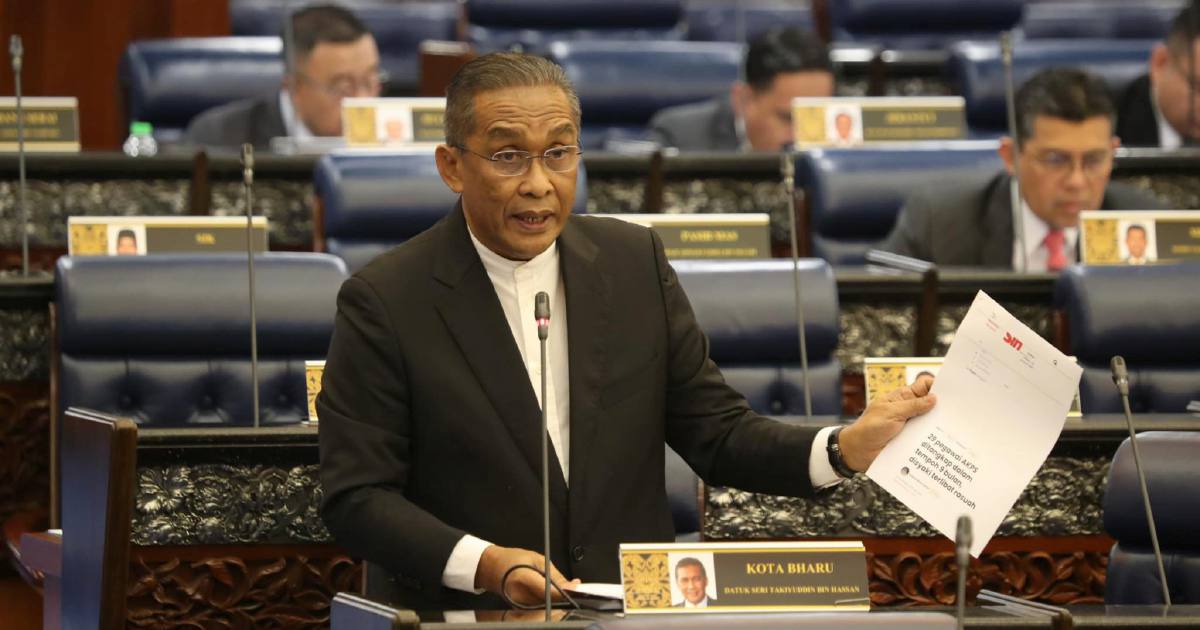
The opposition's parliamentary leadership has moved to stall proceedings on a critical financial institution review, signalling broader political manoeuvring around the contentious Tabung Haji Royal Commission of Inquiry report. Datuk Seri Takiyuddin Hassan, operating in his capacity as chief whip for the opposition benches, made the request to delay the special Dewan Rakyat sitting that would examine the RCI's comprehensive findings into the pilgrimage fund's operations and governance.
Takiyuddin's intervention reflects a calculated political strategy centred on ensuring full parliamentary attendance during what promises to be a substantive and potentially damaging debate. By conditioning the discussion on Prime Minister Datuk Seri Anwar Ibrahim's physical presence in the chamber, the opposition leader appears to be seeking to maximize the political impact of whatever scrutiny the RCI report delivers. The timing of his request underscores the high-stakes nature of the inquiry's conclusions regarding Tabung Haji's management.
Tabung Haji, the state-owned fund administered to facilitate Malaysian Muslims' hajj and umrah pilgrimages, has faced persistent scrutiny over its investment portfolio performance and governance structures in recent years. The establishment of the Royal Commission of Inquiry represented a formal government acknowledgement that the institution required independent examination of its operational framework and fiduciary responsibilities. The RCI's report constitutes the culmination of this formal investigative process.
The opposition's position reveals tension between parliamentary procedures and political theatre. Postponing substantive legislative scrutiny until particular principals are available transforms parliamentary business into a performative exercise where opposition leaders can amplify messaging in the presence of senior government figures. This tactical approach has become increasingly common in Malaysian parliamentary practice, where opposition effectiveness often depends upon leveraging broadcast moments and media attention.
For Malaysian pilgrims and their families, the implications of prolonged parliamentary delay carry practical weight. Many depend upon Tabung Haji's financial management and services for their religious obligations. Any governance failures identified by the RCI require prompt parliamentary acknowledgement and swift remedial action. Extended postponement potentially defers necessary institutional reforms or clarifications about fund management that stakeholders deserve to hear articulated formally in Parliament.
The request also illustrates the opposition's awareness that debate quality improves when government leadership directly engages with criticism. An absent Prime Minister creates an optics problem if the government merely deploys junior ministers to defend the fund's operations. Opposition parliamentarians gain tactical advantage by forcing the government to choose between allowing unfettered criticism without senior governmental response or reconvening Parliament with full attendance.
Anwar Ibrahim's whereabouts or parliamentary absence during this period reflects the fluid nature of contemporary Malaysian governance, where leaders occasionally absent themselves for domestic reasons or international engagements. The opposition's strategic deployment of this temporary absence demonstrates how opposition parties leverage procedural mechanisms to influence the legislative calendar according to their political calculations.
The postponement request carries implications for parliamentary efficiency and institutional credibility. Standing orders establish procedures for conducting parliamentary business, and departure from scheduled sittings—even for legitimate tactical reasons—undermines public confidence in Parliament's effectiveness. Citizens increasingly question whether parliamentary institutions genuinely prioritise substantive scrutiny or primarily serve as venues for political point-scoring.
Regionally, Malaysia's parliamentary dynamics reflect patterns visible across Southeast Asia, where opposition benches employ procedural tactics to counter government advantages in media access and legislative control. The Tabung Haji debate postponement exemplifies how opposition parties exploit temporal and procedural mechanisms to amplify their influence despite numerical disadvantages on legislative floors.
The eventual timing of the Tabung Haji RCI debate will likely depend on broader political calculations extending beyond the immediate parliamentary schedule. If government leadership perceives the RCI report as broadly exonerating current or previous administrations, they may welcome opposition calls for postponement, using the delay to coordinate messaging strategies. Conversely, if the report contains damaging findings about governance failures, the government might resist postponement to limit opposition preparation time.
For institutional investors and Malaysian citizens monitoring Tabung Haji's governance, the postponement debate underscores a troubling reality: parliamentary scrutiny of significant national institutions sometimes defers not to substantive procedural requirements but rather to opposition political convenience. This dynamic raises questions about whether Parliament genuinely functions as an accountability mechanism or primarily as an arena for pre-arranged political contests.
The resolution of Takiyuddin's postponement request will signal whether parliamentary procedure reflects institutional coherence or merely serves as an instrument of partisan advantage. Should the government accommodate the opposition's timing preferences, it suggests both parties recognize mutual benefits in orchestrating parliamentary business according to political theatre rather than democratic necessity. The Tabung Haji RCI debate's eventual timing will therefore carry significance extending well beyond the pilgrimage fund itself, touching upon fundamental questions about Malaysian parliamentary integrity and the opposition's role in institutional accountability.

