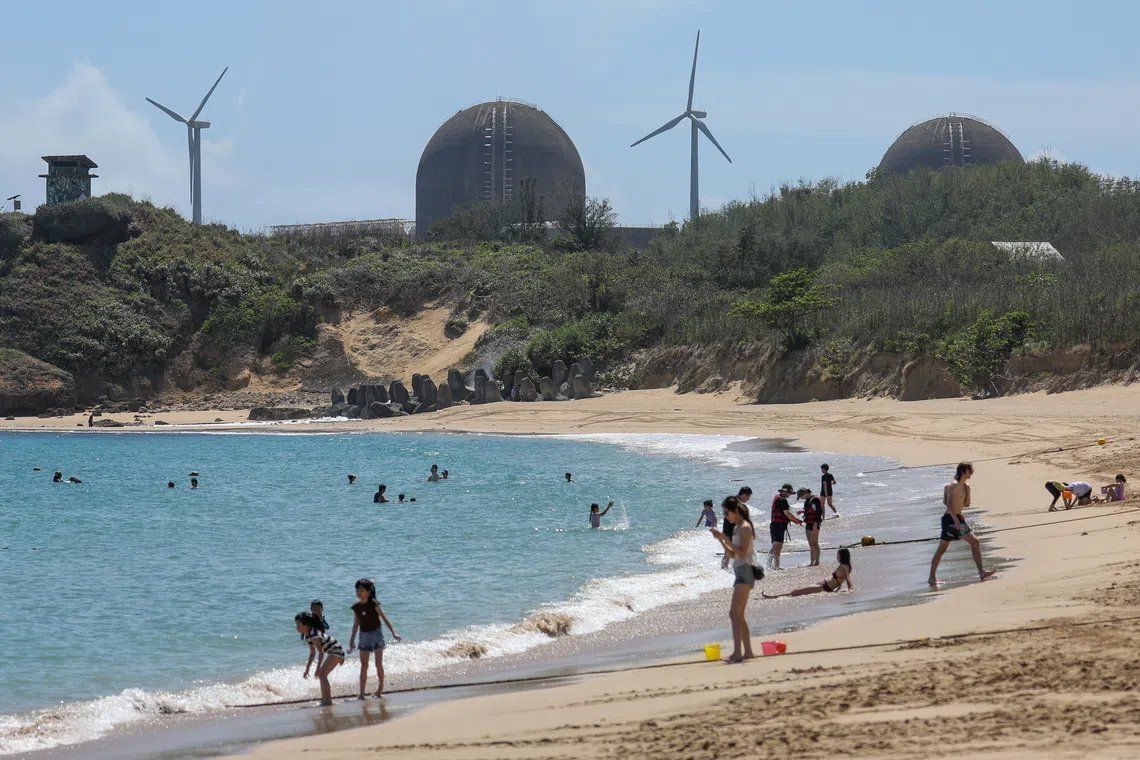
Taiwan faces another referendum on nuclear energy this November, part of a broader pattern that reveals how political parties have increasingly weaponised direct democracy to serve electoral calculations rather than facilitate genuine public deliberation on complex policy questions. The vote comes alongside the island's "nine-in-one" local elections, which will determine 11,051 municipal positions including county magistrates, highlighting a convergence of electoral and policy dynamics that critics say undermines the integrity of both processes.
The nuclear referendum asks voters whether Taiwan should abandon its "Nuclear-Free Homeland" policy to address public health, electricity stability, affordability, national defence resilience, and artificial intelligence industry development. This represents the fourth referendum on Taiwan's nuclear future within just eight years, with the previous vote occurring merely a year ago in August 2025. The frequency itself underscores how referendums have become entangled with electoral strategies rather than reflecting genuinely new circumstances warranting reconsideration of settled policy.
Three referendums were initially submitted to Taiwan's Central Election Commission this year, but only the nuclear proposal gained approval. Authorities rejected a proposal to legalise caning for serious crimes, determining it would violate human rights protections, and similarly blocked a measure directing traffic fine revenue towards road safety improvements and public transport subsidies. The selective approval process illustrates the institutional gatekeeping involved, though experts emphasise that even approved referendums often reflect partisan calculations more than substantive policy needs.
While legitimate arguments exist that global conditions have shifted since last year's vote—including disruptions to oil supplies via the Strait of Hormuz and surging energy demands from artificial intelligence expansion—political scientists and legal experts point to more decisive motivations. The opposition Kuomintang (KMT) and Taiwan People's Party appear to recognise that conservative-leaning voters respond strongly to issues like crime and energy policy, and that scheduling referendums with local elections could substantially boost turnout among their core supporters in ways that benefit close electoral races. Historical precedent supports this calculation; the 2018 local elections featured ten concurrent national referendums, after which the KMT achieved notably strong results.
Qi Dongtao, a senior research fellow at the East Asian Institute at the National University of Singapore, emphasises that the electoral logic behind these referendums equals or possibly exceeds any policy substance. "This electoral consideration is probably at least as important as the policy substance of the referendums themselves," Qi observed, noting that KMT politicians have explicitly discussed the caning referendum in terms of voter mobilisation potential. The opposition additionally seeks to establish political narratives around which they can consolidate support; by proposing tough-on-crime and energy-security measures, KMT politicians can position themselves as bold reformers constrained by the ruling Democratic Progressive Party and Taiwan's existing legal framework, a framing that resonates particularly with voters who view Singapore as exemplifying law-and-order governance.
Taiwan's referendum landscape underwent dramatic transformation in 2017 when parliamentary reforms substantially lowered procedural barriers. Previously, referendums required at least 50 percent turnout to achieve validity, a threshold that proved insurmountable even when voters overwhelmingly supported measures, as demonstrated by former president Chen Shui-bian's 2004 cross-strait referendums. Current rules permit a referendum to pass when "Yes" votes exceed "No" votes and valid affirmative ballots reach merely 25 percent of the total electorate. This dramatic lowering has incentivised frequent referendum deployment, with the volume increasing sharply in subsequent years as political parties recognised the tactic's utility for electoral mobilisation.
Lin Jia-he, an associate professor at National Chengchi University's College of Law, raises profound concerns about the compression of the deliberative timeline. The 2026 nuclear referendum was announced on August 28 and will proceed to voting on November 28—a mere three-month window. He contrasts this with Switzerland's model, where referendums typically require three to five years from proposal to vote, permitting adequate time for government agencies and citizens to genuinely "deliberate and understand" before rendering judgment. Voters simply lack sufficient opportunity to grapple with the "rigorous, complex and diverse" elements of energy policy and optimal energy combinations when campaigns span only months.
The broader concern, articulated by Qi, centres on referendums' transformation from instruments of direct democracy into auxiliary battlegrounds for partisan competition. When political parties deliberately propose contentious issues specifically to generate publicity and mobilise supporters, referendums cease functioning as mechanisms for seeking legitimacy on genuinely consequential questions requiring popular authorisation. They instead become routine weapons in electoral arsenals, deployed strategically rather than judiciously. This degradation of the referendum mechanism undermines its legitimacy as a democratic tool and risks popular cynicism about the entire practice.
Evidence of this cynicism already surfaces among voters themselves. Sean Chang, a 39-year-old public relations professional from Taipei, participated in the 2018 local elections when ten concurrent referendums were held. He initially appreciated referendums' democratic intent but concluded they had become "a tool for each political party to manipulate public opinion." The constant exposure to competing referendum narratives exhausted his engagement; rather than energising his political participation, the multiplicity of simultaneous votes prompted withdrawal and inattention. His experience reflects a broader risk: that over-reliance on referendums as electoral tactics could ultimately erode public faith in direct democratic mechanisms while simultaneously poisoning local electoral campaigns with national-level partisan acrimony.
For Malaysia and the broader Southeast Asian region, Taiwan's referendum experience offers instructive cautionary lessons about institutional design and electoral integrity. As regional democracies contemplate mechanisms for deepening public participation in policymaking, the Taiwanese experience demonstrates how procedurally accessible mechanisms can become corrupted when political incentives favour partisan deployment over substantive deliberation. The convergence of referendums with electoral cycles, while superficially efficient, creates perverse incentives that subordinate policy judgment to electoral calculation and compress deliberative timeframes below what complex issues demand.
The November elections will reveal whether Taiwan's electorate punishes or rewards the opposition's referendum strategy. Regardless of electoral outcomes, however, experts suggest that the island's legislative process requires fundamental recalibration to restore referendums to their intended function—authorising major policy decisions that command genuine popular consensus—rather than permitting their routine deployment as weapons in ongoing partisan struggles. Without institutional reform, Taiwan risks transforming direct democracy from a check on representative bodies into another arena where partisan advantage trumps substantive deliberation, a transformation that diminishes democratic quality despite expanding formal opportunities for voter participation.

