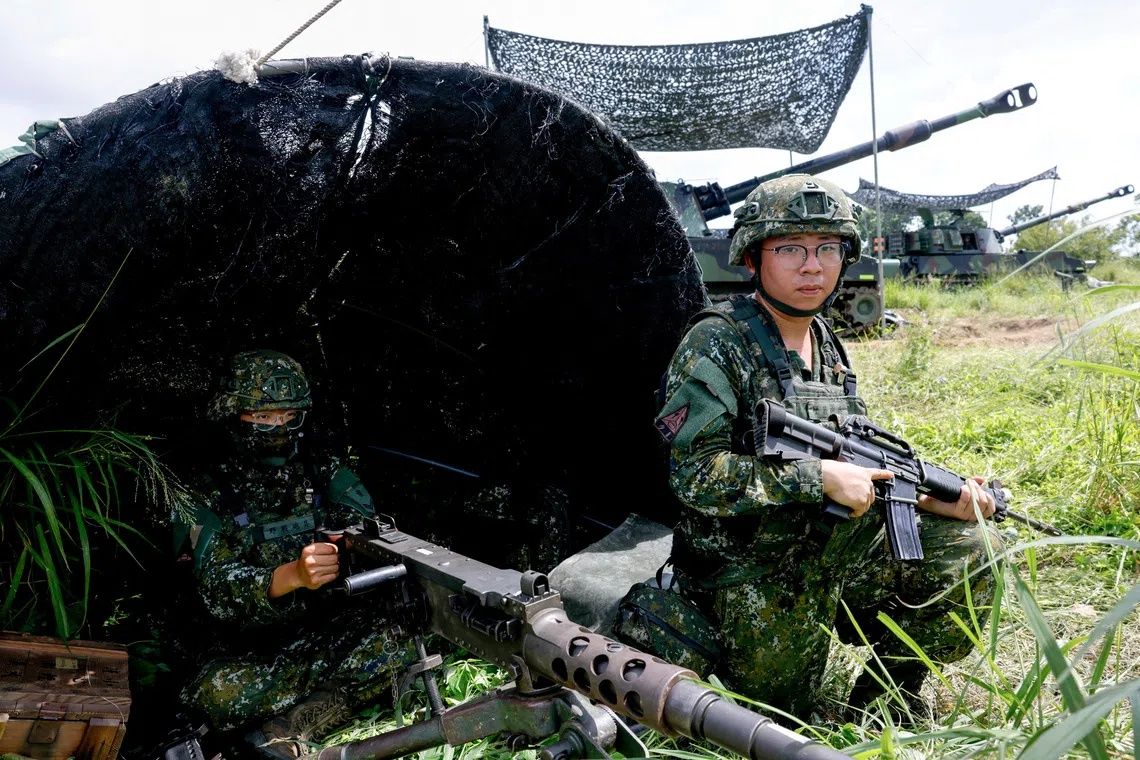
Taiwan's defence establishment has commenced a 10-day military exercise designed to push military commanders beyond textbook responses into the unpredictability of actual warfare. The Han Kuang drills, which began on August 5, represent a significant shift toward more challenging and realistic training conditions, moving away from what defence officials have characterised as overly controlled laboratory-style simulations. The exercises involve more than 20,000 troops, including approximately 5,000 reservists, and will run through August 14, with an underground command centre in Taipei overseeing operations that include fighter jet repositioning and emergency naval deployments across the Taiwan Strait region.
A notable innovation this year involves Taiwan's first deliberate limitation of mobile internet speeds during the drills, simulating conditions that might result from a large-scale military attack. This represents a significant step toward understanding how civilian populations and critical infrastructure would function if communications networks were degraded or partially destroyed. By incorporating this constraint, Taiwan's military planners aim to identify vulnerabilities in how government coordination, emergency services, and essential services relay information during crisis conditions. The internet slowdown testing reflects growing recognition that modern conflicts involve not just military targets but the degradation of civilian connectivity and services that modern societies depend upon.
The exercises also introduce a command protocol modelled after United States military practices, specifically the "backbrief" method, where junior officers receiving orders must restate mission objectives back to their commanding officers before executing tasks. This seemingly simple procedural change addresses a fundamental challenge in military operations: ensuring that strategic intent flows accurately through multiple layers of command hierarchy. Officials involved in planning the drills emphasise that this approach is essential for maintaining synchronisation between senior commanders making strategic decisions and field officers executing those decisions under chaotic conditions. The risk of miscommunication in high-stress wartime situations has historically contributed to operational failures, and Taiwan's adoption of this verification mechanism signals an attempt to institutionalise clearer communication protocols.
Central to Taiwan's training philosophy this year is deliberate exposure of commanders to scenarios that deviate from anticipated enemy behaviour patterns. Rather than executing predetermined responses to expected Chinese military moves, field commanders will face "unexpected scenarios" requiring them to reassess situations rapidly, adjust strategies, and issue new orders under time pressure. This approach acknowledges that actual military campaigns rarely unfold according to pre-written playbooks. The emphasis on adaptive decision-making reflects lessons from historical military operations and recent conflicts where forces that maintained inflexibility suffered significant disadvantages. By training commanders to think dynamically rather than reactively follow predetermined scripts, Taiwan aims to develop a military leadership capable of improvising within established strategic parameters.
Taiwan's defence planners have identified China's potential early targeting of command centres, ports, logistics facilities, and defence manufacturing sites as a critical vulnerability requiring urgent attention. The premise underlying this concern is that a large-scale military campaign against Taiwan would likely begin with strikes intended to decapitate command structures and disrupt supply chains before conventional military engagements commence. Understanding how Taiwan's military and civilian infrastructure would function when these key nodes are compromised or destroyed represents an essential dimension of realistic war planning. The drills will include simulating the wartime relocation of a major arsenal and mobilising civilian factories to maintain production capacity under attack conditions, essentially rehearsing how Taiwan would sustain extended military operations despite initial damage to key facilities.
The exercises extend beyond purely military dimensions to encompass civilian preparedness and broader societal resilience. Taiwan has been conducting separate resilience drills testing how local government officials would maintain administrative continuity during cascading crises ranging from natural disasters to military invasion. This integrated approach reflects understanding that modern warfare affects entire populations, not just military personnel and installations. By training civilian administrators, emergency services personnel, and local officials to function effectively during wartime conditions, Taiwan is building institutional capacity for societal persistence under sustained pressure. The defence official's observation that "the emphasis will be on how our entire population, the Republic of China as a whole—especially our citizens—should face war" underscores this comprehensive approach to national preparedness.
Taiwan's introduction of an "embedded reporter" mechanism within the drills demonstrates recognition that information management and counter-disinformation efforts constitute essential wartime functions. Modern military campaigns invariably involve information warfare, with hostile actors attempting to spread confusion, demoralise populations, and undermine public confidence in leadership. By incorporating frontline news release protocols and disinformation-countering strategies directly into military exercises, Taiwan is treating information management as integral to military operations rather than a secondary administrative function. The ability to rapidly release accurate information while countering enemy narrative claims could significantly influence both military effectiveness and civilian morale during actual conflict.
The deliberate intensification of Han Kuang exercises reflects Taiwan's assessment of evolving military threats in the Taiwan Strait and broader Indo-Pacific region. Chinese military activities have become increasingly sophisticated and assertive, with regular incursions into Taiwan's air defence identification zone and naval exercises demonstrating capabilities for potentially severing Taiwan's Pacific supply lines. Taiwan's defence establishment appears to be responding by ensuring that its military can operate effectively under conditions of genuine Chinese military pressure rather than theoretical scenarios. The shift from "laboratory-like" exercises in "a vacuum" toward training in "real field environment, facing real bottom-line conditions" suggests recognition that peacetime training disconnected from actual threat circumstances provides insufficient preparation.
The historical context of Han Kuang drills, which have been conducted annually since 1984, demonstrates Taiwan's sustained commitment to military readiness across decades of changing geopolitical circumstances. However, the specific modifications introduced this year—internet restrictions, adaptive command protocols, realistic command centre disruption scenarios, and information warfare components—indicate that Taiwan's defence planners perceive the current threat environment as significantly more challenging than recent historical periods. For regional observers and defence analysts across Southeast Asia, Taiwan's evolving military exercise protocols provide insight into how a technologically advanced but numerically smaller military adapts to threats from a much larger neighbour with expanding military capabilities.
The implications for broader regional security extend beyond Taiwan itself, as the island's military preparedness affects stability calculations throughout the Indo-Pacific. Nations across Southeast Asia, including Malaysia, have interests in maintaining the status quo in the Taiwan Strait and preserving freedom of navigation through these economically vital waters. Taiwan's demonstrated commitment to realistic military preparedness may provide reassurance regarding its ability to maintain security without requiring external military intervention, though it also underscores the serious military challenges that the island confronts. The exercises implicitly communicate that Taiwan is investing substantially in making its forces more capable of independent defence, a message with significance for regional powers considering their own strategic positions and alliance relationships.
Defence officials' characterisation of the 2024 Han Kuang drills as representing a qualitative departure from previous exercises suggests that Taiwan's military leadership has concluded that incremental improvements in existing training approaches are insufficient given current threat trajectories. The emphasis on unexpected scenarios, adaptive command decision-making, civilian resilience, infrastructure continuity, and information management indicates a military establishment preparing for prolonged, complex warfare rather than assuming that quick decisive operations would determine outcomes. This orientation likely reflects strategic assessments that any military conflict involving Taiwan would involve sustained operations across multiple domains, with civilian populations experiencing direct effects of military action. Taiwan's willingness to limit internet speeds for civilians during military drills and incorporate realistic command centre disruption scenarios demonstrates an unflinching assessment of what potential conflict might entail and a commitment to preparing populations for worst-case scenarios rather than maintaining comforting assumptions about rapid conflict resolution.

