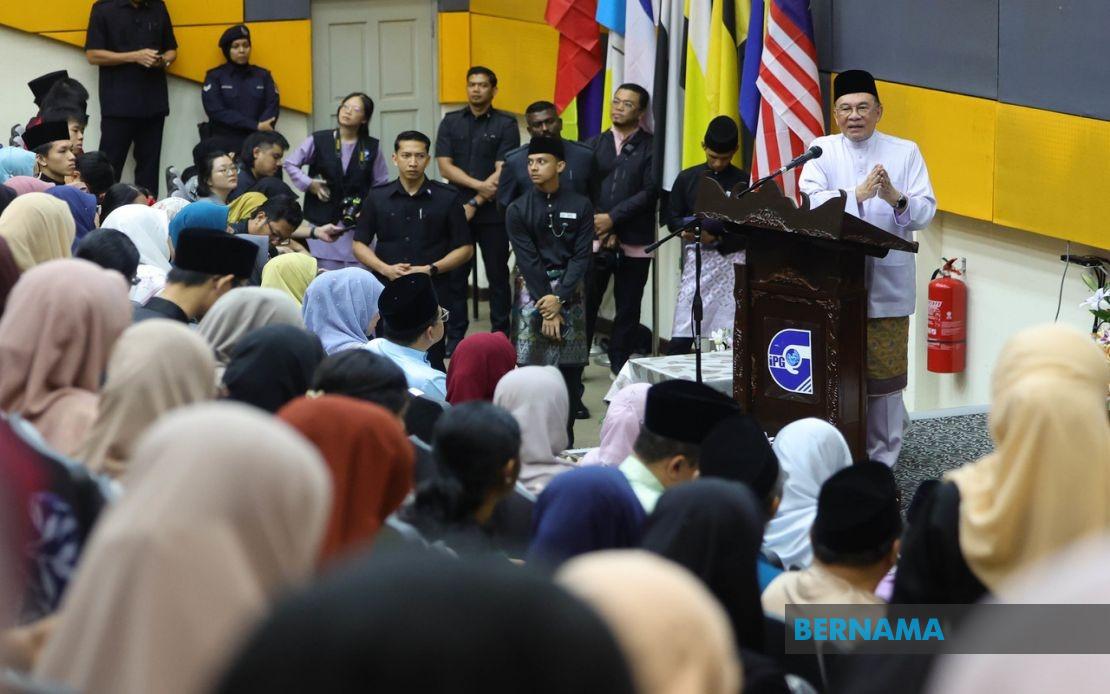
Prime Minister Datuk Seri Anwar Ibrahim has pinpointed the unwillingness of powerful constituencies to relinquish corrupt practices as the most significant barrier confronting his government's reform programme, overshadowing any deficiencies in technological capacity or professional competence. Speaking during a visit to the Technical Education Campus of the Institute of Teacher Education in Bandar Enstek, Anwar elaborated that his tenure spanning more than three years has exposed a troubling pattern: those benefiting from the status quo actively obstruct initiatives designed to strengthen institutional integrity and accountability.
The Prime Minister characterised the challenge as fundamentally cultural rather than logistical. Systemic corruption and administrative inefficiency, he suggested, have become so normalised within Malaysian governance structures that reform efforts automatically provoke defensiveness from quarters comfortable with existing arrangements. This observation carries particular weight given Malaysia's ongoing struggle with perception indices related to institutional transparency, where entrenched practises have historically insulated certain power structures from scrutiny.
Anwar's remarks underscored a paradox within Malaysia's modernisation trajectory. Despite the nation's technological advancement and the presence of sophisticated expertise across government institutions, the genuine obstacles to meaningful reform operate at the behavioural and institutional culture level. The Prime Minister implied that resistance comes not from those lacking modern credentials but from individuals who maintain contemporary appearances whilst refusing substantive shifts in how institutions function.
The PM acknowledged that governance strengthening and anti-corruption campaigns inherently generate opposition because they fundamentally challenge established hierarchies and the privileges accumulated through years of operating within systems lacking robust checks. This dynamic proves particularly acute in administrative circles where informal networks and customary practices have long superseded formal accountability mechanisms. For Malaysian observers, this diagnosis suggests that technical solutions—new systems, revised procedures, enhanced monitoring—address only surface manifestations of deeper institutional dysfunction.
Anwar's comments at the educator-training facility carried implicit reference to the generational dimension of reform. By engaging with teaching professionals and students, the PM appeared to signal that sustainable transformation requires cultivating younger cohorts with reformed institutional values before they become acculturated into existing practises. This reflects recognition that top-down anti-corruption initiatives face inevitable friction when climbing established hierarchies.
The government's determination to persist with unpopular measures despite resistance reveals the philosophical foundation underpinning Anwar's reform conception. He positioned system improvement not as discretionary but as a religious, cultural and civilisational imperative. This framing elevates anti-corruption efforts beyond partisan politics or administrative convenience into fundamental national obligation, potentially justifying contentious policy decisions that alienate powerful constituencies.
For Southeast Asian governments similarly grappling with institutional reform, Anwar's analysis offers cautionary insight. The presence of technological sophistication and technical expertise proves insufficient without corresponding shifts in institutional culture and individual willingness to abandon entrenched advantages. Malaysia's experience suggests that reform momentum depends less on implementing new frameworks than on neutralising opposition from those whose positions depend upon maintaining opacity and accountability deficits.
The Prime Minister's characterisation of resistance emanating from the elite underscores how corruption and institutional weakness become self-perpetuating. Those who have prospered within non-transparent systems naturally defend their preservation, leveraging their positions to slow or redirect reform initiatives. This structural reality confronting Malaysian policymakers mirrors challenges observed across developing democracies attempting systemic renewal whilst managing elite opposition.
Anwar's insistence that governance improvement must continue regardless of unpopularity signals determination to push through institutional resistance, though meaningful evaluation of progress remains contested. His framing positions reform opponents as defenders of an outdated status quo, rhetorically delegitimising obstruction whilst simultaneously acknowledging its persistence as the genuine constraint on Malaysia's administrative modernisation. For regional observers and Malaysian stakeholders, this represents both candid institutional diagnosis and implicit acknowledgment that transforming entrenched systems requires protracted effort extending well beyond technical or expertise considerations.

