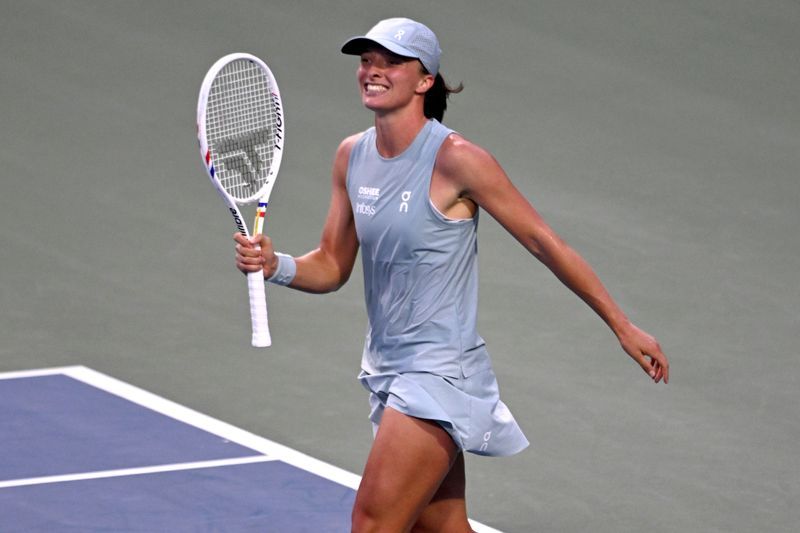
Iga Swiatek delivered a commanding performance to dispatch Diana Shnaider 6-2 6-1 and book her place in the semi-finals of the Canadian Open in Toronto on Monday, offering encouragement that the Polish former world number one is finding form at a critical juncture in the professional calendar. The match lasted just 68 minutes, with Swiatek demonstrating the aggressive baseline play and court movement that has defined her peak performances, overcoming her Russian opponent with apparent ease to reach her first WTA 1000 semi-final of the season.
Swiatek's imperious display came at a strategically important moment in her season. The final Grand Slam tournament of the year awaits at Flushing Meadows, where the 23-year-old Pole holds a championship title from her breakthrough 2022 triumph. For much of this year, however, Swiatek has struggled to deliver the consistency expected of a multiple Grand Slam champion, making Monday's comprehensive victory against Shnaider particularly welcome as a potential turning point.
The opening set demonstrated the full range of Swiatek's capabilities. She manufactured two service breaks early in the contest, capitalising on a succession of unforced errors from Shnaider, who accumulated 12 mistakes in that frame alone. Swiatek's own ball-striking was crisp and assured, while her defensive positioning and lateral movement kept her opponent pinned deep in the court. The set concluded when Swiatek moved to 5-2 before closing it out at 6-2 following further defensive lapses from her opponent.
The second set offered no respite to Shnaider, who found herself unable to generate the rhythm or pressure needed to trouble the seventh-seeded Swiatek. Playing with visible confidence, the Polish player seized control from the baseline and dictated rallies with increasing authority as the match progressed. Remarkably, Swiatek faced not a single break point during the entire set, a testament to the solidity of her serving and her capacity to protect her advantage once established.
Swiatek extended her command with a second break for a 5-1 lead, executing a sharply angled crosscourt winner that caught the line—the kind of precise stroke execution that underscores her capability at the highest level. The match concluded when Shnaider's forehand sailed long on match point, ending a one-sided encounter that will have provided considerable relief to the Swiatek camp.
Yet the context surrounding this victory cannot be overlooked. The season has been genuinely troubled for Swiatek despite her ranking and pedigree. She failed to progress beyond the quarter-final stage at any Grand Slam tournament through to this point, a significant underperformance by her own standards. A shock second-round elimination by compatriot Magda Linette at Miami in straight sets represented a particularly deflating moment. Further disappointment came at Wimbledon, where she arrived as defending champion only to exit in the third round when defeated by Alexandra Eala, another straight-sets defeat that raised questions about her mental and physical resilience.
Those struggles proved decisive in prompting a significant change to her team structure. Swiatek and her coaching staff opted to end their collaboration with long-time coach Wim Fissette, replacing him with Francisco Roig. The Spanish coach brings different expertise and potentially a fresh perspective to address the tactical and psychological issues that have dogged the Pole's campaign. The improved display in Toronto suggests the coaching adjustment may already be bearing fruit, though a single strong performance at one tournament carries limited predictive value.
Swiatek's path to the Canadian Open title will pass through the semi-finals, where she faces either Ekaterina Alexandrova of Russia or ninth-seeded Elina Svitolina of Ukraine, who were scheduled to face each other later on Monday. Svitolina enters with the higher seeding and has shown consistent form throughout the season, while Alexandrova presents a different stylistic challenge. Regardless of her opponent, Swiatek will approach the semi-final contest buoyed by the confidence derived from such a dominant quarter-final performance.
The broader significance of Swiatek's resurgence will only become apparent in the coming weeks, particularly at the US Open. The tournament holds special resonance for her—it marks her sole Grand Slam title to date and represents the last major championship of the calendar year. If she can build on Monday's momentum and progress through the early rounds in New York without suffering the mid-match collapses that have characterised her season, she possesses sufficient talent and experience to mount a serious title challenge. For Malaysian and Southeast Asian tennis followers, Swiatek's trajectory offers instructive lessons about the capacity of elite athletes to overcome form fluctuations through tactical adjustment and renewed coaching perspectives, a theme resonant beyond the tennis court.

