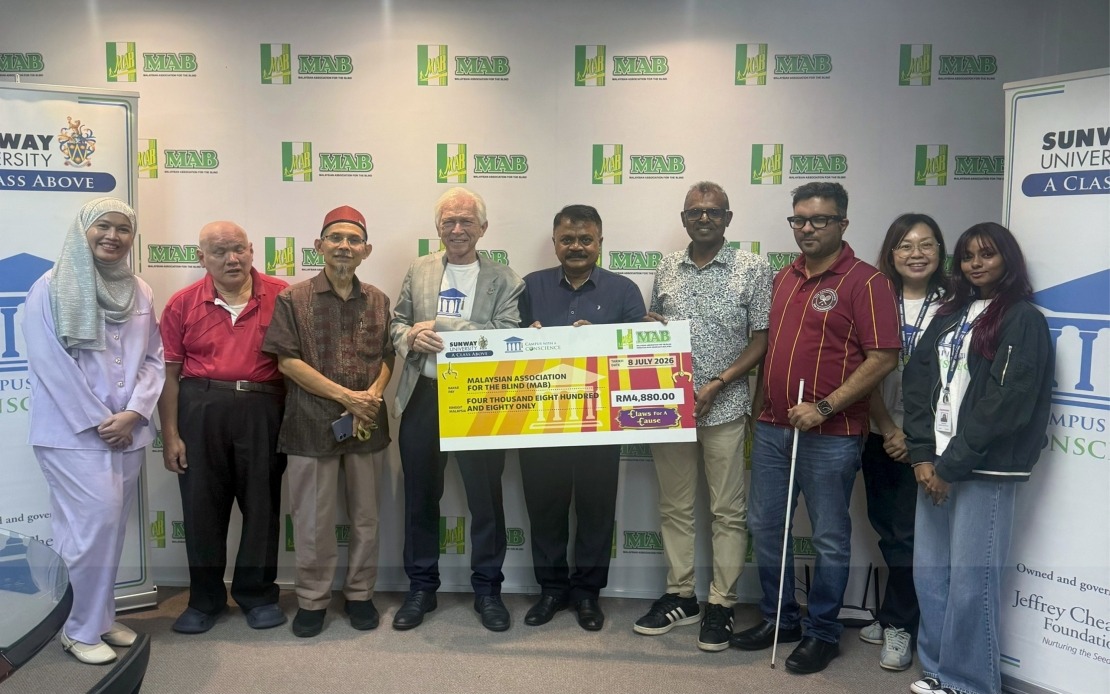
Sunway University has successfully channelled RM4,880 to the Malaysian Association for the Blind following a week-long campus fundraising drive conducted in partnership with entertainment company Space Panda. The "Claws For A Cause" initiative, run under the university's Campus With A Conscience programme, converted a recreational claw machine game into a vehicle for charitable giving, engaging both students and staff members across the institution.
The campaign represents a growing trend among Malaysian educational institutions to integrate social responsibility into campus activities. Rather than relying solely on traditional donation mechanisms, Sunway University leveraged an entertainment-based approach that encouraged broad participation and generated awareness about visual impairment causes. This model reflects how universities are increasingly seeking creative methods to foster philanthropic engagement among younger demographics who may respond more readily to interactive experiences than conventional fundraising appeals.
The Malaysian Association for the Blind, which provides crucial support services and advocacy for individuals with vision loss across the country, benefits from such campus initiatives at a time when funding for disability-focused organisations remains constrained. In Malaysia's competitive nonprofit landscape, where charitable organisations compete for limited donor attention and resources, partnerships with major educational institutions provide meaningful revenue streams and heightened visibility.
Professor Sibrandes Poppema, Sunway University's President and Vice-Chancellor, framed the initiative as an expression of the institution's broader mission beyond traditional academic delivery. He emphasised that contemporary universities, particularly those identifying as "mission-driven" entities, bear responsibility for generating positive societal outcomes through education, research, innovation, and community involvement. This positioning reflects an international shift in higher education philosophy, where institutions increasingly market their social contribution as integral to their institutional identity and value proposition.
The partnership dimension underscores an important dynamic in Malaysian philanthropy: the collaborative model between private sector entities and educational institutions. Space Panda's involvement demonstrates how entertainment and leisure companies can integrate corporate social responsibility into their business operations in ways that align with their existing service offerings. Rather than implementing disconnected corporate giving programmes, Space Panda embedded social purpose directly into its core entertainment offering, creating mutual benefit for brand reputation whilst advancing charitable objectives.
Spoke representative Marcus from Space Panda articulated the company's philosophical commitment to incremental compassion, noting that even modest contributions accumulate into meaningful assistance. This framing carries particular resonance in Southeast Asian contexts, where individual economic constraints often mean that collective small-scale giving becomes the primary mechanism through which community support materialises. The messaging also reflects broader corporate social consciousness, particularly among younger companies seeking to differentiate themselves through ethical positioning.
The initiative illuminates how campus environments function as incubators for social engagement. Universities hosting diverse student populations, spanning various socioeconomic backgrounds and geographic origins, create natural settings for consciousness-raising around social issues. Sunway University's integration of the fundraiser into its Campus With A Conscience programme suggests that such activities form part of a structured approach to embedding civic awareness into the student experience, rather than treating charitable engagement as peripheral activity.
For the broader Malaysian nonprofit sector, such collaborations offer strategic lessons about diversifying funding sources and engaging institutional partners. The Malaysian Association for the Blind and similar organisations supporting marginalised populations depend on sustained resource flows to maintain service delivery. Campus partnerships, even when yielding relatively modest sums like RM4,880, contribute to operational sustainability while simultaneously raising awareness about disability-related issues among student populations who may influence policy directions in future professional careers.
The campaign also reflects evolving consumer behaviour patterns in Malaysia, particularly among younger demographics increasingly motivated by purpose-driven commerce and experiences. Interactive fundraising approaches that entertainment value alongside charitable contribution appeal to individuals who view giving as integrated into leisure rather than as separate obligation. This represents a significant departure from traditional formal donation mechanisms and suggests how organisations can innovate engagement strategies to align with contemporary preferences.
Looking forward, the Sunway University-Space Panda collaboration potentially establishes a replicable model for other educational and commercial entities. Success in raising meaningful funds through entertainment-based fundraising may encourage broader adoption of similar approaches across Malaysian campuses and corporate environments. The partnership demonstrates that social impact need not depend on specialised fundraising expertise or elaborate infrastructure—sometimes simple creativity applied to existing commercial offerings proves most effective.

