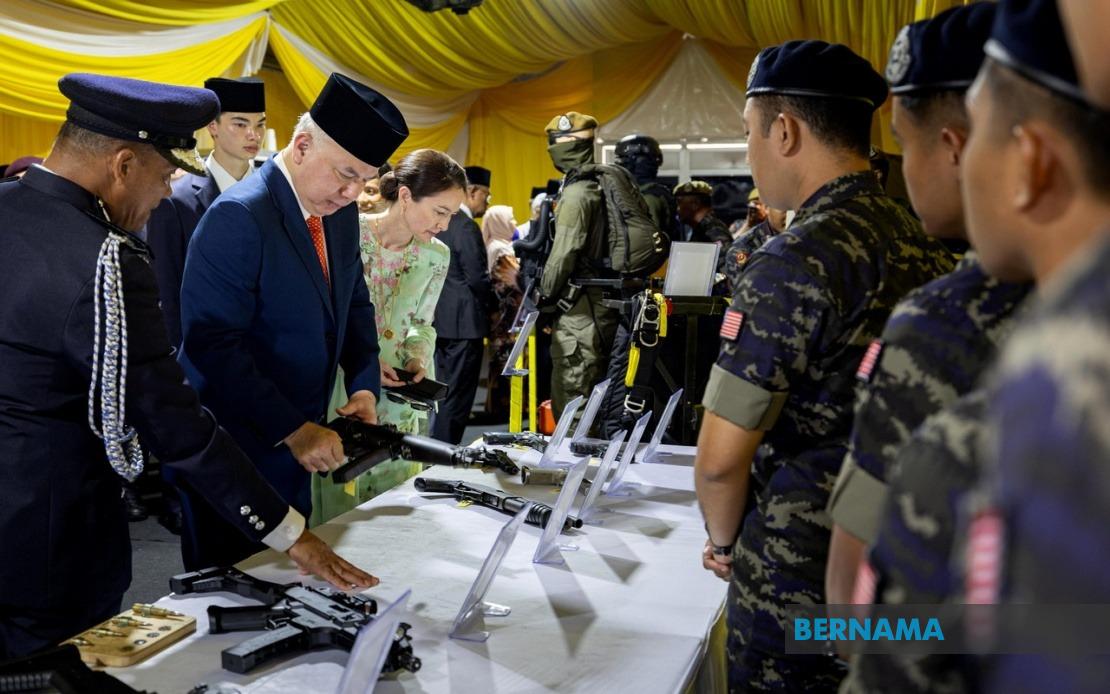
The Sultan of Perak, Sultan Nazrin Shah, formally commissioned the Sultan Nazrin Shah 69 Commando Camp in Ulu Kinta during a ceremony in Ipoh on July 7, honouring the completion of a major security infrastructure project valued at more than RM206 million. The event drew prominent members of the royal household, including Tuanku Zara Salim, Raja Jaafar Raja Muda Musa, and Raja Iskandar Dzurkarnain Sultan Idris Shah, alongside senior government officials and law enforcement leadership. The gathering underscored the symbolic importance of the facility as a landmark investment in Malaysia's counter-terrorism and elite police capabilities.
Home Minister Datuk Seri Saifuddin Nasution Ismail framed the facility's opening as a tangible demonstration of the MADANI Government's dedication to modernizing and strengthening the nation's security apparatus. According to the minister, the camp represents far more than mere infrastructure—it embodies a strategic commitment to equipping Malaysia's security forces with world-class facilities and training environments capable of addressing the increasingly sophisticated threats facing the region. The minister emphasized that such investments reflect the government's recognition that maintaining national peace and sovereignty requires continuous institutional evolution and resource allocation to front-line units.
The government's prioritization of this project carries particular resonance given Malaysia's standing in global security rankings. Saifuddin Nasution highlighted that the country now ranks 12th out of 163 nations in the Global Peace Index, a distinction that reflects sustained efforts by Malaysia's security establishment. This international recognition provides context for why the government has invested significantly in upgrading operational bases for specialized units like the 69 Commando, whose competence directly influences the nation's safety profile and regional reputation.
The 69 Commando unit has established itself as one of Malaysia's most versatile and effective law enforcement assets since its establishment in 1969. Over more than five decades, the unit has demonstrated its operational worth across a broad spectrum of security challenges—from countering the communist insurgency that threatened Malaysian stability during the Cold War era to addressing contemporary extremist threats. The unit's operational history encompasses several high-profile incidents, including the Al-Maunah case in 2000, which tested Malaysia's capacity to handle armed militant activities, and Operation Daulat in Lahad Datu, Sabah, in 2013, when the unit responded to an armed incursion that required sustained tactical engagement.
Beyond these larger operations, the 69 Commando has played a crucial supporting role in Malaysia's involvement with international security matters. The unit contributed to Malaysia's specialized deployment related to the MH17 tragedy in 2014, demonstrating the broader implications of police commando capabilities in managing complex international incidents. The unit's portfolio extends to counter-terrorism operations, hostage rescue missions, and rapid response to emerging high-risk security threats—functions that have become increasingly central to modern policing in a volatile geopolitical environment.
The new facility itself represents a substantial physical and strategic undertaking, sprawling across 338 hectares of land in Ulu Kinta. The site was deliberately selected and meticulously developed to align with the operational, training, and administrative requirements identified by the unit's leadership and the broader police hierarchy. The comprehensive planning that preceded construction ensured that the facility would not only meet current operational standards but also accommodate future expansion and evolving training methodologies. The facility was transferred to the Royal Malaysia Police in 2024 and now serves as the main operational base for the 69 Commando.
The investment in such modern infrastructure carries practical implications for Malaysia's security posture. A purpose-built commando training facility allows for standardized, advanced instruction in techniques, tactics, and technologies that elite units require to remain operationally effective. The controlled environment also enables the unit to conduct realistic scenario training for counter-terrorism and rescue operations without the limitations of temporary or shared facilities. For neighbouring Southeast Asian nations watching Malaysia's security investments, the camp signals a continued commitment to institutional excellence and capability development.
Beyond its immediate operational functions, the facility serves as an institutional monument—a physical representation of the state's recognition and appreciation for the service and sacrifices of generations of 69 Commando personnel. The decision to name the facility after the reigning Sultan of Perak elevates the unit within Malaysia's national hierarchy and reinforces the connection between the monarchy and the security forces. This symbolic dimension matters significantly in a constitutional monarchy where royal patronage carries weight in affirming institutional legitimacy and national importance.
The camp's establishment also reflects broader strategic thinking about how Malaysia will generate and sustain security expertise across coming decades. By providing modern training infrastructure, administrative facilities, and operational spaces specifically designed for commando operations, the facility creates an environment capable of attracting, developing, and retaining highly trained personnel. The emphasis on nurturing a new generation of 69 Commando personnel suggests that the government views this infrastructure investment as foundational to maintaining continuity of specialized expertise and institutional knowledge.
For Malaysia's broader security architecture, the facility represents one component of a larger modernization effort. The integration of advanced training environments, operational planning spaces, and administrative infrastructure within a single 338-hectare complex enables more effective coordination and operational readiness than dispersed facilities could achieve. The camp's design as both a training centre and operational headquarters allows for seamless transitions between preparation and deployment—a critical capability for units responding to emergencies.
The opening ceremony's attendance by Inspector-General of Police Tan Sri Mohd Khalid Ismail and Menteri Besar Datuk Seri Saarani Mohamad reflected the multi-level stakeholder interest in the facility. The Royal Malaysia Police's operational leadership, state government representation, and home ministry oversight all converge on this installation, indicating that successful security outcomes in Malaysia depend on coordinated governance structures across federal and state levels. The facility thus becomes not only a 69 Commando asset but a focal point for integrated security management in Perak and the broader northern corridor.
Looking forward, the Sultan Nazrin Shah Camp appears positioned to become a benchmark facility within Malaysia's security establishment. Its design as a comprehensive complex addressing operations, training, and administration simultaneously creates a model that could inform future investments in other specialized units. As regional security challenges continue evolving—encompassing transnational terrorism, cyber threats, and maritime concerns—facilities like this one become increasingly central to maintaining the security capabilities that underpin Malaysia's stability and regional standing. The camp's official opening marks not a conclusion but rather the beginning of decades of operational service and capability development.

