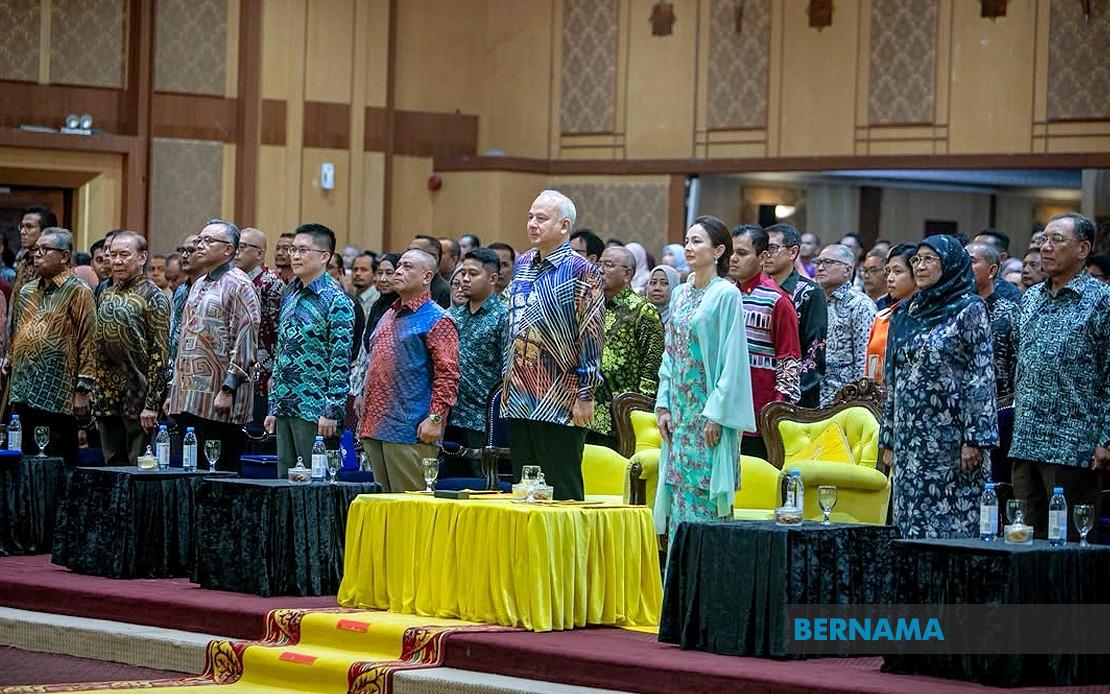
Sultan Nazrin Shah, the Ruler of Perak, presided over the state-level Merdeka Month celebration held at Bangunan Perak Darul Ridzuan in Ipoh, an occasion designed to reinforce patriotic values and loyalty to the monarchy among Perak's younger generation. Alongside His Majesty was the Raja Permaisuri of Perak, Tuanku Zara Salim, alongside Menteri Besar Datuk Seri Saarani Mohamad and Deputy Education Minister Wong Kah Woh, underscoring the event's significance within the state's educational and political calendar.
The 2026 edition of the Merdeka Month programme has achieved exceptional levels of engagement, with Perak Education Department director Zulkafli Mohamed Mokhtar revealing that 214,095 student entries were received across the state's schools. This figure represents participation from 83.6 per cent of all primary and secondary students enrolled in Perak, a striking endorsement of the programme's reach and appeal among the student body. The numbers paint a picture of a well-organised initiative that has succeeded in capturing the imagination of a substantial cross-section of Perak's youth.
What renders these statistics particularly noteworthy is the trajectory of growth demonstrated year-over-year. The 15 per cent increase in entries compared with the previous year indicates that the programme is not merely sustaining interest but actively building momentum as an institutional fixture within Perak's educational landscape. This expansion suggests that schools, students, and parents increasingly recognise the initiative's value as more than ceremonial pageantry, viewing it instead as a meaningful channel for developing competencies and showcasing talent.
Zulkafli framed the programme's success within the broader context of Malaysia's educational reform agenda. He emphasised that the initiative aligns with objectives outlined in the Malaysia Education Plan 2026-2035, a blueprint that extends beyond conventional academic metrics to encompass moral development, critical thinking, and civic consciousness. This positioning reflects a contemporary approach to education policy that acknowledges the necessity of cultivating not merely academically proficient individuals but citizens equipped with ethical foundations and patriotic commitment.
The emphasis on character formation and values-based education within the Merdeka Month activities addresses a persistent concern across Southeast Asian education systems: the tension between knowledge acquisition and character development. By embedding these competitions—encompassing language skills, artistic expression, and public discourse—within a framework of national celebration, Perak's educational authorities have created a structure that simultaneously honours academic achievement and reinforces cultural identity. For Malaysian educators and policymakers observing these developments, the model demonstrates how ceremonial occasions can serve substantive pedagogical functions.
The competitive elements of the programme showcase the breadth of domains being evaluated. Upper secondary students competed in both Malay and English language public speaking, with Ifwat Arrafi Mohd Amin of SMK Tun Abd Razak in Bagan Datuk securing the Malay competition championship, while E Johnnes Abysia from SMK Sungai Pari in Kinta Utara prevailed in the English-language category. These competitions reflect Malaysia's linguistic duality and the significance accorded to proficiency in both national and international communication media within the educational framework.
Beyond linguistic competition, the programme encompassed artistic and literary pursuits, with categories spanning caricature drawing, choral speaking, poetry composition, and essay writing across primary, lower secondary, and upper secondary levels. This multidisciplinary approach recognises that talent and capability manifest across diverse modes of expression, and that national sentiment can be cultivated through artistic endeavour as effectively as through oratory. The inclusion of such varied competitions also widens the pathway for student participation, reducing the likelihood that individuals with non-traditional strengths feel marginalised from the celebration.
The recognition extended to institutional contributors underscored the collaborative nature of educational initiatives in Malaysia's federal system. The Kinta Utara District Education Office received the special award for Best Achievement by District Education Office, accompanied by a RM20,000 cash prize. This recognition of district-level performance highlights the administrative scaffolding required to execute programmes of this scale, acknowledging that student success depends fundamentally on the organisational capacity and strategic commitment of education officials at the ground level.
Sultan Nazrin's personal attendance and his role in presenting awards conveyed several implicit messages about the monarchy's relationship with educational development and national cohesion. The constitutional role of Perak's Sultan as the apex of state ceremonial and cultural authority gains contemporary expression through participation in youth-centred initiatives, signalling that national institutions consider investment in younger generations' development as central to the state's vitality and future trajectory. For a region where monarchical institutions remain symbolically potent, such direct engagement carries weight beyond the immediate event.
The comprehensive nature of the awards ceremony, which saw both Sultan Nazrin and Tuanku Zara distributing prizes across multiple categories, emphasised the inclusive ambition of the programme. By distributing recognition across distinct domains—linguistic prowess, artistic expression, collective performance—the ceremony communicated that excellence takes multiple forms and that diverse talents merit formal acknowledgment and celebration. This approach potentially encourages broader student participation by signalling that pathways to recognition extend beyond conventional academic domains.
For Malaysian stakeholders monitoring education policy developments across the nation, Perak's Merdeka Month programme offers instructive insights into implementation of centrally-articulated policy objectives at the state level. The programme's scale, growth trajectory, and institutional support indicate that when educational initiatives align with ceremonial calendars, benefit from royal patronage, and receive enthusiastic administrative backing, they can achieve penetration rates that translate policy intent into widespread student experience. The 83.6 per cent participation figure suggests a model worth studying for replicability across other states and contexts.
The syllabus of competitions and the emphasis on both national and international communication languages reflect Malaysia's positioning as a nation navigating between regional and global contexts. Students developing proficiency in English-language public speaking are equipped for engagement in regional and international forums, whilst Malay-language competency anchors identity within the national community. The Merdeka Month framework thus becomes a vehicle for nurturing citizens comfortable across linguistic and cultural registers—a capability increasingly vital in a regionalised Southeast Asian context.
Moving forward, the programme's demonstrated capacity to engage large student populations, combined with its alignment with official educational policy, positions it as a substantive rather than superficial element of Perak's educational ecosystem. The royal patronage, administrative investment, and measurable expansion suggest that successive iterations will likely continue gaining prominence. For educators and administrators across Malaysia seeking models for institutionalising youth development within ceremonial frameworks, Perak's approach merits close examination as a case study in translating national policy imperatives into operational reality at the state level.

