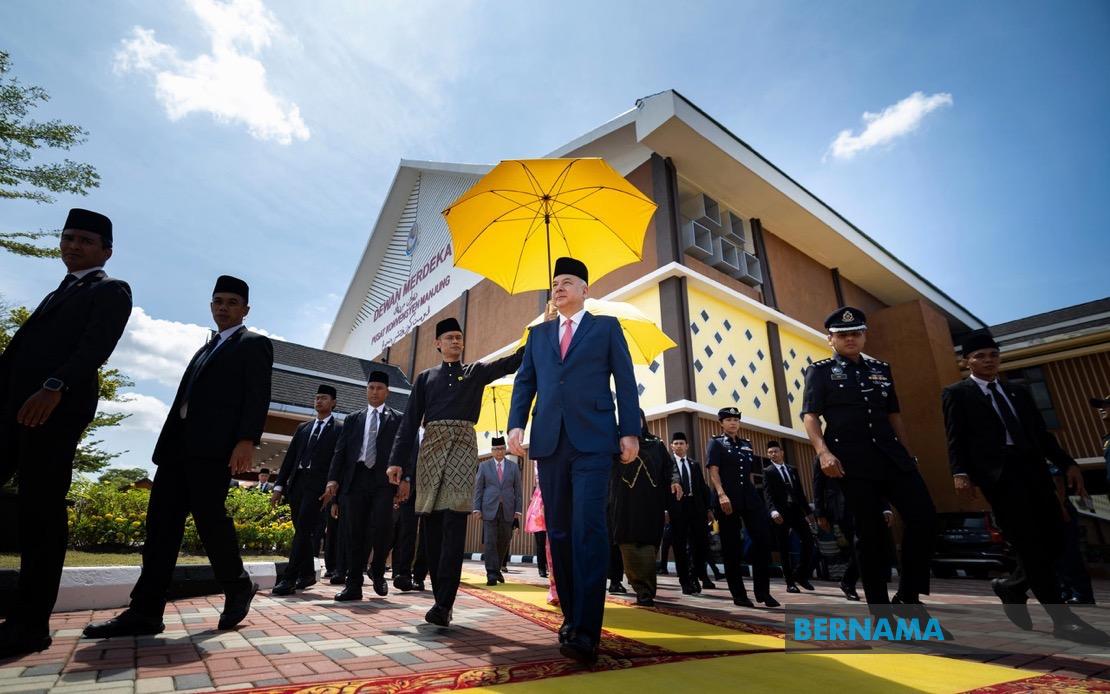
Sultan Nazrin Shah, the reigning monarch of Perak, today formally inaugurated the newly constructed Merdeka Hall within the Manjung Municipal Council's headquarters in Lumut, marking a significant milestone for the coastal district and its administrative body. The ceremonial opening drew prominent regional figures, including Raja Permaisuri Tuanku Zara Salim and Raja Di Hilir Raja Iskandar Dzurkarnain Sultan Idris Shah, reflecting the occasion's importance within Perak's political and cultural calendar. The presence of Perak Menteri Besar Datuk Seri Saarani Mohamad and Higher Education Minister Datuk Seri Dr Zambry Abd Kadir underscored federal and state government alignment on the project's completion and its broader significance for regional development.
The hall represents far more than a conventional public facility. Constructed at an investment of RM12.7 million and designed to accommodate 2,500 attendees, the venue is intended to serve multiple functions spanning official state ceremonies, business conferences, and grassroots community gatherings. This multifaceted purpose reflects a deliberate strategy to position Manjung not merely as a venue provider but as an emerging hub for institutional and cultural activities within northern Perak. The facility's capacity and modern specifications position it as one of the district's premier spaces for large-scale events, potentially attracting external organisations seeking appropriate venues for significant functions.
Menteri Besar Saarani contextualised the opening within three interconnected developmental trajectories. The project itself originated in 2016 when the previous state administration identified the need for improved municipal infrastructure, a recognition that subsequently led to securing federal funding approval. This extended timeline, spanning nearly a decade from conception to completion, reflects the multi-layered processes involved in securing resources and executing public works within Malaysia's federal structure. The successful materialisation of this initiative, despite political transitions and budgetary considerations, demonstrates sustained commitment from successive administrations to Manjung's infrastructural enhancement.
The timing of this inauguration carries particular symbolic weight, as it coincides precisely with the Manjung Municipal Council's 25th anniversary milestone. The council itself traces its institutional lineage to January 1, 1980, when it functioned as a district council before undergoing administrative elevation to municipal status on August 1, 2001. This quarter-century tenure reflects the council's evolution alongside Manjung's broader transformation, from a primarily resource-dependent community toward increasingly diversified economic activity. The silver jubilee provides an opportunity to celebrate institutional maturation while simultaneously projecting forward into an ambitious developmental vision.
The Merdeka Hall's inauguration deliberately aligns with Manjung's strategic pivot toward positioning itself as a Tourism and Maritime City by 2030. This aspiration represents conscious economic reorientation, leveraging the district's geographic advantages along Perak's coast to develop maritime industries, port-related commerce, and tourism infrastructure. The hall itself functions as a supporting asset for this larger transformation, providing essential meeting and exhibition spaces necessary for attracting international business delegations, tourism boards, and investment conferences. By establishing quality venues capable of hosting major events, Manjung enhances its competitive positioning relative to other Malaysian port cities seeking similar status.
Menteri Besar Saarani's remarks emphasised the philosophical dimensions underlying the hall's nomenclature. Naming the facility "Merdeka Hall" invokes Malaysia's foundational independence while simultaneously reminding citizens and officials that national sovereignty represents an ongoing responsibility rather than a static achievement. This framing positions the new venue as more than infrastructure, transforming it into a symbolic space where civic values and institutional purpose intertwine. The deliberate invocation of independence principles within a contemporary municipal context reflects attempts to maintain connection between historical national narratives and present-day governance imperatives.
The hall's envisioned role extends into the realm of institutional culture and social cohesion. Saarani articulated expectations that the space would become a nexus for knowledge development, enhanced mutual understanding, and consensus-building among diverse stakeholder communities. This aspirational language reflects broader Malaysian governance philosophy emphasising dialogue and collaborative problem-solving. Within Manjung's specific context, a multicultural district with substantial populations from various ethnic and religious backgrounds, such spaces assume particular importance for fostering social integration and shared civic purpose.
The completion of this project represents tangible evidence of federal-state governmental cooperation, a factor that Menteri Besar Saarani explicitly highlighted. Such cooperation, whilst sometimes taken for granted, proves essential for executing large-scale public infrastructure projects requiring coordinated resource allocation and administrative oversight. The fact that funding originated from federal allocation while implementation fell under state-level responsibility, with eventual handover to municipal administration, demonstrates the layered governance structures characteristic of Malaysian federalism. Manjung's successful navigation through these institutional complexities offers a case study in effective intergovernmental collaboration.
For Malaysian stakeholders monitoring Perak's development trajectory, this inauguration signals sustained investment in northern state infrastructure despite fiscal pressures affecting public finances nationally. The RM12.7 million expenditure, whilst substantial, reflects proportionate commitment to developing regional capabilities beyond traditional resource extraction economies. This reorientation toward services, tourism, and maritime commerce reflects broader Southeast Asian economic trends as nations seek to diversify revenue streams and establish competitive advantages within increasingly integrated regional markets.
Manjung's positioning as an aspirant Tourism and Maritime City places it within a competitive landscape that includes established regional ports and tourism destinations. Towns such as George Town in Penang, Kuantan in Pahang, and Port Klang in Selangor have cultivated distinct identities and institutional frameworks supporting their respective economic models. Manjung's strategic development plan, supported by new institutional infrastructure like Merdeka Hall, represents its claim for meaningful participation within this emerging class of Malaysian urban centres. The sustainability of such aspirations depends upon continuing public investment, private sector confidence, and effective local administration—factors the hall's completion symbolically affirms.
The convergence of commemorative and forward-looking dimensions characterises this inauguration. Celebrating 25 years of municipal governance acknowledges institutional achievements while simultaneously launching renewed ambitions for future development. This dual temporal orientation—honouring established continuity whilst projecting optimistic trajectories—reflects mature governance consciousness recognising that sustainable progress requires both consolidation of past gains and courageous envisioning of transformed futures. Manjung's Merdeka Hall physically embodies this philosophy, standing as contemporary infrastructure rooted in and serving enduring national principles.

