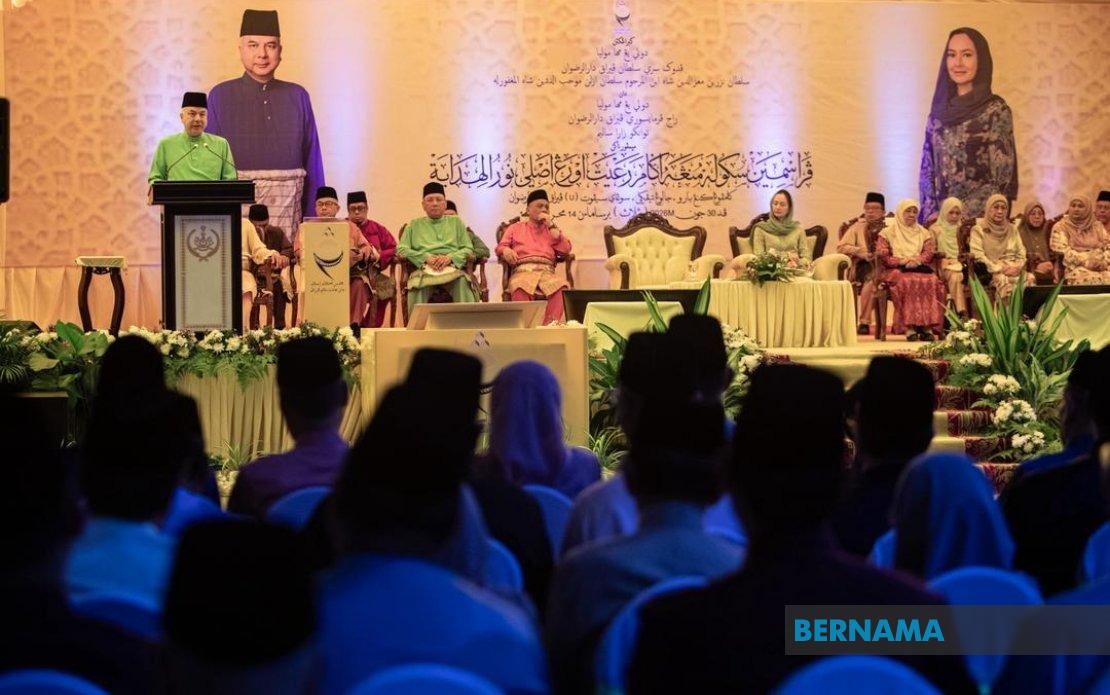
Perak's Sultan Nazrin Shah has formally inaugurated Sekolah Menengah Agama Rakyat (SMAR) Orang Asli Nurul Hidayah in Kampung Kenang, Sungai Siput Utara, an institution that represents a watershed moment in the state's commitment to educational access and human capital development for its indigenous populations. The ceremony, held on June 30, drew senior royalty and state officials, signalling the significance attached to this educational initiative within the Orang Asli community.
The Raja Muda of Perak, Raja Jaafar Raja Muda Musa, and the Raja Di Hilir Perak, Raja Iskandar Dzurkarnain Sultan Idris Shah, were in attendance alongside Menteri Besar Datuk Seri Saarani Mohamad and leaders of the Perak Islamic Religious and Malay Customs Council (MAIPk) and Perak Islamic Religious Department (JAIPk). The breadth of official participation reflected institutional recognition of the school's broader role in advancing indigenous welfare beyond mere classroom instruction.
In addressing the gathering, Sultan Nazrin characterised SMAR Nurul Hidayah as a transformative force within Kampung Kenang and surrounding Orang Asli settlements. As the nation's inaugural purpose-built secondary Islamic school dedicated to serving indigenous learners, the institution embodies a thirty-year journey that commenced modestly as a dakwah and fundamental Islamic learning centre before evolving into a comprehensive educational facility. This trajectory demonstrates how grassroots community initiatives can mature into formal institutions capable of delivering structured, accredited curricula.
The Ruler's framing of the school transcended conventional educational discourse, positioning it instead as a strategic investment in the future security and prosperity of Orang Asli youth. Rather than reducing the institution to bricks and mortar, Sultan Nazrin positioned it as a manifestation of the state's commitment to breaking generational cycles of marginalisation that have historically affected Malaysia's indigenous populations. The emphasis on infrastructure investment carried implicit recognition that disparities in educational facilities often correlate with disparities in educational outcomes.
Central to the Sultan's remarks was the school's hybrid approach, merging conventional academic rigour with religious and moral formation. This integrated model reflects a philosophy that knowledge acquisition and character development are inseparable processes. By situating Islamic values and Shariah principles alongside mathematics, languages, and sciences, the institution offers Orang Asli students pathways to professional advancement without cultural displacement—a significant consideration given historical tensions between modernisation and indigenous identity preservation.
The Ruler highlighted the measurable success already achieved by the institution, noting that former students have returned to their communities as educators and advocates, creating multiplier effects beyond individual advancement. This alumni engagement pattern suggests the school has cultivated not merely upward mobility but community-rooted commitment among its graduates. Such outcomes matter substantially in contexts where brain drain frequently accompanies educational opportunity, as returning professionals can catalyse localised development initiatives.
Sultan Nazrin emphasised that educational equity represents a fundamental national aspiration rather than a peripheral concern. By stressing that every child deserves equal access regardless of background or geographic location, the Ruler articulated a principle increasingly contested in Malaysian policy circles where resource allocation debates often centre on competing regional and demographic priorities. For Orang Asli populations residing in remote or economically marginalised areas, formal endorsement of this principle from royal authority carries political and symbolic weight.
The Sultan's broader philosophical articulation on education's purpose moves beyond instrumental framing to encompass what might be termed holistic human development. By identifying intellectual, spiritual, emotional and physical dimensions as interconnected rather than compartmentalised, he positioned education as fundamentally concerned with citizenship formation. This conception challenges reductive approaches that treat schooling primarily as credentialing mechanisms, instead asserting that institutions bear responsibility for cultivating ethical reasoning and social consciousness.
For Malaysian policymakers and regional observers, SMAR Nurul Hidayah's establishment carries implications extending beyond Perak's borders. The model suggests pathways for expanding quality educational provision to marginalised communities through culturally sensitive, faith-integrated approaches. As Southeast Asian nations grapple with indigenous educational disparities, this Perak initiative offers a documented case study in how traditional institutional frameworks can be adapted to serve historically excluded populations without negating their cultural and religious identity.
The timing of the school's formal inauguration, three decades after its founding, also reflects the extended timescales often required for community-based institutions to achieve formal recognition and integration into state structures. This patient developmental approach contrasts sharply with top-down, externally-imposed educational projects that frequently encounter resistance or underutilisation. The school's success trajectory suggests organic, community-anchored initiatives may generate more durable educational outcomes among populations characterised by historical marginalisation.
Looking forward, Sultan Nazrin's articulated vision for the school prioritises quality enhancement over mere expansion, encouraging educators to leverage improved infrastructure to elevate pedagogical standards. This emphasis on continuous improvement rather than complacency following ceremonial recognition sets demanding benchmarks for institutional leadership. For Orang Asli students, the challenge and opportunity now centres on translating infrastructure gains into measurable academic achievements and career preparation.
The establishment of SMAR Nurul Hidayah ultimately represents the confluence of multiple aspirations: indigenous community advancement, Islamic education promotion, human capital development and equitable access to quality schooling. Whether the institution sustains its trajectory of serving as a community catalyst depends substantially on sustained resourcing, educator quality and institutional autonomy balanced against accountability measures. The coming years will reveal whether this model proves replicable across Malaysia's diverse indigenous regions and varying religious contexts.

