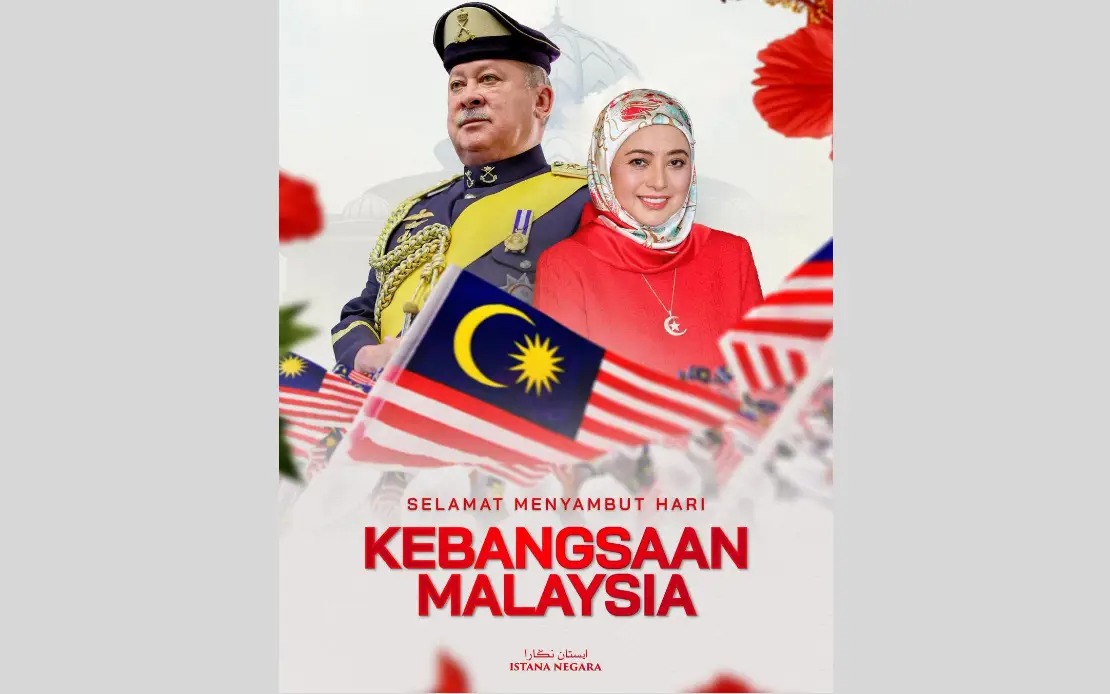
Malaysia marked its 69th National Day on August 31 with Their Majesties Sultan Ibrahim Sultan Iskandar and Raja Zarith Sofiah presiding over a major celebration in Putrajaya, reaffirming the nation's commitment to unity and shared prosperity. The royal couple conveyed festive greetings to all Malaysians through an official message posted on Sultan Ibrahim's Facebook page, underscoring the continued ceremonial and symbolic importance of the monarchy in the country's annual commemoration of independence.
Arriving at the Putrajaya venue at 8 am, the sovereign and consort were warmly received by Prime Minister Datuk Seri Anwar Ibrahim and his wife, Datuk Seri Dr. Wan Azizah Wan Ismail, alongside Communications Minister Datuk Seri Fahmi Fadzil, who chairs the National Day and Malaysia Day (HKHM) 2026 Main Committee. This coordination between the Palace and government demonstrated the formal protocols and institutional cooperation that characterise Malaysia's state occasions, blending constitutional monarchy with democratic governance.
The 2024 celebration operated under the overarching theme "Malaysia MADANI: Kesejahteraan Dinikmati" — translated as Malaysia MADANI: Prosperity Enjoyed — reflecting the government's policy framework emphasising citizen wellbeing and inclusive development. This thematic choice signals how annual national observances have become platforms for promoting the ruling administration's broader vision, with each National Day serving as both commemoration and communication tool for national priorities and social values.
The festivities commenced with a formal military ceremony, establishing the solemn foundation typical of Malaysian National Day proceedings. Following this, the programme transitioned into diverse stage performances and an elaborate parade, crafted to visually encapsulate Malaysia's multicultural character and the aspirations embedded within the Malaysia MADANI framework. The shift from military formality to cultural expression reflects the dual nature of the celebration: honouring martial tradition while celebrating the nation's ethnic and religious plurality.
The logistical scale of the event underscored the significance placed on this annual milestone. Organisers mobilised 10,819 participants distributed across 76 contingents, supplemented by 22 brass bands providing musical accompaniment throughout the proceedings. The parade incorporated 11 specially decorated vehicles alongside 328 land, sea and air assets — a demonstration of Malaysia's defence capabilities and administrative reach — complemented by 112 service animals that added pageantry and cultural representation to the spectacle.
Innovation in crowd engagement featured prominently through a human graphic display arranged across terraces, where participants formed 26 distinct formations collectively narrating Malaysia's multicultural narrative. This participatory dimension transformed spectators into active components of the visual composition, creating an immersive experience of national identity rather than passive observation. Such staging techniques reflect modern approaches to civic ceremonies, where technology and human coordination merge to amplify messaging about national unity and diversity.
The inclusion of 22 electric vehicles within the parade procession signalled subtle environmental consciousness within the celebration framework, acknowledging global sustainability concerns while maintaining ceremonial grandeur. This integration of contemporary environmental values into traditional state occasions demonstrates how even formal, protocol-bound events adapt incrementally to shifting societal priorities and international norms.
For Malaysian audiences, particularly in an era of periodic communal tensions and political polarisation, National Day celebrations serve functions beyond historical commemoration. They provide sanctioned spaces for articulating inclusive nationhood and demonstrating governmental commitment to multiethnic harmony through visual spectacle and ritual performance. The presence of both the monarch and prime minister, along with diverse contingents and formations, reinforces messaging that national institutions embrace pluralism as foundational rather than supplementary to Malaysian identity.
Regionally, Malaysia's National Day observance carries significance as Southeast Asia's oldest independent nation reflects on its trajectory. The Malaysia MADANI framework, prominently featured in this year's celebration, represents the current administration's attempt to reshape national development discourse around welfare and equity, contrasting with previous emphasis on rapid industrialisation and economic growth. How this messaging resonates with citizens and shapes political discourse will likely influence broader regional conversations about development models and governance priorities across Southeast Asia.
The celebration also demonstrated Malaysia's capacity for large-scale coordinated civic events despite infrastructural and logistical complexities. Successfully orchestrating nearly 11,000 participants, hundreds of vehicles, and elaborate formations reflects institutional capability that smaller or less developed nations might struggle to replicate. This operational competence, often invisible to casual observers, underpins the ceremonial impression of national organisational sophistication and institutional coherence that such events are designed to project.
Looking forward, the prominence given to the HKHM 2026 Main Committee and the concurrent mention of Malaysia Day celebrations signal that organisers are already embedding next year's bicentenary of Kuala Lumpur into broader national commemorative consciousness. This forward-planning approach suggests that Malaysia's state occasions increasingly serve as platforms for anticipating and preparing citizens for upcoming milestones, with each National Day building narrative momentum toward future celebrations.

