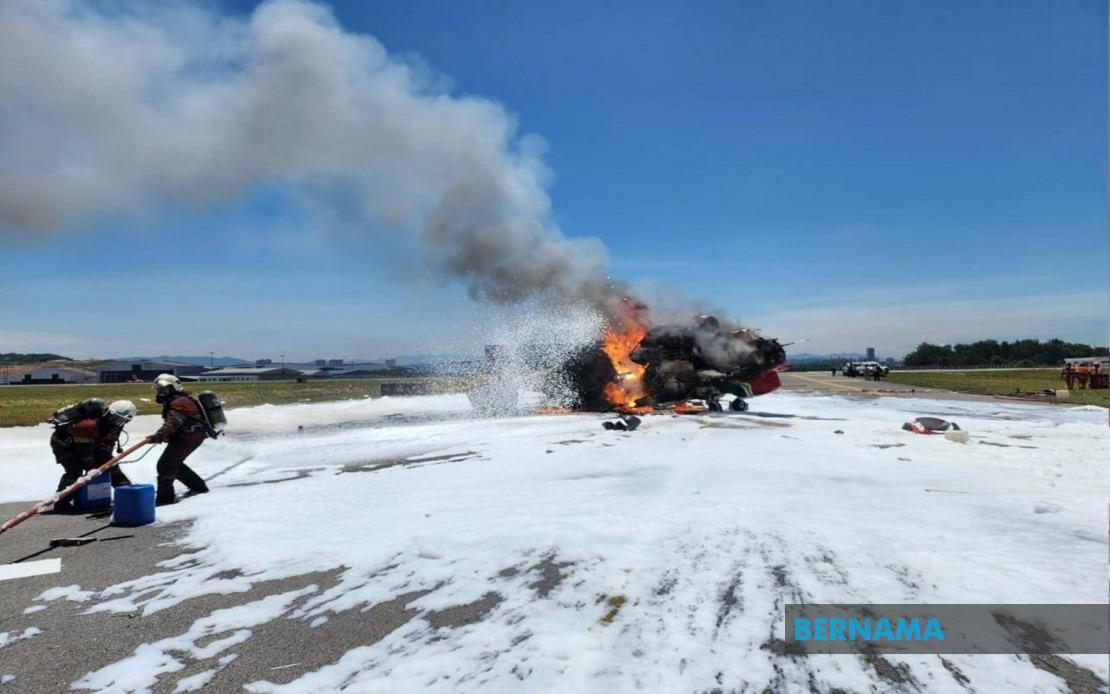
The runway at Sultan Abdul Aziz Shah Airport in Subang returned to normal operations on August 15, marking the end of a brief but disruptive closure triggered by a helicopter fire that erupted during routine maintenance work. Malaysian Civil Aviation Authority (CAAM) chief executive officer Capt Datuk Norazman Mahmud confirmed that air traffic resumed at 2.57 pm, allowing the airport to restore full departure and arrival capabilities after the mid-afternoon incident.
The incident centred on a Kamov KaV-32S helicopter registered in Ukraine, which caught fire at 12.28 pm while undergoing an engine run-up test at Taxiway Victor. Engine run-up tests form a critical component of aircraft maintenance protocols, designed to verify that engines function properly under controlled conditions before the aircraft returns to active service. The explosion and subsequent fire forced authorities to suspend all flight operations as a precautionary measure while emergency response teams attended to the situation and cleared the taxiway.
Four Ukrainian crew members were working on the helicopter at the time of the incident: the pilot, co-pilot, and two additional crew members whose specific roles have not been detailed. One member sustained minor injuries from flying debris generated by the explosion, but no fatalities were reported. The swift response by airport emergency services and the contained nature of the incident prevented escalation, though the closure still created significant operational challenges for the busy regional hub.
The temporary runway closure had measurable impacts on airport operations during the afternoon period. Eight inbound flights destined for Subang were diverted to alternative Malaysian airports to avoid delays and congestion, while three aircraft scheduled for departure experienced postponements pending runway reopening. Flight information displays throughout the terminal building updated passenger information, though the brief closure meant that most schedule adjustments were relatively modest in duration.
CAAM advised affected passengers to remain in contact with their respective airlines for the most current details regarding their flights, recognising that coordination between the aviation authority and individual carriers would be essential in managing the aftermath of the disruption. Airlines operating from the airport had contingency protocols in place to communicate revised schedules and any necessary rebooking options to travellers whose flights were impacted by the incident.
Sultan Abdul Aziz Shah Airport, also known as Subang Airport, serves as one of Malaysia's principal aviation facilities and a major hub for regional and domestic air traffic. The airport handles scheduled passenger services, cargo operations, and general aviation activities, making any operational disruption significant for the broader transportation network. The facility's location in the Klang Valley region means it serves as a critical alternative to Kuala Lumpur International Airport, particularly for certain categories of flights and operators.
Maintenance activities conducted at airfields, particularly engine run-up tests, are standard procedures aimed at ensuring aircraft safety and airworthiness. These tests subject engines to increasing power levels while the aircraft remains stationary, allowing technicians to monitor performance parameters and verify that all systems function correctly. The protocols surrounding such work normally include safety perimeters and emergency response readiness, though incidents during these procedures remain relatively uncommon and typically highlight the value of stringent safety measures.
The involvement of a Ukrainian-registered aircraft reflects the international nature of aviation operations in Malaysia, where helicopters and fixed-wing aircraft from various countries conduct business operations, maintenance activities, and charter services. The use of foreign-registered aircraft for specialist operations is not unusual, and such aircraft are subject to Malaysian aviation regulations and CAAM oversight while operating within Malaysian airspace and at Malaysian airports.
From a broader Southeast Asian perspective, this incident underscores the importance of robust aviation safety protocols and emergency response capabilities at regional airports. The rapid resolution and resumption of normal operations at Subang Airport demonstrates the effectiveness of existing safety frameworks and coordination mechanisms between aviation authorities and ground service providers. The incident resulted in minimal economic impact despite the operational disruption, suggesting that Malaysia's aviation infrastructure and management systems continue to function effectively in responding to unexpected events.
Looking forward, the incident will likely prompt a thorough investigation by CAAM to determine the precise causes of the helicopter's engine failure and fire. Such investigations are standard practice in aviation and contribute to continuous improvement in safety procedures, maintenance protocols, and emergency response strategies. The findings may inform industry practices across the region and contribute to the broader body of knowledge regarding helicopter maintenance and operational safety in Southeast Asian airspace.

