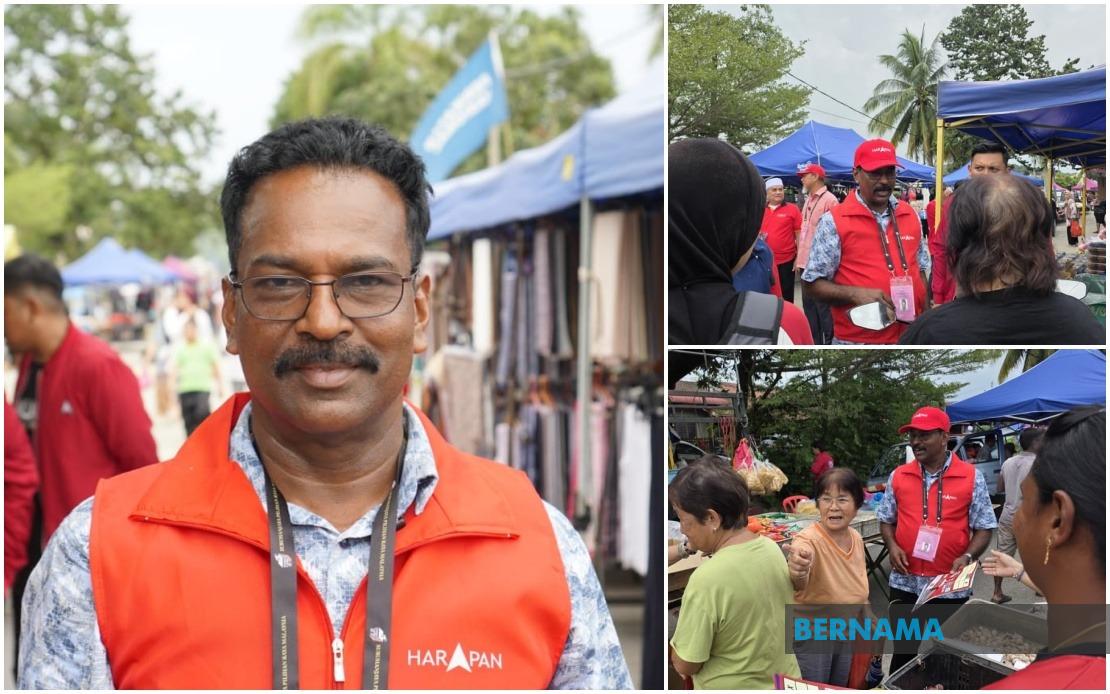
C. Subramani is positioning himself as the catalyst for renewal in Bukit Kepong, riding what he characterises as a groundswell of voter sentiment demanding tangible improvements to their constituency. The Pakatan Harapan contender expressed confidence in his prospects during campaigning for the 16th Johor state election, citing consistently positive feedback from doorstep conversations and community engagement across the constituency. His optimism reflects a broader narrative emerging from PH's campaign strategy in the state: that electoral fatigue with incumbent administrations has created openings in traditionally competitive or opposition-held seats.
Subramani's pathway to victory, if realised, would hinge on effective coordination between state and federal authorities once voting concludes on Saturday. He argues that alignment between Putrajaya and the Johor state government would unlock faster resolution of local grievances that currently stall within bureaucratic silos. This messaging appeals to voters frustrated by jurisdictional delays, particularly regarding matters that nominally fall under federal purview but directly affect daily life—a pain point that resonates across Malaysian constituencies where overlapping governance structures create accountability gaps.
Having previously contested the Buloh Kasap seat during the 2022 Johor state election, Subramani brings incremental political experience to his campaign, though he remains a relative newcomer to statewide electoral contests. His tenure as Pagoh PKR chief has given him organisational footing within the constituency, enabling the ground presence that he credits with identifying voter priorities and infrastructure deficits. This hands-on approach differs markedly from parachute candidacy, a perception liability in Malaysian electoral contests where voters increasingly demand representatives who have demonstrated sustained commitment to their communities.
The candidate has prioritised engagement with Orang Asli communities, visiting four settlements to catalogue socioeconomic challenges and infrastructure gaps that government programmes have failed to address. This deliberate outreach underscores PH's broader strategy of recalibrating its relationship with marginalised populations, who have historically voted unpredictably but constitute meaningful proportions of voters in constituencies with significant indigenous populations. By publicly documenting these visits and framing them as evidence of his commitment to equity, Subramani is attempting to establish credibility on an issue where PH has faced criticism from indigenous rights advocates.
Among his substantive policy commitments is reimagining Bukit Kepong Gallery as a historical tourism destination capable of generating economic activity and employment in the locality. This proposal addresses the challenge facing many rural and semi-rural Malaysian constituencies: economic stagnation and youth out-migration driven by limited livelihood opportunities. Converting cultural or historical assets into tourism infrastructure represents a familiar policy template adopted across Johor and other states, though implementation frequently lags behind announcements. Subramani's emphasis on this initiative suggests he has identified tourism potential as a locally resonant development narrative.
Basic infrastructure deficiencies—inadequate street lighting, narrow bridges, substandard housing stock for lower-income residents—form the backbone of his platform addressing the B40 category. These grievances appear unglamorous compared to grand development narratives, yet they constitute persistent voter frustrations that affect quality of life and safety. By foregrounding such concerns, Subramani is signalling responsiveness to quotidian challenges that often escape the attention of state-level politicians absorbed in larger policy frameworks. This granular focus can prove electorally decisive in marginal contests where swing voters are motivated by concrete improvements rather than ideological positioning.
The three-way contest between Pakatan Harapan, Barisan Nasional, and Perikatan Nasional candidates complicates Subramani's path to victory despite his professed confidence. In the previous 2022 state election, PN-Bersatu's Datuk Dr Sahruddin Jamal secured the Bukit Kepong seat with a majority of 710 votes—a slender margin indicating a genuinely competitive constituency where swing voting patterns can shift outcomes. The presence of three significant contenders means that vote fragmentation becomes central to the result; Subramani's victory would require not merely consolidating PH support but also capturing sufficient numbers of voters dissatisfied with both BN and PN to overcome their incumbency or organisational advantages.
Johor's 16th state election encompasses 172 candidates contesting 56 assembly seats, generating a complex political landscape where local dynamics often diverge from state or national trend lines. Approximately 2.7 million voters are eligible to participate, representing a substantial electorate whose composition varies significantly across urban, semi-urban, and rural constituencies. Bukit Kepong's position within this spectrum—neither predominantly urban nor remote—suggests it remains swing territory where demographic shifts, local sentiment regarding governance quality, and campaign effectiveness converge to produce competitive outcomes.
For Pakatan Harapan, securing victories in constituencies like Bukit Kepong is strategically important as the coalition seeks to recover electoral ground lost during the 2022 state elections, when voter frustration with the federal government's handling of the pandemic and economic management contributed to PN's gains. Johor's significance as a populous state with 56 assembly seats means that gains or losses there have outsized implications for overall state-level representation and the coalition's capacity to govern if opportunities emerge post-election. Subramani's campaign thus represents a microcosm of PH's broader challenge: convincing voters that the coalition has learned from previous governance failings and merits renewed trust.
The candidate's emphasis on federal-state coordination addresses a genuine structural weakness in Malaysian governance that has frustrated both citizens and local officials regardless of party affiliation. When state and federal administrations operate under different political control, programme implementation frequently stalls as each tier blames the other for delays, funding gaps, or miscommunication. Voters in such situations experience governance as dysfunction rather than service delivery. Subramani's framing of alignment as prerequisite for development progress implicitly acknowledges this systemic challenge while positioning PH governance as capable of transcending partisan divides—a message that carries particular weight if delivered credibly through demonstrated record.
Subramani's campaign narrative ultimately rests on three interlocking arguments: that local voters demonstrably desire change from incumbent arrangements, that his personal engagement with constituents has earned credibility sufficient to overcome party-level disadvantages, and that aligned governance between state and federal levels would unlock development gains currently constrained by institutional fragmentation. Whether these propositions prove persuasive to Bukit Kepong voters will become apparent once polling concludes on Saturday, but they reflect sophisticated campaign messaging that addresses both material grievances and voter psychology regarding representation and accountability.

