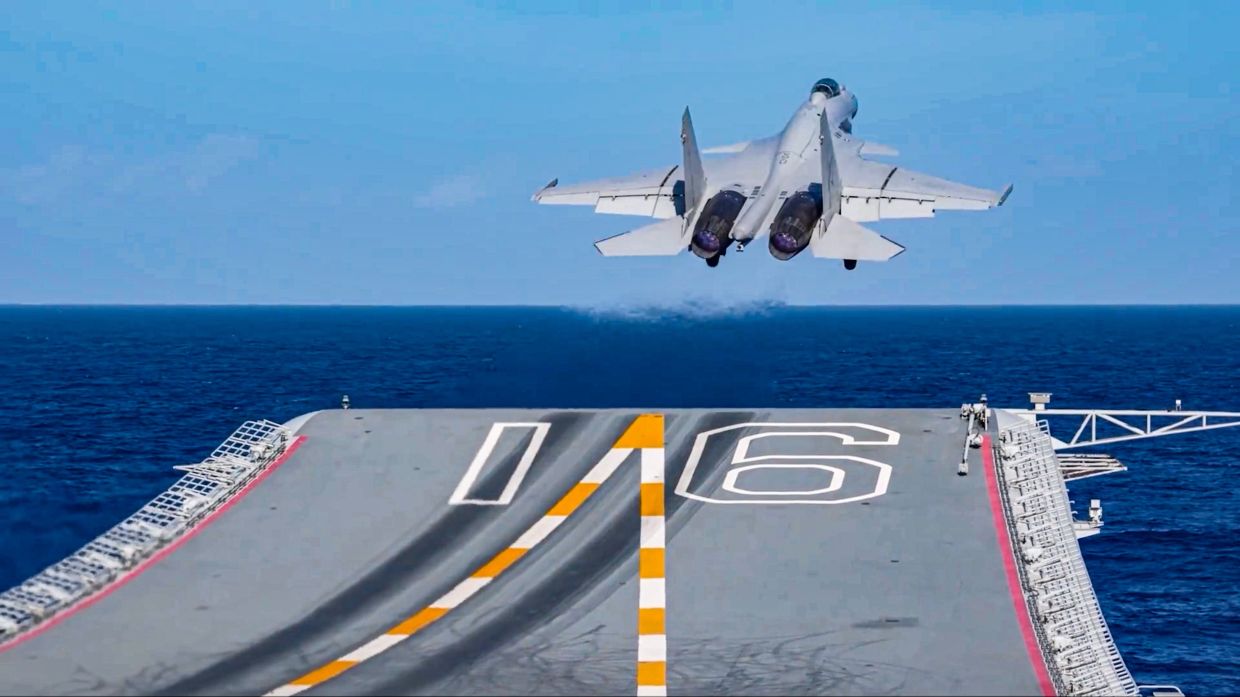
China's ambitious programme to build a modern blue-water navy capable of projecting power far beyond its coastal waters faces a fundamental weakness: an inability to effectively detect and counter submarines operating in the depths around its carrier groups. This underwater vulnerability has become the focal point of strategic assessments examining how the United States and its regional allies might constrain Beijing's naval ambitions, particularly as tensions over Taiwan and competing claims in the South China Sea continue to shape military planning across the Asia-Pacific.
A comprehensive strategic analysis produced by the Washington-based Centre for Strategic and International Studies identifies submarine operations as the most potent component within a broader framework designed to impose costs on China's carrier deployments. The study recommends a multi-layered approach combining land-based strike networks, long-range aerial offensives supported by sophisticated satellite reconnaissance, cyber and electromagnetic disruption, and coordinated drone operations. Yet submarine attacks emerge as the element where Chinese naval capabilities display the most pronounced deficiency, according to specialists examining the People's Liberation Army Navy's operational readiness across different warfare domains.
The underlying weakness centres on the PLAN's acknowledged gaps in undersea detection and continuous tracking systems. Attack submarines operating across the western Pacific, particularly those belonging to the United States, represent an asymmetric threat that could expose high-value carrier vessels to devastating strikes before surface-based defences can respond effectively. These submarines operate in an environment where China's understanding of oceanographic conditions lags significantly behind that of established maritime powers, creating an information asymmetry that hostile underwater forces could readily exploit during future conflicts.
Geography reinforces this vulnerability in consequential ways. The main sea lanes through which Chinese carriers must transit to reach distant operational areas pass through a limited number of critical maritime chokepoints where allied naval forces could concentrate their efforts. Submarines and supporting vessels positioned along these passages could threaten carrier formations during their transits, while beyond these narrow passages, carrier-based aircraft equipped with long-range precision munitions and satellite guidance could conduct strikes against Chinese warships. Simultaneously, coordinated attacks on radar systems, communication infrastructure and sensor networks could degrade the operational awareness upon which modern naval formations depend for survival.
Christopher Sharman, a leading authority on Chinese maritime strategy at the US Naval War College, acknowledges that the underwater vulnerability identified in strategic studies remains substantial, though not immutable. The PLAN has invested considerably in recent years to enhance its capabilities for detecting and predicting submarine movements and the broader undersea environment. Despite these efforts, significant capability gaps persist that constrain Chinese submarine operations and anti-submarine warfare effectiveness, particularly in waters extending beyond the first island chain where operational distances increase and environmental knowledge becomes less complete. Chinese meteorological and oceanographic understanding continues to trail that of the US Navy, creating persistent disadvantages for underwater warfare operations conducted in distant waters.
Beijing has launched ambitious programmes intended to close these technical and intelligence gaps. The Transparent Ocean initiative, conceived over a decade ago, represents a comprehensive effort to establish integrated networks combining satellites, research vessels, ocean buoys, autonomous underwater gliders and seafloor sensor arrays capable of collecting real-time oceanographic data across strategically vital regions including the western Pacific, South China Sea and Indian Ocean. China's Ocean University has expanded these monitoring capabilities significantly, deploying hundreds of deep-sea observation systems and extending detection networks from the South China Sea into the western Pacific. Chinese strategic documents explicitly link this oceanographic intelligence infrastructure to national security imperatives, recognising that understanding the underwater environment provides foundations for effective naval operations.
China's naval modernisation has also prioritised anti-submarine warfare capabilities, resulting in expanded fleets of fixed-wing maritime patrol aircraft and Type 927 ocean surveillance vessels equipped with towed-array sonar systems capable of detecting distant underwater contacts. Aircraft and helicopter sensors have undergone progressive upgrades to enhance submarine detection effectiveness. Nevertheless, naval strategists recognise that protecting carrier formations represents only one dimension of a broader challenge confronting Chinese underwater warfare doctrine. Submarine operations constitute a fundamental pillar within Chinese naval strategy, particularly for achieving sea control objectives within the first island chain during wartime scenarios.
Beyond the first island chain into the Indian Ocean, PLA strategists regard effective undersea operations as essential for countering American naval dominance and complicating potential third-party intervention in conflicts involving Taiwan. China has never renounced military options regarding Taiwan, which Beijing considers an integral part of its territory requiring eventual reunification. Although most nations, including the United States, decline to recognise Taiwan's independence, Washington maintains legal obligations to supply defensive weapons and opposes any forceful attempt to alter Taiwan's status. Military specialists affiliated with Chinese institutions have warned that undersea spaces adjacent to China's coastline remain inadequately controlled and monitored, potentially allowing hostile submarines to operate with relative freedom in strategically critical waters.
Timothy Heath, head of defence research organisation Perceptum, emphasises that anti-submarine warfare remains a formidable challenge for Chinese forces confronting American submarines among the world's quietest platforms. Japanese participation in any Taiwan conflict would dramatically escalate military complexity, enabling Tokyo to deploy its own submarine and anti-ship capabilities against Chinese vessels operating near Japanese territorial waters. These circumstances might theoretically recommend deploying Chinese carriers in the western Pacific to provide air support for naval operations seeking to prevent or delay third-party intervention. However, Heath cautions that deploying carriers at such extended distances would be strategically unwise, given the multiple weapon systems and approaches the United States could employ for targeting them.
China's land-based intermediate-range ballistic missiles represent superior options for threatening American ships extending to the second island chain, Heath argues, since carriers represent exceptionally valuable and costly platforms too vulnerable to deploy in such exposed positions. Strategic analysts maintain that the specific challenges confronting Chinese carrier operations at increasing distances from coastal bases should fundamentally shape American military procurement priorities and investment decisions. These recommendations emphasise greater resources devoted to advanced torpedoes, autonomous undersea systems and missile production undertaken in close partnership with regional allies including Japan and Australia. Such coordinated preparations would strengthen allied capabilities for constraining Chinese naval ambitions while reinforcing collective security arrangements throughout the Indo-Pacific region facing mounting strategic pressures from Beijing's military expansion.

