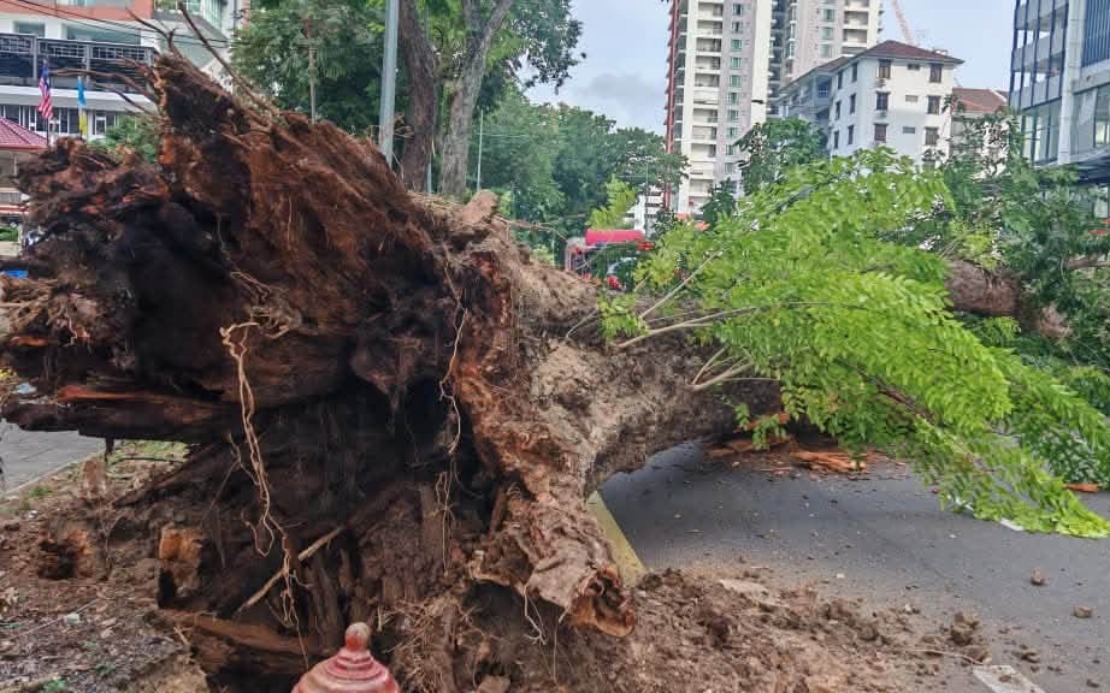
An investigation into the sudden collapse of a 90-year-old Angsana tree along Jalan Macalister in Georgetown has identified multiple structural and environmental factors that contributed to the incident, which left three people injured when their vehicle was struck by the falling timber. The 28-metre-tall Pterocarpus indicus tree came down at approximately 9 am on August 9, crushing a Perodua Ativa sports utility vehicle carrying an elderly couple and their grandchild. According to findings released by Majlis Bandaraya Pulau Pinang (MBPP), the tree had deteriorated significantly over time, with internal assessments revealing critical weaknesses in its structural integrity that ultimately proved catastrophic.
MBPP Mayor Datuk A. Rajendran explained that the tree exhibited approximately 30 per cent root rot throughout its root system, while cavity decay affected roughly 40 per cent of the base trunk. These internal failures were compounded by external pressures that further compromised stability. Chronic soil compaction around the tree's base severely restricted its ability to develop a robust root system, limiting its capacity to anchor against stress. Infrastructure upgrading works undertaken in the vicinity added additional strain to an already weakened specimen. The combination of the tree's considerable height, estimated at 28 metres, and these cumulative factors created a precarious situation where structural failure became increasingly inevitable.
Remarkably, the collapse occurred without the typical weather triggers that commonly precipitate tree falls. Datuk Rajendran noted that there were no reports of heavy rainfall or strong winds immediately preceding or occurring at the time of the incident, suggesting that the tree's deterioration alone was sufficient to cause failure. This observation underscores the silent nature of arboreal decline, where internal decay can progress undetected until catastrophic structural failure occurs suddenly. While the remote sensing study conducted the previous year had indicated the trees along Jalan Macalister were in generally good condition, this assessment appears not to have captured the advanced deterioration already present in this particular specimen.
MBPP's response to the emergency was relatively swift, with removal operations commencing at 9.41 am and the road fully reopened by 2.20 pm. However, the incident has prompted accelerated action by the municipal authority, which has now instructed its appointed contractor to expedite risk-mitigation work along the entire stretch of Jalan Macalister. Certified arborists have been engaged to conduct fresh assessments, with instructions to reduce the height of problematic trees and fell those deemed to pose imminent collapse risks. This proactive stance represents a significant shift in response to the accident and reflects heightened municipal concern about similar hazards elsewhere in Georgetown.
The trajectory of tree management in Georgetown reveals both the scope of the challenge and the resources being deployed. In 2024, MBPP conducted comprehensive assessments of mature and aged trees along Jalan Macalister, identifying 13 specimens for removal, all of which have now been felled. The most recent maintenance work on trees in the area took place on January 29 of this year, suggesting that routine upkeep was occurring, yet failed to identify the critical deterioration that would lead to the August collapse. For the broader city, the municipality approved 179 high-risk trees for felling during this year, with 148 already removed at the time of the statement. In the first three quarters alone, 247 trees were felled across Georgetown.
The reasons for tree removal are diverse and reflect the competing demands placed on urban arboreal stock. Trees are felled for obstructing drainage systems, being dead or leaning, posing collapse risks, accommodating development projects, facilitating road and river widening initiatives, and encroaching on water supply infrastructure. A comprehensive assessment conducted last year identified 2,535 trees across various risk categories within MBPP's jurisdiction. Among these, 45 cases involved drainage obstruction, 138 trees were classified as dead, 2,242 fell under risk or miscellaneous categories, and 110 were associated with development or infrastructure works. The scale of this inventory demonstrates the substantial burden of urban tree management in a tropical Southeast Asian city where rapid development intersects with the need to maintain mature vegetation.
For Malaysian urban planners and municipal authorities, the Georgetown incident carries important lessons about the limitations of infrequent assessment cycles and the challenges of identifying advanced internal decay. Remote sensing technology and conventional visual inspection, while valuable tools, may not reliably detect cavity rot or pathological root conditions until failure becomes imminent. The tree that fell had been assessed as being in acceptable condition, yet harboured critical weaknesses that proved fatal to its structural stability. This gap between assessment outcomes and actual condition underscores the importance of more rigorous diagnostic techniques and possibly more frequent inspections for aged specimens in high-traffic areas.
The broader context of this collapse also illuminates the tension between urban development and environmental preservation in Malaysian cities. Soil compaction resulting from infrastructure work and restricted rooting spaces are anthropogenic factors that significantly reduce tree longevity and stability. Cities like Georgetown, with dense urban environments and ongoing development pressure, face constant decisions about which trees can be retained and which must be sacrificed for practical reasons. The high number of trees felled for pipeline alignment with the Penang Water Supply Corporation reflects how essential infrastructure often takes precedence over vegetation retention.
Moving forward, MBPP's commitment to accelerating the removal of high-risk trees demonstrates a risk-averse approach aimed at preventing further incidents. However, this strategy raises questions about the city's future canopy coverage and the environmental, aesthetic, and cooling benefits that mature trees provide. Malaysian municipalities will need to balance immediate safety imperatives with longer-term urban greening objectives, potentially requiring investment in better diagnostic tools, more frequent specialist inspections for aged specimens, and possibly improved soil management practices that can extend tree viability in constrained urban settings. The Georgetown incident serves as a cautionary reminder that urban forestry demands constant vigilance and resources proportionate to the risks involved.

