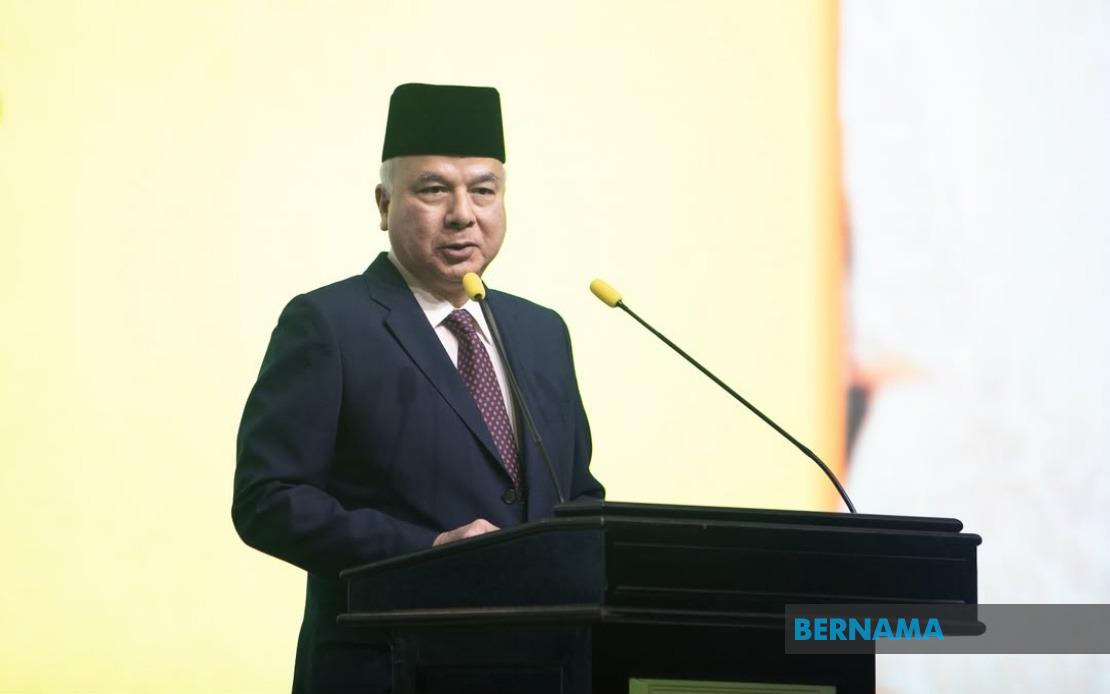
The Sultan of Perak, Sultan Nazrin Shah, delivered a stark assessment of what separates thriving nations from failing ones during his address at the 8th World Conference on Islamic Thought and Civilisation in Ipoh on July 21, arguing that material wealth and human talent alone cannot guarantee a nation's success if its fundamental governance structures are compromised. Speaking before Deputy Prime Minister Datuk Seri Fadillah Yusof, Perak Menteri Besar Datuk Seri Saarani Mohamad, and Higher Education Minister Datuk Seri Dr Zambry Abd Kadir, His Royal Highness outlined a framework for understanding why some countries prosper while others struggle, regardless of their natural endowments or cultural heritage.
At the heart of Sultan Nazrin's thesis lies the recognition that institutional strength transcends any individual leader or governing administration. Good governance, he explained, requires systems robust enough to function effectively even as political personnel change hands. This institutional resilience becomes the foundation upon which all other aspects of state function depend, preventing the concentration of power that inevitably corrodes public trust. Without institutions capable of operating independently of personal whims or political cycles, even well-intentioned administrations cannot deliver consistent, predictable governance that citizens can rely upon.
Transparency in financial matters forms a critical pillar of this institutional framework, Sultan Nazrin stressed. When governments openly account for how public revenues are collected and deployed, citizens gain confidence that their tax contributions and civic participation genuinely serve broader societal interests rather than narrow factional or personal enrichment. This transparency extends beyond mere accounting; it represents a social contract in which the governed can verify that their government acts in the common interest. Without such visibility, cynicism flourishes, and the legitimacy of state institutions erodes from within.
The impartial application of law emerged as another non-negotiable element in Sultan Nazrin's governance blueprint. A functioning legal system demands that no individual, regardless of wealth, position, or influence, escapes accountability while simultaneously ensuring that the humblest citizen receives equal protection. This principle distinguishes legitimate states from arbitrary rule, where power determines outcomes rather than established legal principles. When courts become tools of political factions or wealthy interests, the rule of law transforms into rule by law—a fundamentally different and destabilizing arrangement.
Political culture itself requires deliberate cultivation toward civility and institutional channels for managing disagreement. Sultan Nazrin observed that the world's most stable democracies often feature vigorous debate and passionate political disagreement; stability derives not from enforced consensus but from channelling competing interests through established institutional mechanisms rather than through violence or extra-institutional pressure. When disagreement spills into streets or resolves through coercion rather than ballots and courts, the social fabric tears irrevocably. Political opposition must be recognized as a legitimate institutional check on executive power, not an enemy to be eliminated or suppressed.
Instability itself, the Sultan noted, does not originate from disagreement but from the erosion of the shared rules governing how disagreement is resolved. Once citizens lose faith in electoral integrity, judicial independence, or the integrity of public office, institutional legitimacy collapses. The vulnerable populations suffer disproportionately when institutional trust breaks down, as the poor and marginalized lack alternative mechanisms to protect their interests. This observation carries particular weight in Southeast Asia, where development gains remain fragile and institutional erosion poses persistent risks.
Sultan Nazrin characterized government budgets as moral documents as much as financial instruments, reflecting genuine policy priorities and societal values. Budget allocations reveal whose needs administrations prioritize, making fiscal policy a window into authentic governance philosophy. A civil service operating without regard to race, religion, or political affiliation embodies state unity in its most tangible form, he argued, suggesting that institutional impartiality represents practical nationalism far more effectively than rhetorical appeals.
On the international dimension, Sultan Nazrin emphasized that no nation achieves sustainable development in isolation, however talented or richly endowed. Trade, investment flows, technological exchange, and knowledge transfer constitute the currents upon which modern prosperity travels. Cooperation across borders and between public and private sectors has become prerequisite for sustainable growth. However, the Sultan cautioned that cooperation must not become synonymous with dependency, nor should openness to the world undermine a nation's capacity for independent decision-making. This balance between engagement and autonomy remains perpetually challenging for developing economies seeking integration without loss of agency.
Economic protectionism and over-reliance on single sectors consistently underperform compared to economies embracing diversified, resilient industries while maintaining open trading relationships. Malaysia's positioning as a global Islamic finance hub exemplifies how strategic specialization in comparative advantage can enhance rather than restrict development prospects. The Sultan highlighted that Malaysia's decade-spanning development of sukuk issuance, takaful insurance, and Syariah-compliant fund management demonstrates the possibilities when institutional frameworks align with market opportunities.
Islamic finance, despite its philosophical richness and Malaysia's institutional sophistication in this domain, remains profoundly underutilized as an instrument for cross-border cooperation. Beyond simple compliance with prohibitions on riba, Islamic finance embodies distinctive principles of risk-sharing, asset-backing, and equitable participation in economic gains. These principles address development challenges across the Organization of Islamic Cooperation through infrastructure investment, small and medium enterprise financing, and patient capital deployment for long-term challenges including water security and energy transition. The opportunity cost of underutilizing these tools—given the magnitude of development deficits in many OIC nations—suggests both substantial economic and strategic potential remains untapped.
Sultan Nazrin's address ultimately proposes that institutional quality, not resource abundance, determines national trajectories. A nation possessing weak institutions, unaccountable leadership, and a political culture infected by personal ambition cannot effectively mobilize even considerable advantages. Conversely, societies with strong institutional architecture, transparent operations, impartial justice systems, and civil cultures valuing peaceful power transitions develop capacity to overcome resource constraints and geographic disadvantages. For Malaysian policymakers and regional leaders, the Sultan's framework offers a diagnostic tool for assessing whether developmental investments and institutional reforms address fundamental governance challenges or merely address symptoms while structural weaknesses persist.

