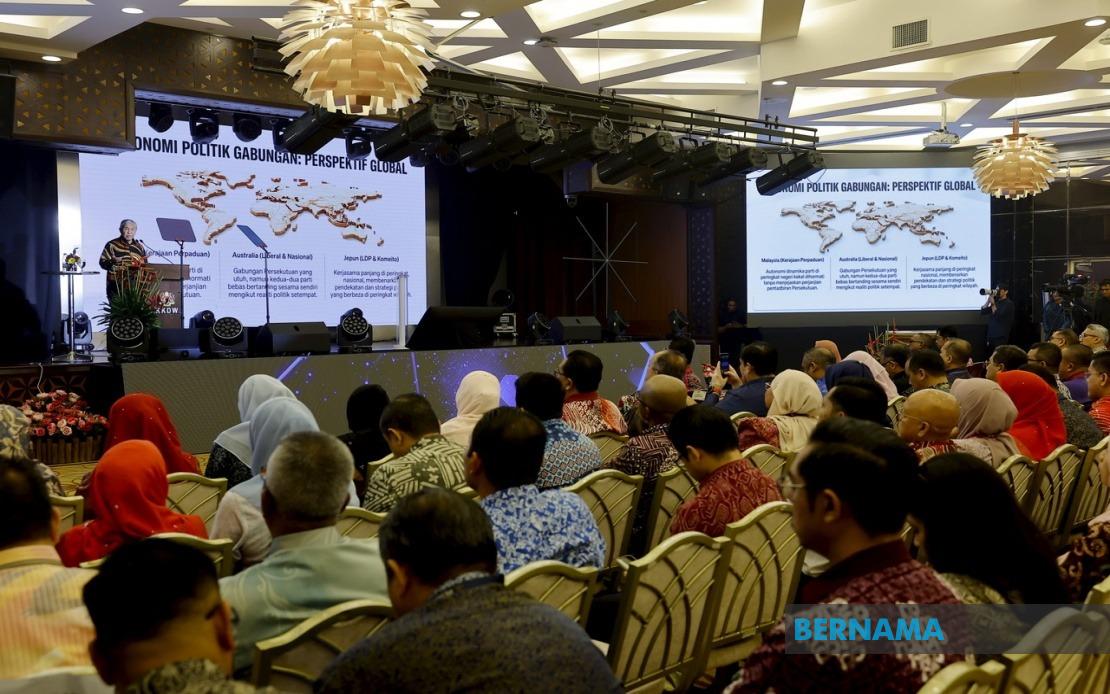
Deputy Prime Minister Datuk Seri Dr Ahmad Zahid Hamidi has moved to allay concerns about the impact of state-level political competition on national governance, asserting that rivalries at the state level present no threat to the stability of the federal administration. Speaking at the Rural and Regional Development Ministry's monthly assembly in Putrajaya on August 6, Ahmad Zahid, who also chairs Barisan Nasional, stressed that the Unity Government's foundational agreement would maintain its force as long as Parliament remains in session, insulating federal operations from state-level turbulence.
The Deputy Prime Minister's statement comes amid heightened political activity surrounding recent and upcoming state elections, particularly in Johor and Negeri Sembilan, where coalition dynamics have drawn scrutiny from political observers. Rather than view these contests as harbingers of instability at the national level, Ahmad Zahid framed them as natural expressions of political competition occurring within a broader framework of federal unity. His remarks suggest a deliberate attempt to compartmentalise state and federal politics, positioning the former as a separate arena where parties can pursue their interests without compromising their commitments at the centre.
Crucially, Ahmad Zahid articulated a framework for understanding how Malaysia's coalition government can function effectively despite differing political strategies among its constituent parties. He explained that participation in the Unity Government does not require coalition members to abandon their distinct political identities or core principles. This distinction matters significantly for countries like Malaysia that have embraced coalition-based governance. By emphasising that parties retain autonomy in determining their political strategies at the state level, Ahmad Zahid acknowledged the legitimate need for coalition partners to maintain separate bases of support and pursue their own electoral interests.
The concept of political autonomy within a coalition structure, as articulated by the Deputy Prime Minister, reflects a maturing approach to multi-party governance in Southeast Asia. Under this understanding, the agreement binding the Unity Government at the federal level functions as a ceiling constraining political behaviour, not a straitjacket eliminating all competition. Parties honour their commitment to the coalition while retaining the flexibility to compete vigorously in state elections and pursue distinct policy positions on certain issues. This model acknowledges that forcing parties to suppress their political identities entirely would be both unrealistic and ultimately destabilising, as it would breed resentment and undermine the voluntary nature of coalition membership.
Ahmad Zahid's assurances carry particular weight because the Barisan Nasional chairman directly leads one of the largest coalition partners in the federal government. His willingness to articulate a permissive framework for state-level competition suggests confidence that BN's state-level activities will not spill over into threats against federal arrangements. At the same time, his comments implicitly acknowledge that other coalition members, including PKR, DAP, and other Pakatan Harapan parties, similarly retain the right to pursue their own state-level strategies without federal-level consequences.
The stability of the federal government ultimately hinges on the durability of the underlying agreement binding coalition members together. Ahmad Zahid's repeated emphasis on this agreement remaining in force until Parliament dissolves serves as both reassurance and reminder. For Malaysian observers and international investors concerned about political risk, such explicit reaffirmations of commitment matter. They signal that despite tactical disagreements and state-level rivalry, the core coalition remains intact around shared objectives including the MADANI governance agenda.
Regarding the substantive work of government, Ahmad Zahid indicated that state-level political developments would not disrupt the implementation of federal policies, programmes, and projects. This promise addresses a practical concern about whether coalition tensions could impede economic activity, infrastructure development, and service delivery. By asserting that the administration will function normally regardless of state electoral outcomes, the Deputy Prime Minister seeks to isolate the machinery of government from political fluctuations. For businesses and citizens relying on consistent policy implementation, such continuity assurances provide valuable stability.
The Deputy Prime Minister's framework also carries implications for how Malaysia's coalition system evolves going forward. By normalising the coexistence of federal cooperation with state-level competition, Ahmad Zahid establishes precedent for sustained multi-party governance without the constant threat of coalition collapse. This represents a departure from earlier coalition models in Malaysia where defections and shifting alliances frequently disrupted stability. The Unity Government's longevity thus far suggests that institutionalising clear agreements and accepting tactical autonomy may prove more durable than attempting to enforce monolithic unity.
For Southeast Asian observers, Malaysia's experience demonstrates both the possibilities and complexities of sustaining coalition governance. Unlike some regional neighbours where single-party dominance persists, Malaysia has embraced genuine multi-party coalitions at the federal level. This necessarily introduces elements of competition and tension, yet these need not automatically translate into governmental dysfunction. Ahmad Zahid's comments reflect an emerging maturity in recognising that stable coalitions require clear rules of engagement, defined spheres of autonomy, and acceptance that coalition members will pursue distinct interests within agreed parameters.
Looking forward, the credibility of Ahmad Zahid's assurances will be tested as state elections continue and coalition partners inevitably clash over specific issues and electoral strategies. The Deputy Prime Minister has essentially laid out markers against which future federal stability can be measured. Should state-level rivalries begin intruding into federal arrangements, or should coalition partners violate the terms of their agreement, Malaysian observers will recall these explicit commitments to stability. For now, Ahmad Zahid's statement represents an attempt to normalise state-level political competition while maintaining confidence in federal institutional arrangements.

