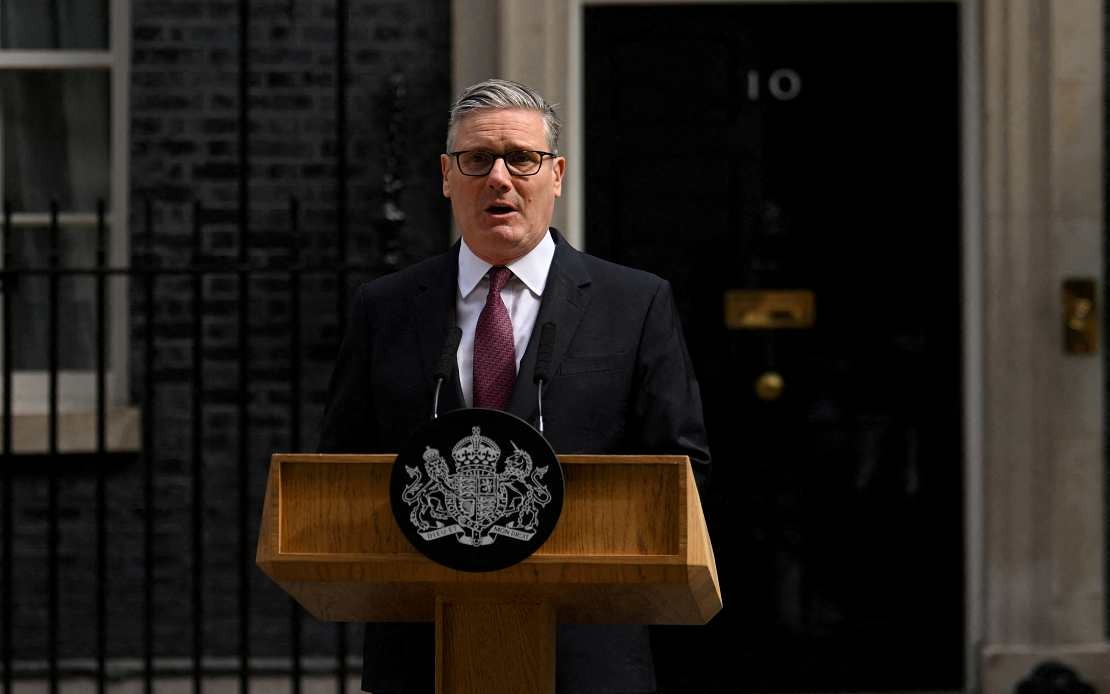
Keir Starmer delivered his valedictory address as British prime minister on Monday from Downing Street, marking the conclusion of a political journey that began with Labour's catastrophic defeat in 2019. Standing alongside his wife Victoria Starmer and surrounded by colleagues and friends, the departing premier struck a reflective tone, insisting that his tenure had strengthened the nation and positioned it on a firmer footing. He announced his imminent resignation to King Charles before preparing to depart for Buckingham Palace to formally tender his resignation, effectively closing a significant chapter in British political history.
Starmer's remarks underscored a narrative of transformation and redemption that defined his leadership. When he assumed control of Labour following the party's disastrous 2019 general election result, the organisation faced questions about its viability and electoral competitiveness. Over the subsequent years, he undertook a comprehensive reconstruction of party structures, messaging, and positioning to appeal to the broader British electorate. This patient, methodical approach culminated in Labour's decisive triumph in the 2024 general election, which he characterised as a landslide victory that reflected popular approval of his renewed vision for the party.
The timing of Starmer's departure comes after approximately two years in the prime ministerial office, a relatively brief tenure that nonetheless witnessed significant policy initiatives and constitutional moments. His assertion that Britain stood "stronger and fairer" than upon Labour's arrival in government encapsulated his administration's self-assessment regarding economic management, public services reform, and social policy direction. Whether this characterisation would survive scrutiny from independent observers remained subject to considerable debate, yet it represented his personal conviction regarding his time in office.
Andy Burnham emerges as Starmer's designated successor, though the formal mechanisms of his accession remained unclear from immediate reports. Burnham, a prominent Labour figure with extensive experience in government and regional politics, represents continuity with the party's electoral strategy whilst potentially offering a different leadership style or policy emphasis. His background, including previous ministerial roles and his tenure as mayor of Greater Manchester, provided him with substantial executive experience and a demonstrated capacity to engage with both Westminster politics and regional governance challenges.
The transition between Starmer and Burnham carries significance for how Labour will navigate the remainder of its parliamentary term and prepare for future electoral contests. The circumstances prompting Starmer's decision to step down after such a relatively short period warranted examination, though immediate public statements focused on his achievement of transforming the party and securing electoral victory rather than controversies or policy disagreements. The relationship between these two senior Labour figures, and how smoothly power transfers between them, would influence the party's internal cohesion and public standing during this period of leadership transition.
For Malaysian and Southeast Asian observers of British politics, the Labour transition illustrates broader patterns of political party renewal and regeneration following electoral setbacks. Starmer's project of reconstructing Labour demonstrated how comprehensive organisational reform, disciplined messaging, and strategic repositioning could restore an electorally damaged party to competitive status. These dynamics resonate with regional political parties that have experienced electoral reverses and sought pathways to renewal, offering lessons regarding the timeframes required for meaningful transformation and the patience needed to rebuild public trust.
The handover process also highlights leadership succession within Westminster democracy, where transitions between prime ministers occur within established constitutional frameworks yet involve substantial personal and political judgement. Unlike systems with fixed term limits or predetermined succession mechanisms, British practice relies upon party management and royal appointments, creating moments of political fluidity and uncertainty. The manner in which Labour executes this transition—whether through formal party mechanisms, broader consultation, or leadership contests—carries implications for perceptions of the party's internal health and democratic vitality.
Starmer's legacy will ultimately depend upon how his policies perform over time, whether public perceptions of improved national strength and fairness solidify or dissipate, and how subsequent Labour leadership builds upon or modifies his foundational approach. His emphasis on party reform and electoral competitiveness, achieved through disciplined repositioning, stands in contrast to alternative labour strategies in other democracies. The British context, with its particular constitutional arrangements, media environment, and electoral system, created specific conditions for his approach, though the underlying principle of systematic party renewal holds broader applicability.
Burnham's assumption of power initiates a new phase in Labour's governance, where the fresh priorities and leadership style of a different leader will shape party direction and policy implementation. Whether he will maintain the cautious, centrist positioning that characterised Starmer's approach, or pursue alternative emphases reflecting his own background in regional governance, remains to be determined. The transition represents not merely a change of individual leadership but a potential inflection point in how Labour presents itself to the British electorate and manages its substantial parliamentary majority.

