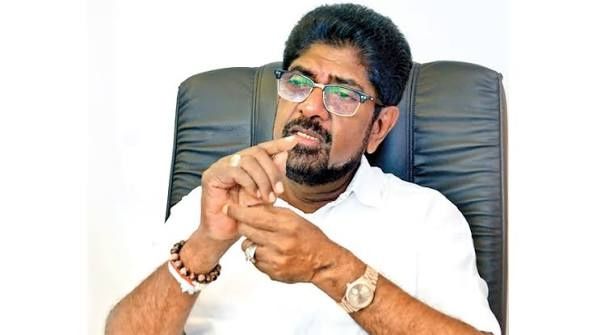
Keheliya Rambukwella, a former minister in Sri Lanka's government, was arrested this week on suspicion of masterminding the theft of a priceless historical artifact—a centuries-old carved granite moonstone that once formed part of the ceremonial entrance to the palace of Veera Parakrama Narendrasinghe, the last Sinhala king to rule the island before his reign ended in 1739. The arrest was announced by the Commission to Investigate Allegations of Bribery or Corruption (CIABOC), which has been probing the disappearance of the valuable carved rock since it was removed in December 2022.
The moonstone represents far more than a simple architectural ornament in Sri Lankan cultural and historical consciousness. These circular stepping stones typically serve as symbolic gateways to royal residences, holding profound significance in ancient Sinhala design and heritage. The palace from which the stone was taken stands as a crucial window into the island's pre-colonial past, making the theft not merely a criminal matter but an affront to national patrimony. CIABOC's investigation determined that Rambukwella did not act alone but rather conspired with others and actively facilitated the removal of the heavy granite object while holding ministerial office, a detail that compounds the gravity of the allegation.
Beyond his involvement in the moonstone disappearance, investigators have alleged that Rambukwella also obstructed police efforts to pursue the case at the time of the theft. This obstruction charge carries particular weight, as it suggests he used his official position to shield those involved and derail the investigative process. The anti-corruption commission specifically stated that he "conspired, aided and abetted the theft at a time when he was a minister," underscoring how his governmental role was weaponised to facilitate the crime.
The former minister now faces multiple concurrent legal challenges extending well beyond the moonstone case. Alongside the heritage theft allegations, authorities have charged him with an unrelated misdemeanour involving the misappropriation of state funds. According to the charges, Rambukwella used government money to pay salaries for six individuals employed in his private business ventures—a clear violation of civil service regulations that separates public office from personal profit.
However, the most serious criminal exposure facing Rambukwella stems from his tenure as health minister, a period marked by scandal and alleged negligence. During his time leading the health portfolio, he authorised the procurement of pharmaceutical supplies that turned out to be counterfeit, most notably a life-saving cancer treatment that was discovered to contain nothing more than water. This shocking revelation exposed patients battling terminal illness to false hope and physical danger, transforming what might have appeared as administrative incompetence into a potential case of endangering public health on a massive scale.
The counterfeit medicine scandal did not implicate Rambukwella alone. Several other senior officials within the health ministry have been indicted in connection with the same scheme, suggesting a systemic problem within procurement processes rather than isolated individual wrongdoing. Nevertheless, Rambukwella's position as health minister places him at the apex of responsibility for the decisions that allowed such contaminated and fraudulent pharmaceuticals to enter the state hospital system.
The timing of these scandals cannot be separated from Sri Lanka's broader economic catastrophe. When Rambukwella held the health portfolio, the nation was gripped by an unprecedented medicine shortage that cascaded from the country's historic default on its US$46 billion foreign debt in April 2022. That default itself followed Sri Lanka's formal declaration of bankruptcy, a humbling admission that forced the government to confront its inability to meet international financial obligations. In this context of scarcity and institutional breakdown, the decision to procure counterfeit drugs—whether through deliberate fraud or criminal negligence—represents a particularly callous betrayal of vulnerable patients.
For Malaysian observers, the Rambukwella case offers instructive lessons about the intersection of ministerial accountability and systemic corruption. Like Malaysia, Sri Lanka operates within a framework where ministers wield considerable discretionary power over state resources and procurement decisions. The moonstone theft case is particularly striking because it suggests that even cultural heritage assets can become targets for theft when ministerial oversight and anti-corruption mechanisms fail. The ability of a sitting minister to facilitate the removal of a sacred historical object and obstruct investigation reveals dangerous gaps in institutional checks.
The multiple charges against Rambukwella also illustrate how corruption often manifests not as a single spectacular crime but as a pattern of interconnected offences spanning different portfolios and timeframes. His alleged misuse of state funds for private employment, the counterfeit medicine procurement during his health ministry role, and the moonstone conspiracy represent different flavours of abuse of office, yet they collectively paint a picture of a public servant who systematically exploited his position for personal or factional gain.
The CIABOC's decision to proceed with arrests and charges during an economically fragile period suggests that Sri Lanka's anti-corruption institutions, despite the country's overall institutional stress, retain some operational independence. This contrasts with scenarios in other nations where economic crisis leads to political suppression of investigations. Yet the question remains whether the formal machinery of accountability will translate into meaningful justice and deterrence, or whether connected officials will find ways to mitigate consequences through procedural delay or political intervention.
As Sri Lanka continues to navigate its debt restructuring and economic recovery, high-profile corruption cases like Rambukwella's serve dual purposes: they satisfy public appetite for accountability while potentially functioning as theatre that masks systemic reforms yet to come. The test of genuine institutional reform will lie not in individual prosecutions but in whether the root causes enabling procurement fraud, misappropriation of heritage assets, and obstruction of investigations are addressed through structural change.

