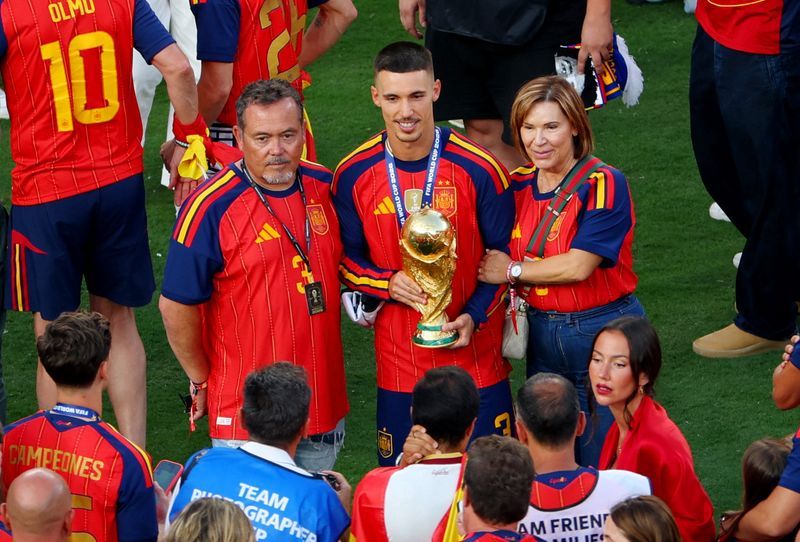
Spain's 1-0 victory over Argentina in the World Cup final at East Rutherford, New Jersey, on July 19 represented far more than a single goal. It was the culmination of a footballing philosophy so deeply embedded in Spanish culture that it transcends sport, reflecting how a diverse nation found collective purpose through the beautiful game. The decisive strike, scored by substitute Ferran Torres and created by fellow replacement Nico Williams, epitomised the Spanish approach: no individual superstar, but rather an orchestra where every player, regardless of when they entered the field, understands the composition perfectly.
The match itself was a masterclass in controlled dominance. Spain maintained over 65 percent possession throughout the encounter, a statistic that barely captures the suffocating nature of their control. They registered 12 shots on target while Argentina managed only one, which came late in extra time and failed to trouble the scoreboard. More tellingly, Spain completed more than twice as many passes as their opponents, dictating the tempo and rhythm with such precision that Argentina found themselves perpetually chasing shadows. Yet this was not the destruction of a superior opponent but rather a grinding, persistent assertion of superiority—a team that refused to rush, refused to panic, and refused to deviate from the principles that define them.
What makes this victory particularly significant for understanding modern football is how it contradicts the narrative that possession football has become antiquated. Spain did not simply retain the ball; they weaponised it, using circulation and movement to exhaust opponents and create openings. Even when chances emerged, they were often squandered, exposing a familiar vulnerability: the absence of a clinical, traditional centre-forward who could finish with ruthless efficiency. This gap in the squad has haunted Spanish football for years, yet it remained merely an inconvenience rather than a fatal flaw, subordinate to the overwhelming superiority of their overall system.
The decision to deploy substitutes for the match-winning combination underscores Luis de la Fuente's understanding of his team's identity. This is not a squad assembled around marquee names requiring guaranteed minutes but rather a carefully constructed collective where replacements have absorbed the tactical principles so thoroughly that disruption becomes seamless. Williams and Torres understood the positional responsibilities, the passing angles, and the pressing triggers without hesitation. Across the knockout rounds, substitutes had scored Spain's decisive goals on three separate occasions—a statistic that would seem improbable for any other team but feels inevitable for one built on such philosophical consistency.
Spain's dominance extended beyond a single match. Their unbeaten streak now stands at 38 matches, surpassing Italy's previous record and underlining three years of sustained excellence in international football. This is not a flash of brilliance but rather a programme of relentless development under a coach many Spanish media outlets once dismissed as Luis de la "Who"—a reference to his lengthy apprenticeship through the Spanish Football Association's youth structures. De la Fuente's patient, methodical rise proved that infrastructure and philosophy matter more than celebrity, a lesson that resonates far beyond football.
The individual honours accumulated by Spanish players during the tournament reinforced this philosophy of collective excellence. Pau Cubarsi earned recognition as Best Young Player, Unai Simon as Best Goalkeeper, and Rodri claimed the Most Valuable Player award. Only the Golden Boot escaped Spain's grip, won by France's Kylian Mbappe, and this too felt consonant with the Spanish narrative: their 14 goals across eight matches were distributed among eight different players. Similarly, during their European Championship victory in 2024, Spain scored 16 goals through 10 different players—a distribution that frustrates traditional strikers while making the team extraordinarily difficult to neutralise.
Beyond the tactical and statistical dimensions lies a deeper resonance with Spanish identity itself. The squad composition reflects the country's internal geography and cultural heritage in ways that transcend tokenism. Players hailing from the Basque Country—Mikel Oyarzabal, Unai Simon, and Mikel Merino—shared the pitch with representatives from Galicia, Valencia, Madrid, Andalusia, and the Canary Islands. Two of the nine Catalan-born players in the squad, Pau Cubarsi and Marc Cucurella, were instrumental, while Lamine Yamal and Nico Williams embodied the success of immigration and demographic change within Spanish society. This was not merely a football team but a microcosm of contemporary Spain, its contradictions, its diversity, and its capacity to unite around shared purpose.
Historically, Spain's strength has derived from this internal multiplicity—the recognition that the nation comprises distinct regions, each with unique histories, languages, and identities. That Sunday evening in New Jersey, these differences did not dissolve; rather, they ceased to be divisive. The Catalan, the Basque, the Andalusian, and the Madrileño stood together not because their regional identities had been erased but because football provided a framework within which those identities complemented rather than competed. It was a fleeting demonstration of what collective purpose could achieve when channelled through shared values and mutual respect.
The victory carries particular significance for Malaysian and Southeast Asian observers, many of whom grapple with their own questions about national cohesion amid diversity. Spain's triumph suggests that unity need not require uniformity; rather, it emerges when individuals surrender not their identity but their insistence on primacy. In football terms, this manifests as player discipline and tactical obedience. In political and social terms, it implies a willingness to subsume particular interest to collective benefit. That Spain achieved on the international stage what remains elusive in many political forums—genuine, functional unity amid diversity—offers a profound if bittersweet commentary on the relative capacities of sport and governance to bind fractured societies.
De la Fuente's team has established a template for footballing excellence that prioritises philosophy over personalities, collective strength over individual brilliance, and sustained excellence over momentary triumph. Whether this model can be replicated by other nations, or whether Spain's particular cultural and organisational advantages make them unique, remains an open question. Yet for one night at least, on the grass of New Jersey, Spain reminded the football world—and by extension, the broader world watching—that mastery through unity transcends sport. It becomes a statement about who we are and what we might become when we commit to something larger than ourselves.

