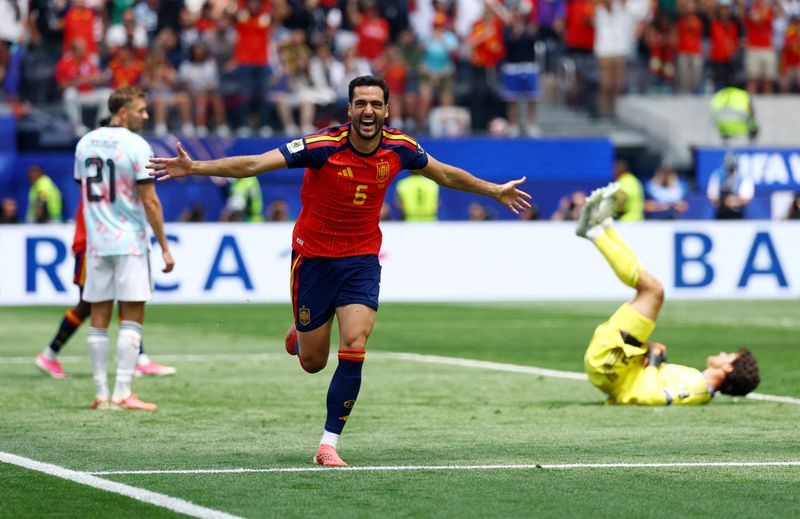
Spain secured their place in the World Cup semi-finals on Friday with a hard-fought 2-1 victory over Belgium, a result that sets up a tantalizing clash against tournament favourites France in Dallas. The pivotal moment came in the 88th minute when substitute Mikel Merino capitalized on a goalkeeping error to fire home from close range, turning what had been a closely contested quarter-final into a Spanish triumph at the sold-out Los Angeles Stadium, where stifling heat added to the intensity of the contest.
The breakthrough moment demonstrated how fine the margins are in knockout football. Belgium's replacement goalkeeper Senne Lammens, thrust into action after Thibaut Courtois sustained an injury, struggled to deal with Pau Cubarsi's low drive. The ball skipped away from his grasp and bobbled forward, leaving Merino with a simple finish that sent the Spanish-dominated crowd into raptures. For Lammens, it was a cruel introduction to World Cup football at its most demanding level, yet his presence on the pitch itself reflected the mounting injury crisis consuming the Belgian camp.
Spain's path to the semi-finals represents a significant achievement for Luis de la Fuente's side, who have now reached this stage only once before in the tournament's history. That previous semi-final appearance came in 2010, when Spain won the World Cup, establishing themselves as one of the era's dominant football nations. Their only other deep run in the competition occurred in 1950, when the tournament's format featured a final group stage rather than conventional knock-out rounds, and Spain finished fourth. The current squad's advancement therefore places them among elite company in their football heritage.
Spain's dominance early in the match bore fruit when Fabian Ruiz gave them a 30th-minute lead, demonstrating the attacking intent that de la Fuente had instilled. Ruiz's goal came after Courtois produced a diving save, only for the PSG midfielder to pounce on the loose ball and slip it past Timothy Castagne's legs. The decision to start Ruiz ahead of Pedri proved vindicated by this opening goal, though Pedri would later enter the fray to provide fresh impetus as the match evolved. This tactical choice by de la Fuente highlighted how World Cup football demands adaptability and willingness to make unconventional decisions based on form and circumstances.
Belgium's response came swiftly, with Charles De Ketelaere levelling the match just eleven minutes later through a well-timed header from Castagne's cross past Unai Simon. This equaliser marked the first goal Spain had conceded throughout the entire tournament, a statistic that underscored their defensive solidity prior to this contest. De Ketelaere's finish breathed new life into a Belgian side that had come to California already depleted by injuries, and the match entered a grinding second half played under relentless heat that tested both teams' physical reserves.
Belgium's injury woes extended well beyond the midfield, with captain Youri Tielemans ruled out shortly before kickoff after suffering a warm-up injury. Hans Vanaken stepped in to replace him, while midfielder Amadou Onana remained unavailable following a serious ACL tear sustained during their round-of-16 victory against the United States. These absences left Belgium operating at a significant disadvantage, forcing them to adapt their tactical approach and leaving gaps that Spain would eventually exploit through fresh legs and attacking substitutions.
Spain emerged with renewed energy after the interval, gradually asserting control over a Belgian defence that was being stretched by wave after wave of Spanish attacks. The introduction of Merino in the 86th minute provided the thrust needed to break through Belgium's increasingly desperate resistance, and his freshness proved decisive when the goalkeeping error presented the opportunity. De la Fuente's use of the bench demonstrated how crucial timing and player rotation have become in modern tournament football, particularly when facing opponents already hampered by injury.
The semi-final meeting between Spain and France in Dallas on Tuesday represents a fascinating collision of styles and pedigree. France enters as tournament favourites and defending champions, while Spain brings a tradition of technical excellence and recent tournament success. The Dallas venue will be a neutral ground for both European powerhouses, yet the match carries significant implications for the tournament's narrative. Spain's passage has been notable for their controlled, possession-based football, while France's route has been characterized by their ability to win tight contests through clinical finishing and tactical discipline.
The atmosphere at Los Angeles Stadium reflected the magnitude of the occasion, with celebrities including musicians Courtney Love and Noel Gallagher, actor Brad Pitt, and Spanish stars Penélope Cruz and Javier Bardem among the thousands who gathered to witness this quarter-final encounter. The presence of such figures underscored how the World Cup transcends sport, becoming a cultural event that attracts global attention regardless of nationality. For Spanish football followers watching from Southeast Asia and beyond, the advancement represents validation of de la Fuente's philosophy and squad selection, offering hope that their team possesses the depth and tactical flexibility required to challenge for the trophy.

