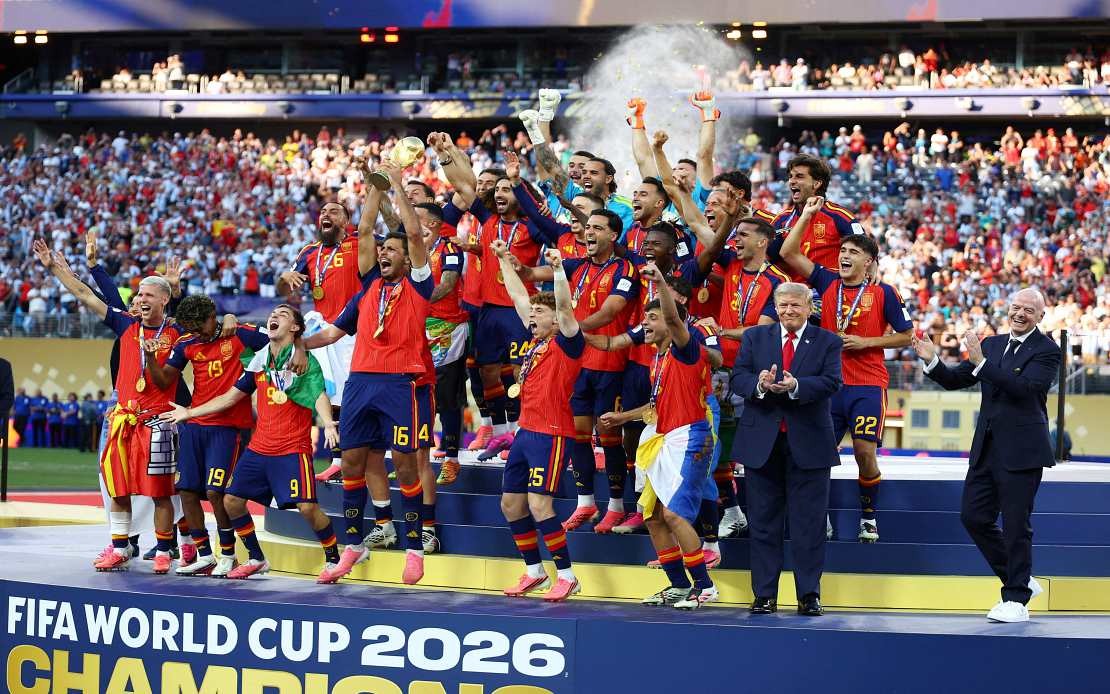
Spain prepared for a momentous homecoming on Monday following their conquest of football's greatest prize at the World Cup in the United States. The triumphant squad, spearheaded by captain Rodri, touched down at Madrid airport at 12:50 pm, marking the beginning of nationwide festivities to mark the nation's second men's World Cup championship. Organisers anticipated extraordinary crowds throughout the day as supporters flooded the capital to welcome back their heroes.
The celebrations unfolded according to a carefully choreographed schedule that reflected Spain's pride in the achievement. King Felipe VI hosted the team at the Royal Palace in the afternoon, providing an official state reception befitting the magnitude of the victory. This formal acknowledgement underscored the cultural significance of World Cup success in Spanish society, where football occupies a central position in national identity.
Following the royal audience, the squad embarked on an open-top bus journey through central Madrid's streets, winding through thoroughfares lined with supporters estimated to number in the hundreds of thousands. The parade route allowed ordinary citizens across the capital to participate in collective celebration, transforming public spaces into scenes of unified national euphoria. Such public displays demonstrate how sporting achievements transcend entertainment, becoming occasions where entire nations affirm their bonds.
The day's culminating event took place at Cibales Square, where organisers scheduled a major public gathering commencing at 6 pm. The team was expected to arrive at 9 pm, by which time the square would likely accommodate vast throngs of well-wishers. The extended timeline ensured maximum participation, allowing supporters throughout Madrid and surrounding regions sufficient opportunity to gather for the finale.
Defender Marc Cucurella articulated the squad's enthusiasm about the homecoming, emphasising the desire to share their accomplishment with the broader population. His remarks reflected a team mindful that countless supporters had invested emotional energy throughout the tournament despite being unable to attend matches abroad. The players recognised their responsibility to deliver a celebration worthy of the investment and loyalty demonstrated by the nation's fans, transforming individual athletic success into collective joy.
Spain's second World Cup title represented a watershed moment for Spanish football, building upon the nation's earlier success and continental dominance in recent decades. The decisive victory came through a dramatic extra-time goal from Ferran Torres against Argentina, concluded on Sunday in the United States. This margin of victory—achieved when regulation time had produced deadlock—underscored the tournament's unpredictability and the exceptional character of Spain's championship triumph.
The presence of the Spanish royal family at the tournament venue in New Jersey conveyed the significance accorded to the campaign at the highest levels of state. King Felipe VI's attendance demonstrated institutional investment in the team's success, transforming the World Cup from a sporting event into an affair of national consequence involving government, monarchy, and citizenry alike. Prime Minister Pedro Sánchez reinforced this narrative through his immediate social media statement declaring Spain as World Champions and praising the team's performance, thereby associating the political establishment with the victory.
For Malaysian and Southeast Asian observers, Spain's homecoming celebrations offer instructive perspectives on how nations marshal public enthusiasm around athletic achievement. The structured approach to celebrations—combining official state recognition through royal ceremony with grassroots public participation through street parades—reflects sophisticated understanding of how sporting success can reinforce national cohesion. Similar approaches characterise major tournaments when Southeast Asian nations achieve significant results, demonstrating universal patterns in how governments and societies process collective sporting triumphs.
The World Cup victory also reaffirmed Spain's standing within global football's hierarchy at a moment when various nations compete for continental and intercontinental supremacy. Having already established dominance through previous tournament successes and regional championships, Spain's latest triumph consolidated their position as consistent heavyweight competitors. For regional football observers, Spain's sustained excellence illustrates the importance of systematic player development, tactical coherence, and institutional investment across extended timeframes rather than sporadic efforts.
The Madrid celebrations exemplified how modern sporting events generate economic and social benefits extending beyond match-day experiences. The anticipated visitor influx would benefit local hospitality, retail, and service sectors, while the public festivities created memorable experiences for residents and visitors alike. Such secondary effects increasingly factor into governments' calculations regarding investment in football infrastructure and team support.

