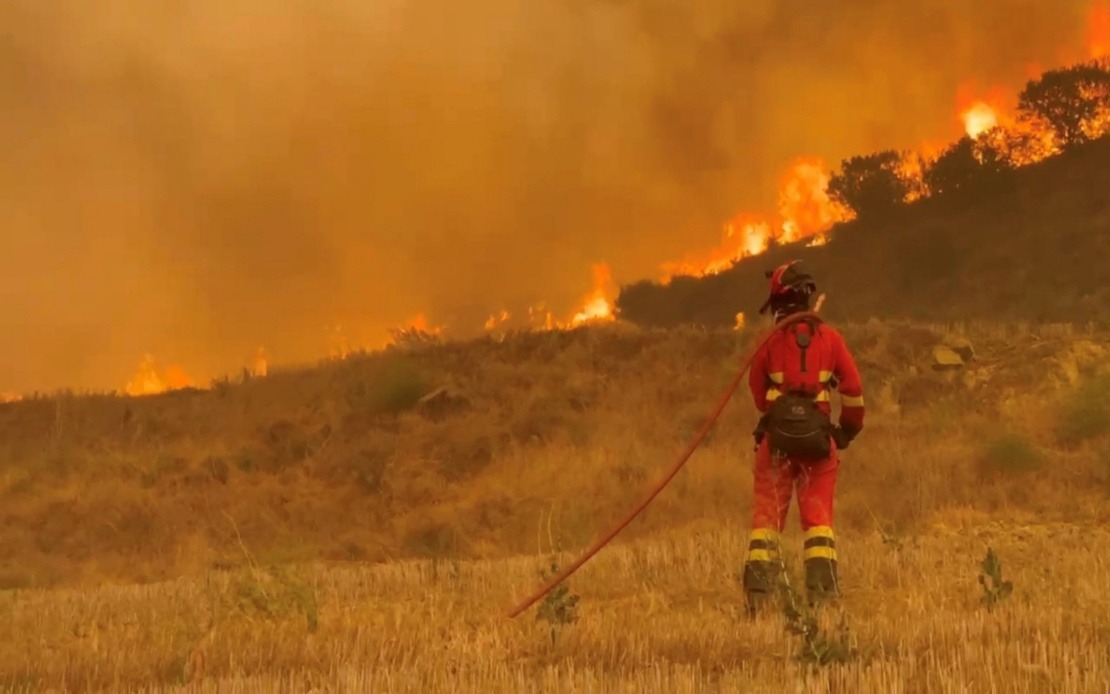
Spain is battling its most severe wildfire of 2024 in the northeastern province of Zaragoza, where flames have ravaged approximately 12,000 hectares of land. The massive blaze, which ignited on Wednesday in the Cinco Villas region, remains highly active and continues to spread uncontrollably, forcing authorities to evacuate more than 1,100 residents from surrounding communities. The scale of this disaster underscores the mounting vulnerability of Mediterranean nations to increasingly intense wildfires, a trend that carries significance for Southeast Asian countries also grappling with seasonal fire crises.
The fire's perimeter has expanded across roughly 60 kilometres, creating a formidable challenge for emergency responders. Authorities characterised the situation as extremely fluid, with significant expansion occurring overnight into Friday as temperatures remained elevated and weather conditions favoured rapid fire progression. The evacuation order has affected five municipalities within Zaragoza itself, plus an additional municipality in the neighbouring Navarre region, displacing hundreds of families from their homes with minimal warning.
The response effort reflects the scale of the emergency, with around 400 firefighters deployed on the ground supported by 19 aircraft conducting aerial bombardment and reconnaissance missions. Overnight operations focused specifically on defending residential areas in Uncastillo, prioritising the protection of lives and infrastructure over broader containment. While electricity supplies have been restored across affected towns, numerous key roads remain closed, complicating evacuation routes and hampering the movement of additional resources to the frontline.
The Cinco Villas region has implemented lockdown protocols in parts of the affected area, and two major roads continue to be inaccessible, further isolating communities and limiting civilian movement. Authorities also requested deployment of Spain's Military Emergency Unit, demonstrating the crisis's severity and the recognition that civilian firefighting capability alone would prove insufficient. The military contingent, numbering around 100 personnel, was dispatched to reinforce existing firefighting operations and provide additional logistical support.
This disaster is not occurring in isolation. A second wildfire in La Mierla, situated in the northern province of Guadalajara, has consumed approximately 900 hectares and remains actively expanding. Nearby communities have been placed under lockdown measures, and evacuation protocols initiated as a precautionary measure. A third fire near Lozoyuela, located north of Madrid, continues to pose challenges despite showing somewhat better containment prospects; emergency officials have indicated that while the situation is progressing in a favourable direction, the blaze remains neither fully controlled nor completely contained.
Investigators have already made an arrest in connection with the Madrid-region fire, apprehending a man suspected of deliberately initiating the blaze. The regional government has indicated its intention to participate in legal proceedings as a civil party, signalling both accountability efforts and the serious resource drain caused by human-started fires. This development highlights how deliberate arson compounds the natural vulnerability of Mediterranean regions during peak fire season.
The confluence of environmental and climatic factors has created ideal conditions for explosive fire growth across Spain's interior. Meteorologists point to persistently high temperatures, sustained strong winds, critically low humidity levels, and abundant dry vegetation as the primary culprits. Paradoxically, the abundant fuel load stems partly from unusually heavy rainfall during spring months, which promoted lush vegetation growth that subsequently dried to tinder-like conditions as summer heat intensified.
Ecologists and climate scientists increasingly identify structural factors amplifying wildfire risk across rural Europe. The widespread abandonment of agricultural land and pastoral management has resulted in dense, unmanaged vegetation accumulation in previously cleared areas. Combined with the documented effects of anthropogenic climate change—including extended fire seasons, temperature increases, and moisture deficits—this abandonment creates a powder-keg scenario where fire can spread with remarkable speed and intensity. The Spanish situation mirrors patterns emerging across Mediterranean Europe and has parallels with fire management challenges confronting Southeast Asian nations.
For Malaysian and regional observers, Spain's struggle offers instructive lessons about the interconnection between land use, climate dynamics, and disaster preparedness. Southeast Asia's own vulnerability to seasonal fires—particularly in Malaysia, Indonesia, and Thailand—shares some underlying drivers with the Spanish crisis: changing precipitation patterns, temperature increases, and land-use transformations driven by agricultural expansion and abandonment. While the Mediterranean context differs from tropical environments, the fundamental principle that climate change and land management fundamentally reshape fire risk applies universally.
The scale of deployment—400 ground personnel and 19 aircraft—demonstrates the extraordinary resource commitment required to combat contemporary mega-fires, yet even this massive effort may struggle to contain the blaze. The involvement of military units signals recognition that civilian infrastructure alone cannot manage emergencies of this magnitude. For developing nations with more constrained resources, these lessons suggest that prevention through landscape management, early warning systems, and community preparedness becomes increasingly critical compared to relying primarily on suppression capacity.
As firefighters continue around-the-clock operations, the humanitarian cost mounts for displaced residents uncertain about their homes' fates. The broader implications extend beyond immediate casualties: ecosystem destruction, air quality degradation across wider regions, carbon dioxide releases, and disruption to agricultural and tourism economies compound the direct damage. Spain's wildfire season typically extends through summer months, meaning this crisis represents only the beginning of potential difficulties ahead.

