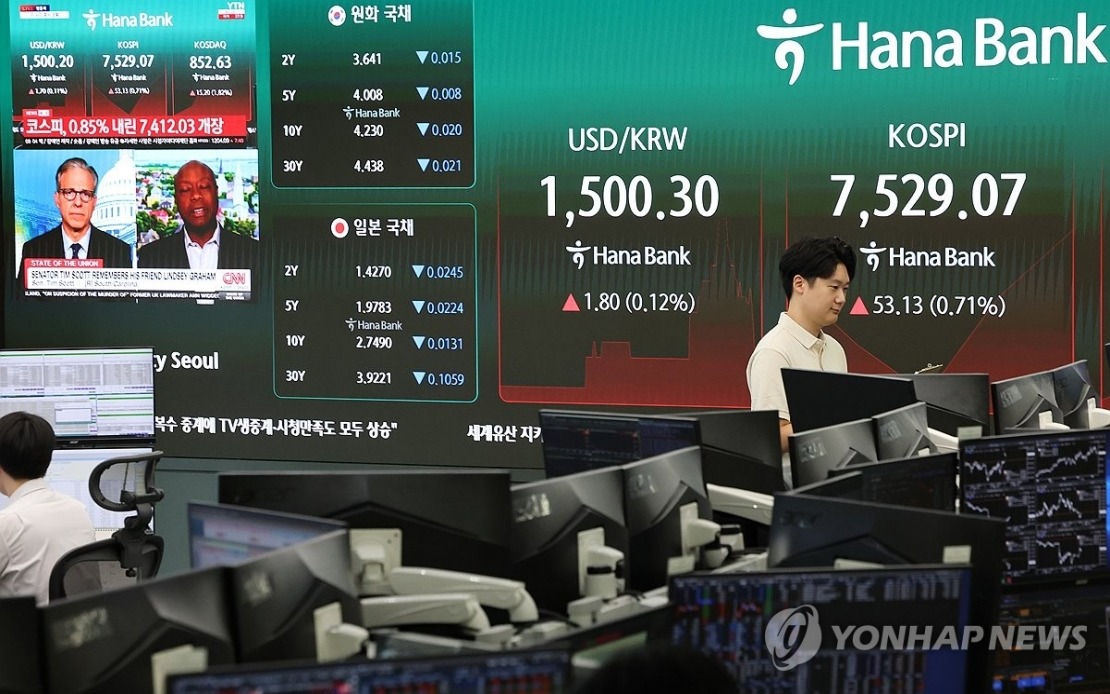
South Korea's stock market experienced significant turbulence on Monday when the Korea Exchange activated an automatic circuit breaker mechanism to contain a sharp selloff in the KOSPI index. The trading halt came just before 1:28 p.m. local time after the benchmark indicator retreated more than 8 percent from the prior session's closing level, triggering the exchange's predetermined safeguard designed to arrest volatile price movements and restore orderly market conditions.
Trading in KOSPI-listed equities was suspended for 20 minutes as a result of the activation, giving investors time to reassess positions and digest the catalyst behind the sudden decline. The circuit breaker mechanism functions as a crucial circuit-breaker system that pauses transactions when predetermined thresholds are breached, preventing panic-driven cascades that could amplify losses across the market. The suspension provided breathing room during a period of heightened uncertainty affecting regional and global financial sentiment.
The underlying cause of the market's sharp retreat stemmed from escalating military tensions between the United States and Iran involving disputed control of the Strait of Hormuz. Fresh exchanges of strikes between the two powers rekindled investor concerns about potential disruptions to one of the world's most critical maritime chokepoints, through which approximately one-third of global seaborne petroleum exports transit annually. For an energy-importing nation like South Korea that depends heavily on stable oil supplies, any threat to Hormuz stability carries direct implications for economic growth and corporate profitability.
The geopolitical friction created a contagion effect across Asian financial markets as investors fled riskier assets and sought safer havens. Heightened tensions in West Asia historically trigger sharp equity retreats as market participants become more averse to uncertainty, leading to rapid portfolio rebalancing away from equities toward bonds and precious metals. The selling pressure reflected broader concerns that escalating conflict could disrupt energy supplies and raise input costs for manufacturing-dependent economies throughout the region.
Monday's activation marked the seventh instance this year that the KRX has felt compelled to deploy circuit breakers, underscoring the elevated volatility characterizing global markets throughout 2024. The frequency of these interventions signals that underlying economic and geopolitical anxieties continue simmering beneath surface-level equity valuations. Each activation essentially captures a moment when collective market anxiety breaches predetermined thresholds, revealing the fragility beneath investor confidence despite nominal price stability during calmer periods.
For Malaysian stakeholders and regional observers, South Korea's market turbulence carries several implications worth monitoring. The KOSPI serves as a barometer for Asian technology and semiconductor sentiment given South Korea's leading position in these sectors, industries that directly intersect with Malaysian export supply chains and investment portfolios. When the KOSPI experiences sharp declines, regional semiconductor suppliers and technology firms often face downstream pressure as customer demand weakens and capital expenditure cycles compress.
Moreover, the vulnerability of Asian equities to geopolitical shocks centred on Middle Eastern flashpoints underscores the region's structural exposure to global energy price volatility. Malaysia, alongside other Southeast Asian nations, remains sensitive to crude oil price swings driven by supply disruption fears originating from West Asian tensions. The circuit breaker activation in Seoul therefore serves as an early warning system indicating rising risk premiums across Asian financial markets with potential spillover effects on local stock exchanges and currencies.
Investor behaviour during such episodes reveals the interconnectedness of modern capital markets. A geopolitical event in the Middle East, interpreted through the lens of an advanced Asian economy's equity markets, within hours influences trading decisions affecting Malaysian businesses and portfolio holdings across the region. The 20-minute KOSPI trading suspension functioned not merely as a mechanical pause but as a symbolic moment of collective regional reassessment regarding risk-return calculations in an increasingly volatile geopolitical environment.
The persistent activation of circuit breakers throughout 2024 suggests that markets remain structurally unprepared for sudden shocks despite nominal returns and price recovery narratives. These safeguards, while preventing catastrophic free-falls, also implicitly acknowledge that underlying volatility has not diminished but merely been temporarily contained through mechanical interventions. For regional investors and policymakers monitoring stability across Asian markets, the frequency of these halts warrants closer attention to the deepening fragility characterizing global financial conditions beneath surface-level optimism.

