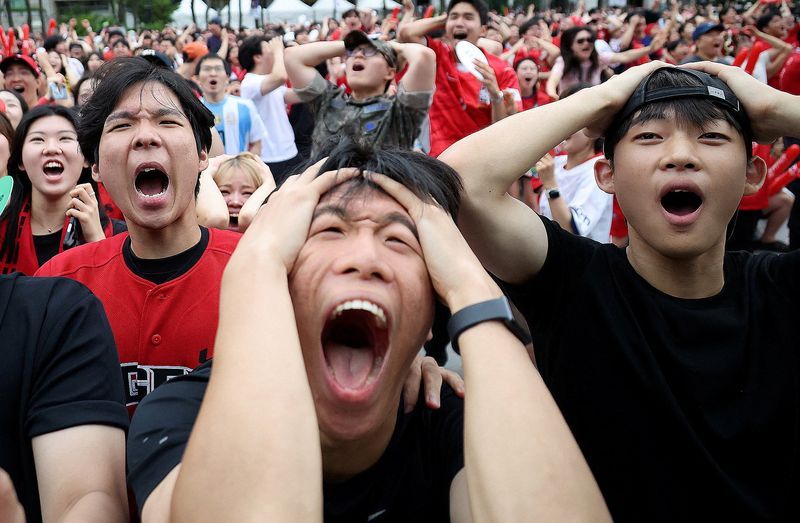
South Korea's President Lee Jae Myung has triggered a high-level government review into his nation's stunning World Cup elimination, publicly castigating the appointment of national football coach Hong Myung-bo and raising pointed questions about institutional accountability in sports management. The outburst underscores how deeply the team's premature exit has rattled the country's political establishment, with Lee declaring himself "utterly baffled" by a performance that shattered widespread expectations of advancement from what observers had deemed a manageable group stage.
The South Korean squad's failure to progress from Group A represents a significant embarrassment for the football federation and the government bodies that oversee it. Successive defeats to Mexico and South Africa left the team in third place, missing out on qualification despite being among the pre-tournament favourites to advance. Lee's response has moved beyond typical sports commentary into a broader critique of how public institutions make critical personnel decisions, transforming a football story into a governance issue with implications reaching far beyond the pitch.
In his statement posted on social media platform X on Sunday, Lee articulated a sweeping indictment of what he characterised as systemic failures in appointment procedures. He contended that when organisational loyalty and factional considerations supersede professional merit and capability, the inevitable consequence is disappointing outcomes. The president's language suggests he views Hong's appointment as emblematic of deeper institutional problems within South Korea's sports administration—a pattern he implies extends beyond football to affect other sectors and governmental operations.
Hong's reappointment as national team manager in 2024 had already attracted controversy and media scrutiny regarding the recruitment process. Korean journalists had questioned whether the decision reflected genuine competitive evaluation or instead rewarded personal connections and factional allegiances, allegations that Hong consistently denied. Lee's public intervention appears to validate longstanding concerns about transparency and merit-based selection in high-profile sporting positions, lending presidential weight to criticism that had previously remained confined to sports media and online discourse.
The political fallout has extended into formal accountability mechanisms. A petition circulated through South Korea's national assembly website calling for Hong's dismissal garnered sufficient signatures within days to qualify for an initial parliamentary review. This procedural escalation indicates that significant numbers of South Korean citizens and lawmakers share the president's concerns about the coaching decision, transforming a sports controversy into a matter of official legislative consideration. The speed with which the petition achieved the necessary threshold suggests widespread public dissatisfaction cutting across conventional demographic or partisan lines.
Social media has amplified the political dimensions of the controversy. Photographs and videos showing South Korean shopkeepers posting notices banning Hong from their establishments have circulated widely online, creating a visible manifestation of public resentment. These grassroots expressions of frustration, while informal, demonstrate the extent to which the World Cup failure has captured the national mood and generated pressure on both the football establishment and government to respond decisively.
Lee has formally requested that South Korea's Ministry of Culture, Sports and Tourism conduct a comprehensive investigation into the circumstances surrounding the team's elimination. This directive asks officials to examine the precise conditions and decisions that contributed to the failure, identify root causes, and propose corrective measures to prevent similar occurrences. The instruction implies that Lee views the incident not as a isolated coaching or tactical mishap but rather as symptomatic of broader institutional dysfunction requiring structural remedies.
The president's framing of the World Cup exit as an "organisational and personnel failure" rather than simply a sporting disappointment situates the controversy within discussions about accountability in public institutions. His emphasis on distinguishing between public and private interests, and his warnings against prioritising personal advantage over collective welfare, applies a governance framework to what might otherwise remain a football matter. This rhetorical strategy elevates the issue to one of constitutional principle and institutional integrity.
For Malaysia and other Southeast Asian nations observing South Korean politics, the episode illustrates how thoroughly sports and politics intertwine in East Asian democracies. The willingness of a sitting president to intervene publicly in football administration reflects expectations that high-profile national sports programs remain accountable to the broader public interest. This contrasts with contexts where such matters might be delegated to independent sporting bodies operating largely insulated from political scrutiny.
The investigation Lee has initiated will inevitably examine not only Hong's qualifications and appointment process but also the broader ecosystem of decision-making within South Korea's sports ministry and football federation. Such a review, if conducted with genuine independence, could establish precedents for how personnel appointments in other prominent national institutions are evaluated and justified to the public. The outcome may determine whether South Korea moves toward greater transparency in sports governance or whether the review becomes a political exercise that fails to address underlying systemic concerns.
The emotional intensity of Lee's response—his declaration of being "utterly baffled" rather than merely disappointed—signals that the president recognises the World Cup failure as politically significant. A major sporting setback that undermines national pride while being attributed to negligent decision-making presents a governance challenge that demands visible executive action. Lee's intervention, while controversial in its directness toward a sitting coach, demonstrates how national football programs function as extensions of state legitimacy in contemporary democracies.

