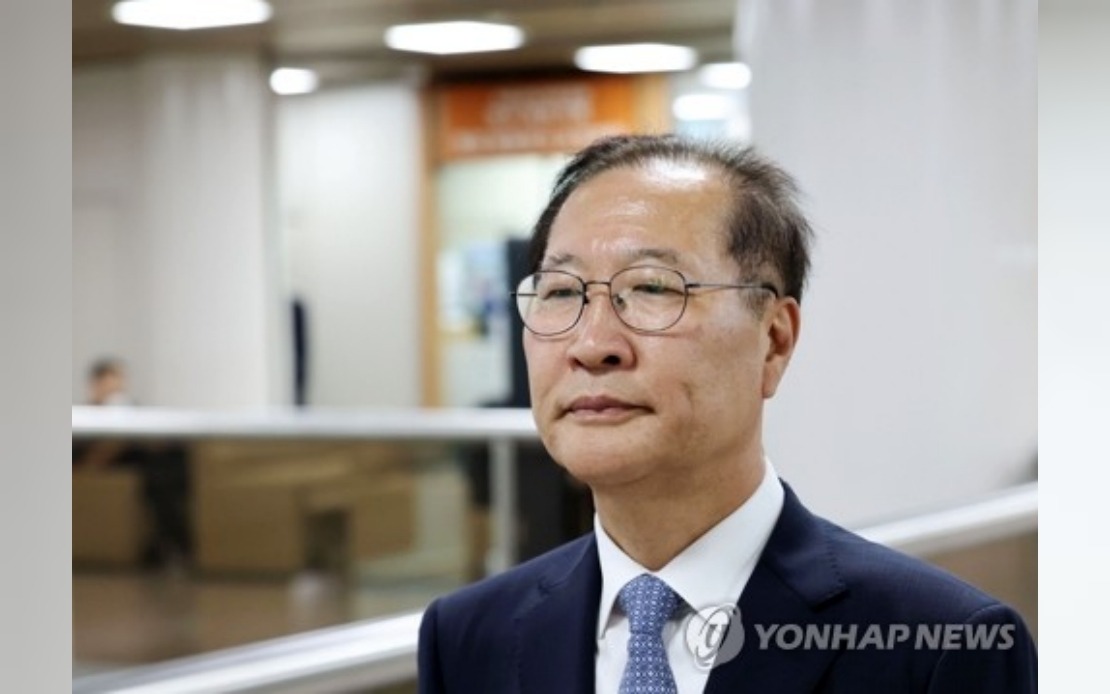
South Korea's judicial system delivered another significant blow to former President Yoon Suk Yeol's administration on Monday when the Seoul Central District Court sentenced former Justice Minister Park Sung-jae to 25 years in prison. The conviction came after the court determined that Park had played an instrumental role in supporting an insurrectionary attempt through his active participation in the controversial martial law declaration that rocked the nation in December 2024. The sentence, handed down by the district court, surpassed the 20-year term recommended by special counsel Cho Eun-suk's investigative team, demonstrating that the judiciary viewed Park's culpability as particularly grave. The court made the custody decision immediately following sentencing, citing substantial concerns that Park might attempt to suppress or destroy critical evidence related to the case.
Park faced two primary charges that culminated in conviction. Prosecutors accused him of orchestrating insurrection as a key participant and of abusing his ministerial authority. The specific evidence centred on Park's decision to convene a high-level meeting of senior ministry officials immediately after Yoon's martial law proclamation on December 3, 2024. According to the court's findings, this gathering served multiple purposes that revealed Park's complicity in the broader scheme. The gathering purportedly functioned to assess whether prosecutors should be deployed to bodies supporting the martial law initiative, to evaluate whether correctional facilities possessed sufficient capacity to accommodate the anticipated wave of politically significant detainees expected to face arrest, and to ensure that ministry personnel responsible for administering travel restrictions were positioned to execute their assignments efficiently.
The court's reasoning in convicting Park centred on a fundamental constitutional breach. In its judgment, the tribunal emphasised that Park had essentially abandoned his constitutionally mandated duty to preserve and defend the constitutional order. Instead of resisting what the court characterised as an illegal seizure of governmental authority, Park calculated that the insurrection possessed sufficient momentum to succeed and chose to become an active participant rather than an obstacle. This narrative, accepted fully by the court, painted a picture of institutional betrayal from within the executive branch itself. The ruling underscored that individuals holding ministerial rank bore heightened responsibility to protect constitutional governance, particularly when facing pressure to compromise those principles.
Parк's conviction extends a troubling pattern within Yoon's administration of senior officials receiving substantial prison sentences for their roles in the martial law episode. Before Park's sentencing, two other cabinet-level figures had already faced convictions on analogous charges. Former Prime Minister Han Duck-soo and former Defence Minister Kim Yong-hyun both received convictions for playing central roles in the insurrection. This cascading series of convictions demonstrates the extent to which the martial law attempt involved coordination across multiple ministries and governmental agencies, suggesting a systematic attempt to manipulate state institutions to serve authoritarian objectives.
Yoon himself faced the most severe consequences when he received a life sentence in February for orchestrating the insurrection through his martial law declaration. However, Yoon has mounted an appeal challenging that conviction, indicating that the legal proceedings remain in flux. The stacking of convictions against multiple officials creates a narrative of institutional capture where key decision-makers across different agencies coordinated to implement an extralegal governmental takeover. For Malaysian observers, this episode illustrates the mechanisms through which democratic institutions can be subverted from within when senior officials abandon constitutional commitments.
The court explicitly rejected certain additional allegations against Park, though these dismissals merit careful examination. Prosecutors had charged Park with violations of anti-corruption legislation based on allegations that he had issued inappropriate directives to subordinates. These charges stemmed from a 2024 incident wherein Yoon's wife, Kim Keon Hee, allegedly requested that Park's ministry investigate certain elements of a prosecution inquiry into corruption allegations affecting her. The court determined that these anti-graft charges exceeded the investigative scope that special counsel Cho Eun-suk possessed, effectively removing them from the proceedings. This boundary-drawing between different investigative mandates reflects the compartmentalisation of South Korea's prosecutorial apparatus, where different entities maintain distinct jurisdictional territories.
Park's legal team signalled their intention to pursue appellate remedies, characterising the court's verdict as fundamentally unsupported by both factual evidence and applicable legal doctrine. This appeal strategy represents a common response in cases involving political figures and governmental insiders, where defence counsel typically challenge both the evidentiary foundation and the legal interpretation underlying convictions. However, such appeals face considerable headwinds in a climate where multiple layers of the judiciary have already examined these events and concluded that coordinated insurrectionary activity occurred.
The special counsel team, by contrast, adopted a measured stance regarding potential appeals. Rather than aggressively pursuing additional convictions or enhanced penalties, the prosecution indicated that the court's ruling adequately articulated the constitutional obligations binding justice ministers. Specifically, the prosecutors emphasised that the judgment established clearly that such officials bear the responsibility to actively resist illegal martial law declarations and to prioritise constitutional preservation over institutional hierarchies. This position suggests satisfaction with the judicial outcome achieved and confidence that the precedent established would guide future governmental conduct.
For Southeast Asian observers, particularly those in Malaysia with its own constitutional framework and concerns regarding executive authority, this South Korean sequence carries instructive weight. The case demonstrates how martial law mechanisms, ostensibly designed for genuine emergencies, can become instruments of power consolidation when invoked without legitimate justification. The involvement of multiple cabinet officials suggests that institutional safeguards alone prove insufficient when political leadership attempts coordinated institutional capture. The judicial response, convicting senior officials and imposing substantial sentences, reflects a determination to reestablish constitutional boundaries, yet the appeals process and the severity of Yoon's sentence indicate ongoing contestation over the legitimacy of these proceedings.
The aftermath of the martial law episode continues reshaping South Korean governance. These convictions send signals to government officials about the potential consequences of participating in extra-constitutional governmental measures. The differentiated sentences, with Park receiving 25 years compared to Yoon's life imprisonment, suggest the judiciary distinguishes between those who conceived insurrectionary plans and those who implemented them. For Malaysia and other regional democracies, the South Korean experience underscores both the vulnerability of constitutional systems to manipulation by determined executives and the capacity of independent judiciaries to impose accountability when political institutions have been compromised. The case remains far from resolution, with multiple appeals pending and broader questions about South Korea's political stability remaining open.