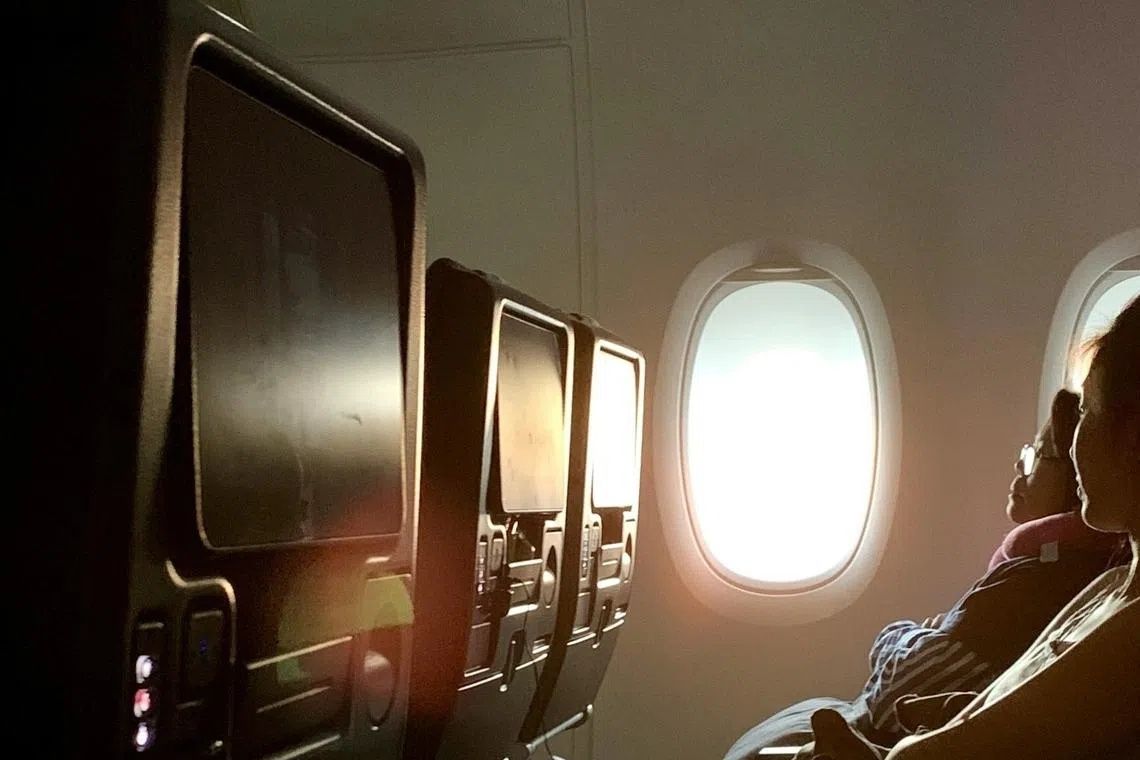
A middle schooler in South Korea has escalated concerns about children's exposure to unsuitable content during air travel by filing an official petition with the government, triggering fresh scrutiny of how airlines curate their entertainment offerings. The teenager, who filed the complaint through Petition 24—an online platform operated by the Ministry of the Interior and Safety—described inadvertently viewing violent and sexually explicit scenes while aboard a flight, despite attempting to avoid the content on the seat-back monitor in front of them.
The petitioner's complaint carries particular weight because it was not an isolated incident. The teenager reported that a younger sibling in primary school also encountered the problematic material during the same journey, raising questions about the adequacy of current safeguarding protocols. This exposure of multiple minors underscores a systemic vulnerability in how airlines manage passenger entertainment in shared cabin spaces where privacy is inherently limited and content selection is not always within a child's control.
The proposed solution targets the structural weakness in current systems. Rather than simply requesting better content curation, the petitioner has called for mandatory technological interventions—specifically privacy screens on seat-back displays that would prevent adjacent passengers, particularly young children, from viewing material exceeding certain age ratings. This approach acknowledges a practical reality: even when children attempt to ignore inappropriate content, the visual stimuli in a confined aircraft environment can penetrate their attention despite their intentions.
South Korean law already establishes a framework for protecting minors from harmful media. Both the Child Welfare Act and the Youth Protection Act mandate that children and teenagers be shielded from content deemed inappropriate for their developmental stage. The teenager's petition effectively argues that airlines have not been sufficiently implementing these legal protections in their in-flight operations, despite the captive and vulnerable nature of the audience in an aircraft cabin.
Currently, South Korea's two major carriers—Korean Air and Asiana Airlines—maintain some content restrictions. Neither airline screens movies rated for audiences aged 19 and above, acknowledging that certain adult-oriented programming should be excluded entirely from in-flight systems. Additionally, both carriers typically obtain edited versions of films with graphic violent or sexual sequences either removed or heavily censored to create a more family-appropriate viewing experience.
However, the existence of these policies appears insufficient to prevent inappropriate exposure. The fact that a complaint has surfaced suggests either that enforcement is inconsistent or that the restrictions do not extend to all content categories. For instance, films rated for ages 15 and above presumably remain in circulation, and while theoretically suitable for mid-teens, may contain disturbing imagery that younger children should not encounter without parental guidance or informed consent.
The case of the acclaimed film Parasite illustrates this grey zone. In 2020, both Korean Air and Asiana Airlines withdrew this movie—rated for viewers aged 15 and above—from their in-flight playlists specifically due to scenes of violence and sexual content. Despite meeting the threshold of the carriers' stated policies, the film's inclusion still generated enough concern that both airlines judged removal preferable to retention. This retrospective decision suggests that the airlines themselves recognise that their rating benchmarks may not adequately account for the viewing context of an aircraft, where children of varying ages are exposed without effective parental supervision.
The petition touches on a broader issue affecting airlines across the Asia-Pacific region. While Korean carriers have implemented some restrictions, the approach remains reactive rather than proactive, and the mechanisms for enforcement—or alternative measures like privacy screens—remain underdeveloped. For Malaysian and Southeast Asian travellers, this raises questions about standards on regional carriers and whether similar protections exist on flights throughout the region. The principle that children deserve protection from inappropriate content in transit is universal, yet implementation varies widely.
From a regulatory standpoint, the petition invites South Korea's government to clarify whether existing child protection laws should be interpreted as imposing direct obligations on airlines, or whether airlines have discretionary latitude in implementing safeguards. It also suggests that technological solutions—privacy filters, parental control options, or age-gated access to certain content—may be necessary complements to content restriction policies.
The teenager's decision to formalise this complaint through an official petition channel reflects a growing expectation among younger citizens that corporations must be held accountable for protecting vulnerable groups. The response from South Korean authorities—whether the Ministry of the Interior and Safety takes action, whether it pressures airlines to adopt the privacy screen proposal, or whether it launches a broader review of in-flight entertainment standards—will signal the government's commitment to enforcing child protection obligations beyond traditional media platforms.
For airlines operating in the region, this petition serves as a warning that content curation cannot rely solely on rating systems and edited versions. The physical environment of an aircraft, combined with the reduced supervision typical during flights, creates unique circumstances that warrant distinctive safeguarding approaches. The proposal for privacy screens is practical, implementable, and would address the core complaint: shielding younger passengers from exposure to content they did not choose to view and cannot easily avoid in a confined space.

