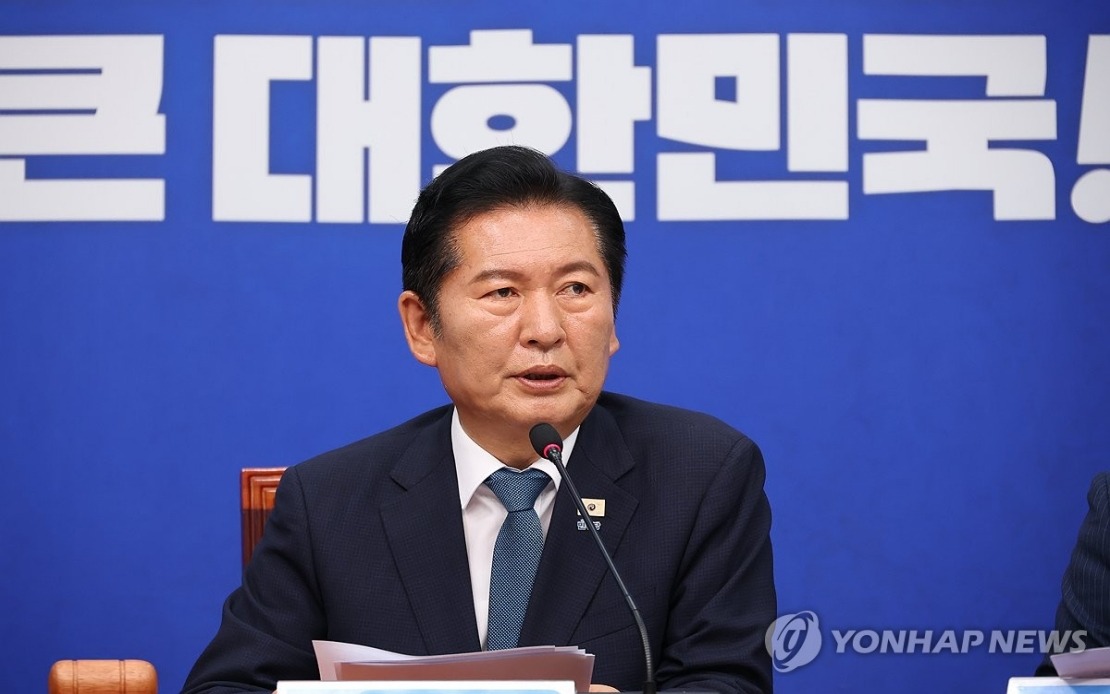
Jung Chung-rae, a senior lawmaker in South Korea's ruling Democratic Party, stepped down from his position as party chairman on Wednesday, triggering what observers expect will be a hotly contested race to determine the party's future direction. His departure comes just weeks before the party's national convention, scheduled for August 17, and appears designed to strengthen his chances of securing the top position through a fresh electoral mandate. The timing and circumstances of his exit underscore the simmering tensions within the governing coalition as it navigates its agenda under President Lee Jae Myung.
During an address to the party's supreme council at the National Assembly, Jung reflected on his tenure with language suggesting both personal sacrifice and institutional strain. He disclosed that recent weeks had prompted deep introspection about his political journey, hinting at the considerable pressure surrounding his role. His comments painted a portrait of a leader buffeted by competing interests, acknowledging the turbulence he has endured without explicitly detailing the specific conflicts that prompted his resignation.
Throughout his remarks, Jung emphasised his unwavering commitment to supporting the Lee administration and maintaining cohesion among the ruling party, the government apparatus, and the presidential office. He portrayed himself as having worked tirelessly to ensure these three pillars functioned as an integrated unit, framing his tenure as one of service despite significant obstacles. This framing is strategically important, as it allows Jung to present his resignation not as a retreat but as a deliberate choice made from a position of strength and principle.
However, Jung's description of operating without respite, facing resistance from multiple quarters both internally and externally, points to genuine fractures within the Democratic Party. Critics, particularly those aligned with Lee, have contended that Jung has prioritised the interests of his own political faction over advancing the president's agenda and building broader party consensus. This fundamental disagreement about the party chair's role has created a visible rift that threatens the party's ability to function cohesively as it approaches crucial parliamentary sessions and prepares for electoral considerations.
Jung's departure opens the field for a three-candidate race that pits him against formidable rivals. Prime Minister Kim Min-seok, who maintains close ties to President Lee and enjoys considerable executive authority, represents the presidential establishment's preferred choice. His candidacy would essentially institutionalise Lee's influence over party operations, ensuring alignment between government policy and party messaging. Song Young-gil, a former Democratic Party leader, brings extensive party experience and independent credibility, potentially positioning himself as a bridge figure capable of unifying disparate factions.
Recent reports indicate that Song Young-gil has signalled his intention to enter the race and has been exploring the possibility of consolidating his candidacy with Kim, according to Democratic Party lawmaker Park Jie-won. Such a merger would dramatically shift the competitive landscape, potentially creating a two-person contest between a unified establishment candidate and Jung's challenge from outside the immediate presidential circle. This manoeuvre suggests that Lee's supporters may be concerned about Jung's strength and are preparing strategic responses to prevent his election.
The convention scheduled for mid-August will be particularly significant for South Korean politics given the Democratic Party's dominance in parliament and its role in shaping the legislative agenda. The winner will inherit a party facing substantial governance challenges and will be responsible for maintaining party discipline, managing factional disputes, and coordinating with the Lee administration on policy priorities. The contest therefore reflects deeper questions about power distribution within the ruling coalition and the relative autonomy the party should enjoy from presidential influence.
Until the convention takes place, Democratic Party floor leader Han Byung-do will assume acting leadership responsibilities. His interim role will require careful navigation of intra-party tensions while maintaining the party's legislative operations. The succession of acting leaders has historically been a period when rival camps consolidate support and articulate their competing visions for the party's future, making the next several weeks crucial for the various candidates and their supporters.
For Malaysian observers and the broader Southeast Asian region, South Korea's internal political dynamics carry relevance insofar as the Democratic Party's direction will influence Seoul's foreign policy priorities, trade relationships, and regional engagement strategies. The outcome of August's convention will help determine whether Lee's administration can count on consistent party support for its initiatives or whether a more independent party leadership will emerge to provide checks and balances on executive power. The resolution of this leadership question will echo through South Korea's political system and may shape the peninsula's international relationships for years to come.