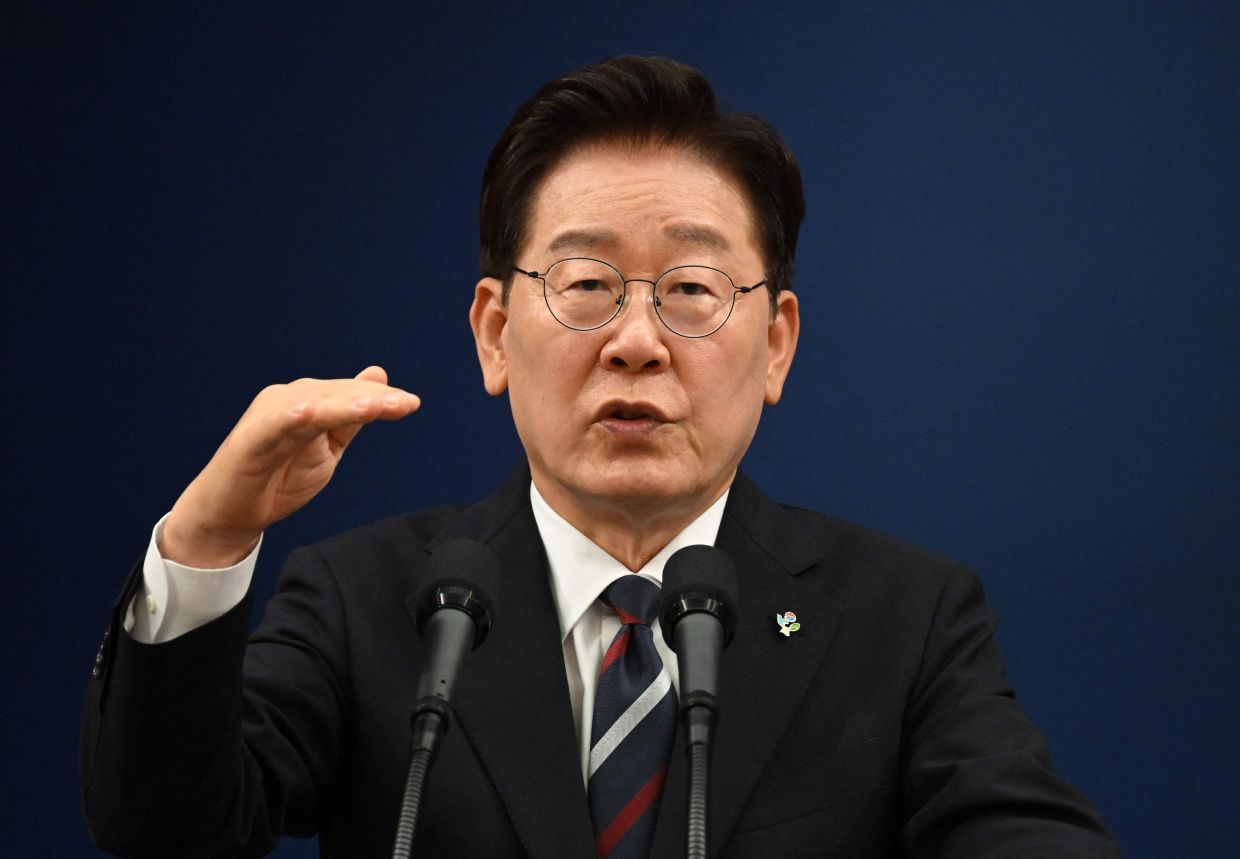
South Korean President Lee Jae Myung faces a significant credibility challenge as his approval rating collapsed to 46.7 per cent in mid-June 2025, marking the first occasion his public backing has dipped below the halfway mark since assuming office on June 4 that year. The steady erosion of support—occurring over five consecutive weeks according to polling by Realmeter—represents a troubling trajectory for any newly elected head of state, particularly one commanding a divided nation with competing political interests and economic anxieties.
The slide from majority support to near-parity between approval and disapproval carries meaningful implications beyond domestic Korean politics. As a major Northeast Asian economy and a central player in regional security architecture alongside Japan and China, political instability or weakened presidential authority in Seoul can ripple across the Indo-Pacific region. For Southeast Asian countries balancing relationships with South Korea through trade, investment, and diplomatic engagement, the political turbulence signals potential shifts in Seoul's policy priorities and decision-making capacity during a period of substantial regional tension.
Realmeter's findings underscore two interconnected domestic crises that have compounded the president's difficulties. The ballot shortages that marred the June 3 local elections exposed serious administrative lapses in election management, eroding public confidence in governmental competence precisely when voter faith in institutions matters most. Simultaneously, internal fracturing within Lee's own Democratic Party of Korea—centred on rivalry over who will lead the party following the August 17 convention—has created the impression of a government distracted by factional maneuvering rather than focused on national priorities. These twin pressures reduced approval by 4.8 percentage points in a single week, demonstrating how rapidly public sentiment can shift when governing structures appear dysfunctional.
Disapproval sentiment reached 49.7 per cent, technically surpassing approval for the first time, though the survey's margin of error of plus or minus 2 percentage points suggests the crossover remains statistically marginal. Nevertheless, the symbolic threshold matters: it signals the psychological point where more citizens harbour doubts about presidential performance than confidence in it. Historical comparison reveals that Lee has actually maintained public support longer than several predecessors. Former President Yoon Suk Yeol's disapproval exceeded approval by June 2022—merely six weeks into his administration—while Moon Jae-in experienced the same crossover nineteen months into his tenure and Park Geun-hye required sixteen months. By this measure, Lee has managed a marginally more resilient honeymoon period.
Geographic patterns in the approval decline illuminate deeper fractures in the president's coalition. His support collapsed most dramatically in Daegu and North Gyeongsang Province, historically conservative strongholds where he shed 9.9 percentage points to reach just 34.6 per cent. This deterioration in traditionally supportive territory suggests that even his political base feels betrayed by the electoral administration failures. In the Greater Seoul metropolitan region—encompassing Seoul, Incheon, and Gyeonggi Province—approval tumbled 7.6 percentage points in each locale, indicating that the moderate and swing voters essential to winning future elections are quietly withdrawing their provisional support. These peripheral regions that typically decide close electoral contests now show significantly reduced confidence in Lee's leadership.
The ideological breakdown reveals an alarming fissure within the progressive coalition. While support among liberals declined modestly by 3.2 percentage points to 80.4 per cent, suggesting his base remains substantially intact, approval among moderates fell 4.9 percentage points to 47.5 per cent. This represents a critical vulnerability. Moderates occupy the political centre-ground most susceptible to persuasion by opposition messaging and most sensitive to perceptions of governmental competence. Their declining support augurs difficulty building consensus on major policy initiatives and suggests that any further stumbles could convert these wavering voters into opposition supporters.
Lee's office responded with carefully calibrated humility, acknowledging the polling through Cheong Wa Dae's statement and pledging heightened responsiveness to public concerns. This defensive posture reflects institutional awareness that dismissing the numbers would invite accusations of arrogance, yet the formulaic language—emphasizing humble acceptance while framing approval fluctuations as natural assessments of economic conditions and state affairs—attempts to reframe disapproval as ordinary political weather rather than symptomatic of deeper governance failures. Whether this rhetorical repositioning translates into concrete policy adjustments or faster government response times remains uncertain.
The broader Democratic Party's trajectory adds further complexity to Lee's predicament. In a separate survey conducted June 18-19, the party's support rose 2.1 percentage points to 40.1 per cent, narrowly trailing the conservative People Power Party at 42.3 per cent. Realmeter attributed the Democratic Party's modest rebound to a perceived crisis-management phase following bipartisan agreement to investigate election administration failures. This suggests that demonstrating a willingness to investigate one's own institutional malfunctions—painful as that may be—can paradoxically improve political standing by projecting accountability rather than obstruction. For Lee personally, however, this party-level recovery provides limited comfort when his individual approval rating continues deteriorating.
Younger voters represent a particularly alarming constituency for the governing coalition. The People Power Party's approval among voters in their twenties plummeted 10.5 percentage points to 48.6 per cent, while those in their thirties saw support drop 5.1 percentage points to 47.4 per cent. This continued exodus of youth voters from conservative ranks reflects generational political realignment that extends beyond any single administration's failures. For Southeast Asian observers, the trend underscores how digital-native populations organise politically through decentralised networks rather than traditional party structures, potentially destabilising established political arrangements across Asia.
The economic context further complicates Lee's political situation. While Realmeter noted some positive factors including perceived success of his European diplomatic tour and the Kospi's breakthrough above the 9,000-point threshold, these achievements appear insufficient to offset public anxiety about widening asset market disparities. This gap between headline economic indicators and household economic sentiment—a phenomenon familiar throughout Southeast Asia—suggests that aggregate growth statistics mask deeply concerning inequality and wealth concentration perceived by ordinary citizens. Moderates and Greater Seoul residents particularly appear to harbour concerns that economic gains concentrate among the already wealthy, generating resentment that flows into disapproval of Lee's stewardship.
The survey methodology utilised automated response systems and contacted 2,517 voters aged 18 and above from June 15-19, providing reasonably robust sampling across the nation's political geography. The five-week downward trajectory reflects consistent deterioration rather than anomalous weekly fluctuations. Should this trend continue for another 2-3 weeks, Lee would face mounting pressure to demonstrate tangible policy successes or shuffle his administration's leadership to signal renewal. The August 17 Democratic Party convention looms as a potential inflection point where factional disputes either crystallise into irreconcilable damage or resolve through clear leadership outcomes that restore party cohesion.
For Malaysia and Southeast Asia's broader political economy, South Korea's domestic turbulence carries subtle implications. Lee's presidency represents a particular vision for Korean development emphasising continued industrial prowess and diplomatic activism. Internal political weakness could incline Seoul toward more defensive, less ambitious regional engagement or generate domestic pressure for spending reallocation away from foreign initiatives. Additionally, persistent approval rating decline might tempt opposition forces toward bolder challenges to executive authority, potentially creating policy uncertainty that investors monitor closely. Southeast Asian governments engaged with South Korean counterparts in regional security arrangements, trade negotiations, and technology partnerships would be prudent to prepare contingencies for shifting Korean political winds.