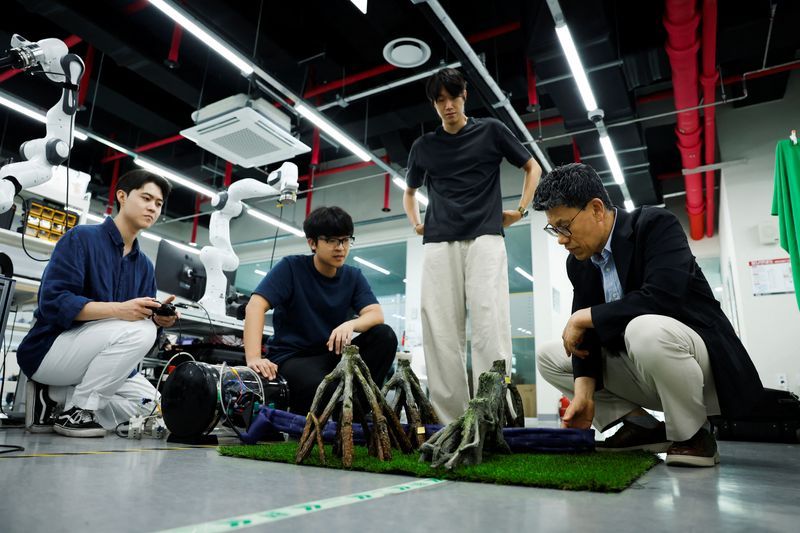
A collaborative research team from South Korea's Korea Advanced Institute of Science and Technology (KAIST) and Stanford University has successfully demonstrated a robotic dressing system that represents a significant advance in wearable automation technology. The innovation, which uses flexible pneumatic structures embedded within garments, enables users to don protective or functional clothing independently and rapidly, opening possibilities for applications ranging from industrial safety to emergency response. The breakthrough was unveiled at KAIST's campus in Daejeon and marks a notable intersection between mechanical engineering and practical robotics.
The core mechanism behind the technology relies on soft, vine-like structures powered by compressed air that are integrated directly into the fabric of the garment. When pressurised, these pneumatic tubes expand and contract in a coordinated manner, systematically advancing the clothing up and around the wearer's body much like ivy scaling a wall. The process does not require the wearer to remain stationary, nor does it demand complex computational algorithms to function effectively. Instead, the system operates through relatively simple pneumatic control, making it both reliable and practical for real-world deployment. The entire process of dressing in a full protective suit takes approximately ten seconds from activation.
The inspiration for this innovation came from an everyday observation. Kim Nam Gyun, the KAIST postdoctoral researcher who led the project, recalled a moment while cycling when unexpected rain prompted him to consider how beneficial it would be if a raincoat could deploy automatically without interrupting his motion. This casual observation crystallised into a formal research question: could robotic systems mimic biological movement patterns to achieve practical clothing functions? That conceptual spark eventually grew into the current prototype, which demonstrates the value of cross-disciplinary thinking in solving practical problems.
At the heart of the system's functionality is a sophisticated yet elegant mechanical principle. Rather than attempting to move the entire robotic structure from point to point, the vine-like appendages grow primarily at their tips, allowing them to navigate the complex curved surfaces of the human body with remarkable stability. This growth-based locomotion enables the system to adapt seamlessly to different body shapes and sizes, accommodating movement and postural changes without losing contact with the wearer. The technology can navigate narrow spaces, adjust to varying surface textures—whether smooth, sticky, or sloped—and maintain its trajectory regardless of the surrounding environment's characteristics.
Ryu Jee-Hwan, a professor of civil and environmental engineering at KAIST, emphasised that the pneumatic vine approach provides significant advantages over alternative robotic dressing systems. The mechanism's inherent flexibility allows it to accommodate the dynamic nature of human bodies during the dressing process. Because the system does not depend on rigid frameworks or precise positioning, it proves far more forgiving in practical applications than conventional robotic systems that require exact alignment and stillness. This robustness translates directly to usability and reliability in real-world scenarios where perfect conditions rarely exist.
The potential applications for this technology extend well beyond novelty or entertainment value. Within semiconductor manufacturing facilities, cleanroom technicians must don protective suits quickly and with complete integrity, and the current manual process consumes significant time during shift changes. The self-dressing system could substantially reduce this downtime while ensuring consistently proper donning of critical protective gear. For emergency services personnel—firefighters, hazmat teams, and medical first responders—the ability to rapidly deploy full protective equipment without compromising focus or safety could prove literally lifesaving in time-critical situations. The technology also holds particular relevance for elderly individuals and those with mobility limitations or disabilities, who currently struggle with complex protective clothing or specialised garments.
The research team specifically highlighted one critical advantage that distinguishes their system from competing approaches: it operates without requiring the wearer to maintain absolute stillness during deployment. This distinction carries enormous practical implications. Previous robotic dressing systems often necessitated the user standing motionless while machinery operated, a requirement that proves inconvenient in genuinely urgent situations and unrealistic for applications where continuous movement is necessary. The KAIST-Stanford system's capacity to function despite the wearer's motion represents a fundamental improvement in usability and real-world applicability.
The development of this technology reflects a broader perspective on the relationship between mechanical engineering and artificial intelligence. While contemporary technological discourse often emphasises software and algorithmic solutions, Ryu observed that elegant mechanical design frequently offers equally valuable solutions to complex problems. As artificial intelligence continues expanding its influence across industries, the self-dressing robot exemplifies how thoughtful mechanical engineering can complement and enhance AI systems, rather than compete with them. This perspective challenges assumptions within technology circles that software-centric approaches invariably offer superior solutions.
The research findings were formally published in IEEE Robotics and Automation Letters, a peer-reviewed academic journal that specialises in rigorous evaluation of robotics research. This peer-review process lends credibility to the findings and subjects the technology to scrutiny from the international robotics research community. The publication timeline reflects years of development, testing, and refinement that preceded the public unveiling, suggesting a mature technology rather than an early-stage concept. The involvement of both KAIST and Stanford—two globally recognised leaders in robotics and materials science—further validates the significance and quality of the work.
For Southeast Asian manufacturing economies, particularly Malaysia's significant electronics and semiconductor sectors, the emergence of such automation technologies warrants careful attention. As global supply chains increasingly emphasise speed, efficiency, and workplace safety, technologies that streamline protective equipment deployment could offer competitive advantages. Additionally, as regional populations age, solutions that enhance independence and dignity for elderly citizens address demographic challenges facing the region. The technology also represents the type of advanced materials engineering and robotics capability that regional governments increasingly prioritise through innovation initiatives and research funding.

