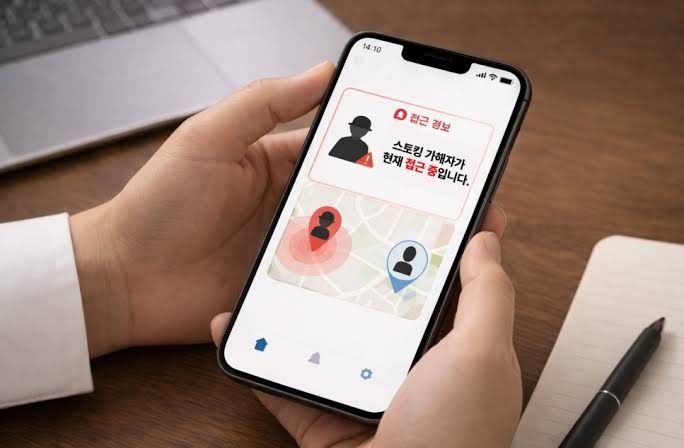
South Korea stepped up its efforts to combat stalking and intimate partner violence on June 24 by rolling out a government-operated smartphone application that fundamentally changes how victims can protect themselves. The new system, managed through the Ministry of Justice, grants stalking victims direct access to location and movement data of individuals suspected of stalking them, provided those suspects are wearing court-mandated electronic ankle monitors. This represents a departure from earlier passive protection measures that relied on emergency alert devices alone, shifting control towards victims themselves in monitoring potential threats.
The urgency behind this technological intervention stems from a troubling pattern of inadequacy in existing safeguards. Between 2021 and August 2025, at least 23 stalking victims were either murdered or subjected to attempted murder despite having been equipped with emergency alert devices by authorities. These figures, highlighted by Representative Lee Gwang-hee of the ruling Democratic Party of Korea, underscore the limitations of reactive emergency systems and point to a need for proactive monitoring mechanisms. The gap between issuing protective devices and preventing actual harm has prompted policymakers to reconsider the balance of power in stalking cases, placing more agency directly in victims' hands rather than relying solely on law enforcement response times.
The implementation of electronic monitoring for high-risk stalking cases represents a relatively recent development in South Korea's criminal justice approach. Beginning in 2024, courts have been empowered to order the installation of ankle monitors on individuals convicted or accused of stalking, particularly in circumstances deemed especially dangerous. This measure supplements the smartwatch-style emergency alert devices that authorities had distributed to vulnerable individuals for several years prior. However, the mere existence of ankle monitors proved insufficient without a means for victims to leverage that surveillance data themselves. The new application bridges that gap by creating a direct information channel from the monitoring system to the victim's phone, enabling them to make informed decisions about their safety and movements.
Privacy considerations have loomed large in the design and rollout of such a system. Sharing precise location information about any individual, even those subject to court orders, raises significant civil liberties questions that democracies must carefully balance against victim protection imperatives. South Korea's Ministry of Justice acknowledged these concerns by revising the regulatory framework governing electronic monitoring in December 2025, establishing safeguards to prevent misuse of location data and clarifying the circumstances under which victims may access such information. These revisions attempt to create a legally defensible middle ground between the surveillance interests of victims and the residual privacy rights of the monitored individuals.
The application's functionality extends beyond simple location awareness. The system provides victims not only with a suspect's current whereabouts but also with information about the direction and nature of their movement. This additional context allows victims to assess the immediacy of a threat, distinguishing between someone moving away from them and someone actively approaching their known location. For individuals living under the constant psychological burden of stalking, this real-time information serves both a practical safety function and a psychological one, reducing the sense of helplessness that often characterises the stalking experience. The ability to know, at any moment, where a known threat is positioned offers a form of agency that passive alert devices cannot provide.
The introduction of real-time location tracking reflects broader global trends in victim advocacy and domestic violence prevention. Many jurisdictions have grappled with similar questions about how to leverage technology to empower vulnerable populations without creating new surveillance infrastructures that could be misused. South Korea's approach, while not entirely novel internationally, arrives within a local context where femicide and stalking-related homicides have received increasing public and political attention. The technological solution must be understood not merely as a tool but as a political response to victim activism and media scrutiny of cases in which existing protections failed catastrophically.
Looking ahead, South Korea's Justice Ministry has signalled further reforms designed to strengthen victim agency in the legal process itself. Beginning in April 2027, the ministry intends to establish a system allowing stalking victims to petition courts directly for restraining orders, rather than depending on law enforcement agencies to initiate such requests on their behalf. This second-phase reform removes an intermediary step that has historically delayed protective measures and occasionally prevented cases from proceeding when police resources were stretched thin or when institutional protocols were sluggishly applied. Direct court access represents a structural acknowledgment that victims themselves are often better positioned to determine what legal protections they require.
The practical implications for Southeast Asian observers merit consideration. Many countries in the region grapple with inadequate stalking legislation, limited victim support services, and cultural attitudes that minimise the severity of harassment and surveillance. South Korea's integrated approach combining electronic monitoring, victim-accessible location data, privacy safeguards, and direct court access offers a potential model, though implementation would need to account for local legal systems, technological infrastructure, and social contexts. The emphasis on victim empowerment and technological solutions reflects a recognition that traditional law enforcement approaches have proven insufficient.
Implementing such systems successfully depends heavily on public awareness and institutional coordination. Victims must know the application exists and understand how to use it. Police, courts, and monitoring agencies must maintain reliable systems and real-time data sharing. Training for justice system professionals must ensure they understand both the technological capabilities and the victim-centred philosophy underlying the reforms. South Korea's phased approach, introducing the location-tracking application now and the direct petition system later, suggests a realistic acknowledgment that institutional change requires sequential implementation and adjustment based on initial experience.
The broader significance of South Korea's initiative lies in its recognition that victim protection in the digital age demands similarly sophisticated tools and legal frameworks. Stalking has evolved alongside technology, with perpetrators employing digital surveillance, location tracking, and persistent online harassment. Victim protection measures must evolve in parallel, offering technological countermeasures while maintaining robust legal and privacy protections. South Korea's combination of electronic monitoring, real-time location sharing, and enhanced victim access to courts represents an attempt to create a more comprehensive ecosystem for protecting those targeted by persistent harassment and violence. Whether such measures will substantially reduce harm depends on rigorous evaluation, adequate resources for enforcement, and sustained political commitment to prioritising victim safety.

