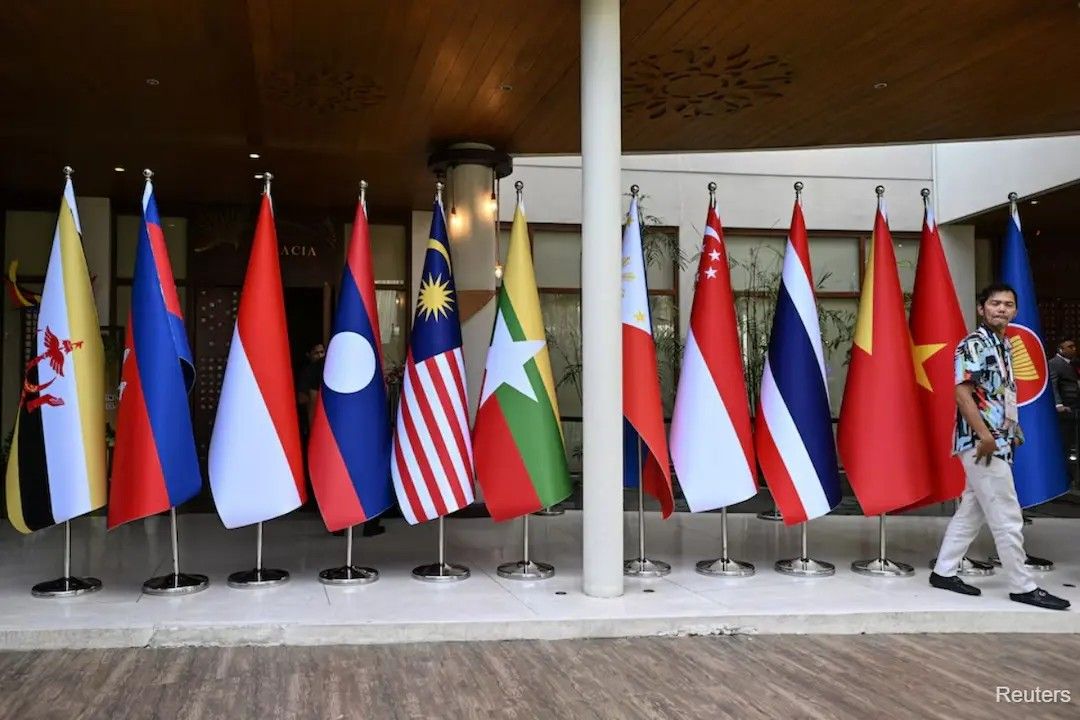
Rising geopolitical temperature in the South China Sea threatens to dominate discussions when ASEAN foreign ministers convene in Manila this week, with the United States moving quickly to rebuke what it characterizes as reckless Chinese conduct in waters vital to regional stability and global commerce. Secretary of State Marco Rubio's arrival in the Philippine capital came within hours of Washington issuing a sharp condemnation of Beijing's actions, establishing the contentious security environment that will frame ministerial deliberations among the eleven-member bloc. The timing signals Washington's determination to place the maritime dispute front and centre on ASEAN's agenda, even as the organization struggles to forge consensus on how to manage great power competition in its own backyard.
The flashpoint between Manila and Beijing underscores the fragility of any supposed understanding between the rival claimants. On Monday, personnel from the Philippine Navy and Chinese Coast Guard engaged in what officials in Manila described as a physical assault near the Second Thomas Shoal, a disputed feature where the Philippines maintains a small garrison aboard a grounded vessel. This marked the most serious seaborne confrontation in months, reversing a period of relative restraint that had raised cautious hopes for de-escalation. Chinese authorities offered a contrasting account, insisting that Filipino operatives provoked the incident by dispatching personnel in small boats to approach a Chinese vessel. The conflicting narratives highlight how each side interprets identical events through incompatible frameworks, making resolution through dialogue increasingly elusive.
Rubio's public positioning reflects broader American strategy to rally Southeast Asian support against what Washington views as Beijing's assertive revisionism. In an opinion piece released Tuesday morning in Manila media, the Secretary of State emphasized United States commitment to preserving freedom of navigation in Southeast Asian waters and maintaining the defensive architecture that has underpinned regional security for decades. His language carried unmistakable warnings about the consequences of allowing any single power to dominate these strategic channels: economic coercion, compromised sovereignty, and fundamental threats to the region's future. The rhetorical thrust was clearly aimed at China, though Rubio stopped short of naming Beijing directly, instead invoking the spectre of a hegemonic power weaponizing trade relationships to bend smaller nations to its will.
China's expansive maritime claims remain a persistent irritant for the international community and a source of legal controversy. Beijing asserts sovereignty over nearly the entire South China Sea, a position fundamentally contradicted by a 2016 international arbitral ruling that found no legal basis for such expansive territorial assertions. Yet Beijing dismisses this judgment, continuing to advance claims that encompass waters off the coasts of multiple Southeast Asian nations and through which trillions of dollars in global commerce annually transits. The South China Sea thus represents simultaneously a crucial economic artery and a flashpoint where competing visions of international law and regional order collide with potentially destabilizing consequences.
One casualty of this intensifying rivalry is the long-negotiated Code of Conduct between ASEAN and China, a mechanism ostensibly designed to regulate maritime behaviour and prevent escalation. The Second Thomas Shoal clash dealt another blow to hopes that this framework might achieve substantive constraints on dangerous conduct. Regional analysts have expressed considerable scepticism about whether the code, even if finalized, will possess sufficient enforcement mechanisms or binding power to meaningfully shape state behaviour when vital interests are at stake. The perpetual gap between ASEAN's desire for binding commitments and China's preference for flexible, non-binding arrangements reflects deeper asymmetries in bargaining power that show little sign of narrowing.
Beyond the South China Sea, the Manila meeting occurs against a backdrop of intensifying energy security concerns affecting the entire region. The Philippines declared a national energy emergency last March and has been forced to diversify fuel sources with increasing desperation, even purchasing crude from Russia at a time when Moscow faces international sanctions. This vulnerability reflects broader Southeast Asian exposure to disruptions in the Strait of Hormuz, where renewed hostilities between Iran and traditional American allies threaten to constrict oil supplies and inflame already precarious energy markets. The attendance of Russian Foreign Minister Sergei Lavrov in Manila signals Moscow's continued efforts to deepen economic ties with Southeast Asia, adding another layer of geopolitical complexity to regional calculations.
Energy security has emerged as a potential avenue for productive regional cooperation, with ASEAN pursuing ratification of its Framework Agreement on Petroleum Security, a fuel-sharing mechanism designed to cushion member states against supply shocks. The mechanistic aspects of this arrangement offer less contentious ground than maritime disputes, yet ratification has proceeded slowly amid competing national priorities and domestic political considerations. For energy-dependent Southeast Asian economies, securing reliable supplies at reasonable prices has become nearly as important as maintaining freedom of navigation, reflecting how comprehensively the region's prosperity depends on predictable access to global markets and resources.
Myanmar's status within ASEAN represents another profound challenge testing bloc cohesion, one that has festered since the military coup of 2021 expelled the country from key meetings. Thailand, which shares an extensive border with Myanmar and hosts approximately 2.5 million Myanmar refugees, has become the primary advocate for reintegrating Naypyidaw into full participation. Thai Foreign Minister Sihasak Phuangketkeow has signalled readiness to welcome Myanmar's leader Min Aung Hlaing for an August visit, framing reengagement as the most constructive path forward after five years of isolation. Bangkok's reasoning reflects its immediate security interests and humanitarian responsibilities, alongside a belief that isolation has failed to modify Myanmar's military rulers' conduct.
Yet this integrationist position faces stiff resistance from other ASEAN members who view Myanmar's ongoing civil conflict and what they characterise as systematic oppression as disqualifying factors for full diplomatic rehabilitation. Malaysia's Foreign Minister Mohamad Hasan articulated this stance clearly in May, arguing that meaningful dialogue cannot proceed while violence and repression continue unabated. This division reflects a fundamental tension within ASEAN: whether the bloc's traditional non-interference principle and emphasis on dialogue should take precedence over concerns about legitimizing military governance and human rights violations. The May meeting in Cebu saw Philippine President Ferdinand Marcos advocate for recalibrating ASEAN's long-stalled five-point peace plan, acknowledging the inadequacy of existing approaches without generating breakthrough proposals.
The Philippines' own historical experience with authoritarian rule may inform Marcos's willingness to contemplate Myanmar reintegration, though opinions within Manila's policy establishment remain divided on the wisdom of accommodating the junta. What remains clear is that ASEAN's collective approach to Myanmar will significantly shape the bloc's credibility with both internal constituencies and external partners. An organization perceived as indifferent to military coups and ongoing atrocities risks forfeiting moral authority and regional legitimacy, while one perceived as imposing external pressure faces accusations of abandoning non-interference principles that have long defined its diplomatic character.
The Manila gathering thus arrives at a moment of acute institutional strain, with competing crises demanding attention and resolution procedures proving inadequate to the magnitude of challenges confronting Southeast Asia. The South China Sea tensions, energy security vulnerabilities, Myanmar's isolation, and great power rivalry all intersect within the framework of an organization traditionally dependent on consensus and designed for gradualism rather than rapid crisis management. How ASEAN navigates these intersecting pressures will reveal much about the organization's viability as a coherent actor in an increasingly contested regional environment. The week ahead promises intense negotiations, competing declarations of principle, and likely considerable frustration from member states unable to reconcile divergent interests within a multilateral framework increasingly strained by forces beyond its control.

